Klemm Mathias, Kellnar Antonia, Naumann Dominik, Brunner Stefan, Stremmel Christopher
Medizinische Klinik und Poliklinik I, LMU Klinikum, Munich, Bavaria, Germany.
Cardiol Res Pract. 2025 May 15;2025:5239630. doi: 10.1155/crp/5239630. eCollection 2025.
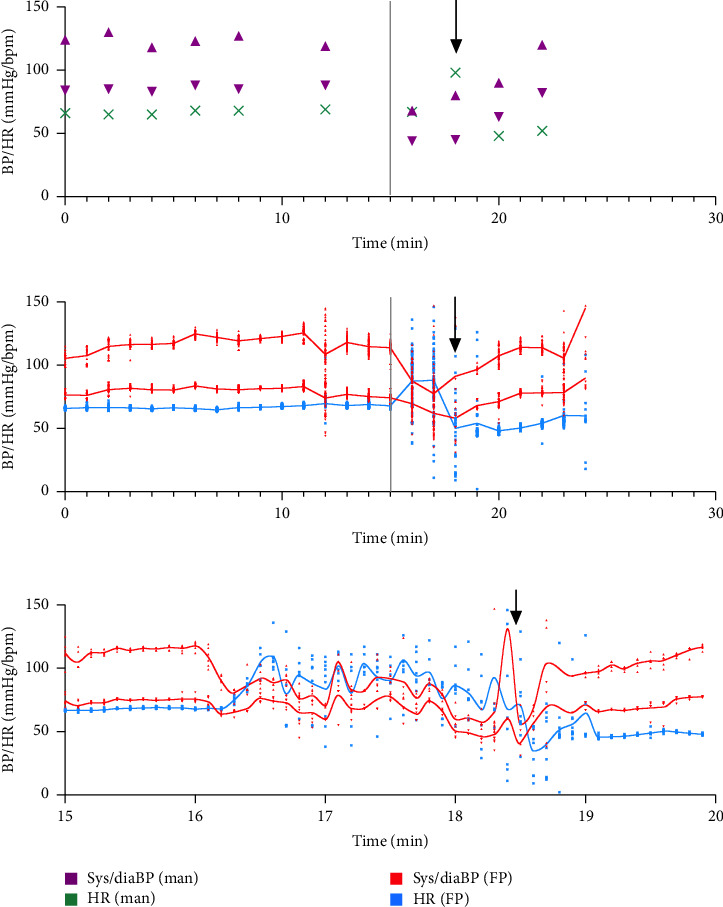
The head-up tilt test (HUTT) is a well-established diagnostic procedure used to differentiate between the types of syncope. Since its introduction in 1986, the protocol has undergone several refinements aimed at increasing diagnostic accuracy. Despite growing interest in advanced autonomic ECG parameters and beat-to-beat blood pressure monitoring, their integration into routine HUTT protocols remains limited. In this study, we compared the conventional HUTT protocol using two-minute interval monitoring with an advanced protocol incorporating autonomic ECG parameters-periodic repolarization dynamics (PRD) and deceleration capacity (DC)-as well as continuous beat-to-beat hemodynamic monitoring. The extended protocol improves diagnostic resolution by detecting more pronounced hemodynamic fluctuations, enabling real-time trend analysis, and allowing earlier recognition of impending syncope. The tilt phase was characterized by a significant initial increase in PRD, and patients with syncope showed significantly higher PRD values during the tilt phase (8.14 vs. 3.91 deg, =0.043). Continuous hemodynamic monitoring during HUTT improves the diagnostic quality by detecting changes at an early stage, thus allowing to anticipate syncope and to clearly identify its etiology. While beat-to-beat blood pressure monitoring is already recommended by current syncope guidelines, we propose the additional evaluation of autonomic ECG parameters as a valuable extension to standard protocols.
头高位倾斜试验(HUTT)是一种成熟的用于区分晕厥类型的诊断程序。自1986年引入以来,该方案已经历了几次改进,旨在提高诊断准确性。尽管人们对先进的自主神经心电图参数和逐搏血压监测的兴趣日益增加,但将它们纳入常规HUTT方案的情况仍然有限。在本研究中,我们将使用两分钟间隔监测的传统HUTT方案与纳入自主神经心电图参数——周期性复极动力学(PRD)和减速能力(DC)——以及连续逐搏血流动力学监测的先进方案进行了比较。扩展方案通过检测更明显的血流动力学波动、实现实时趋势分析以及更早识别即将发生的晕厥来提高诊断分辨率。倾斜阶段的特征是PRD显著初始增加,晕厥患者在倾斜阶段的PRD值显著更高(8.14对3.91度,P = 0.043)。HUTT期间的连续血流动力学监测通过在早期检测变化来提高诊断质量,从而能够预测晕厥并明确识别其病因。虽然目前的晕厥指南已经推荐了逐搏血压监测,但我们建议将自主神经心电图参数的额外评估作为标准方案的一项有价值的补充。