Amini Anna M, Zhou Ruihan, Austermann Katharina, Králová Dominika, Serra Gessica, Ibrahim Ibrahim S, Corona Giulia, Bergillos-Meca Triana, Aboufarrag Hassan, Kroon Paul A, Spencer Jeremy Pe, Yaqoob Parveen
Department of Food and Nutritional Sciences, Hugh Sinclair Unit of Human Nutrition, University of Reading, Reading, United Kingdom.
School of Life and Health Sciences, Whitelands College, University of Roehampton, London, United Kingdom.
J Nutr. 2025 Jul;155(7):2275-2289. doi: 10.1016/j.tjnut.2025.05.017. Epub 2025 May 23.
Epidemiologic evidence suggests an inverse association between anthocyanin consumption and cardiovascular disease (CVD) risk. Modulation of vascular function and hemostasis may contribute to this, but there is limited clinical evidence.
The present study investigated the acute effects of an anthocyanin-rich blackcurrant beverage, compared with a matched placebo, on selected markers of CVD risk in healthy middle-aged subjects in response to a high-fat meal.
Twenty-three volunteers aged 39.9 ± 8.1 y [body mass index (BMI) (in kg/m) 22.9 ± 2.3] completed a double-blind, randomized, placebo-controlled, crossover trial. Volunteers consumed either a 200 mL blackcurrant beverage (744 mg polyphenols comprising 711 mg anthocyanins and 32 mg procyanidins) or a placebo, together with a high-fat breakfast (52.3 g fat) followed by a lunch (30 g fat) at 3 h, and the postprandial vascular response was compared. The primary endpoints were the assessment of vascular function by flow-mediated dilation (FMD) and the inhibition of collagen- and adenosine diphosphate-induced platelet aggregation. Secondary outcomes included blood pressure (BP), digital volume pulse waveforms, circulating numbers of endothelium- and platelet-derived extracellular vesicles, plasma concentrations of interleukin (IL)-8, and plasma and urinary concentrations of polyphenols and their metabolites were also evaluated.
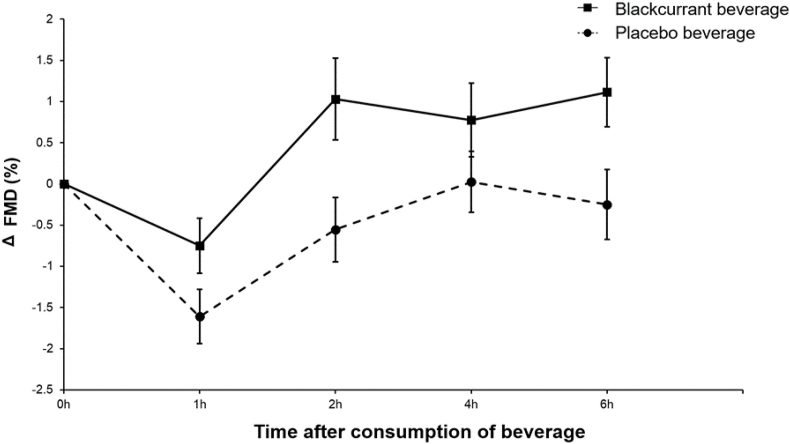
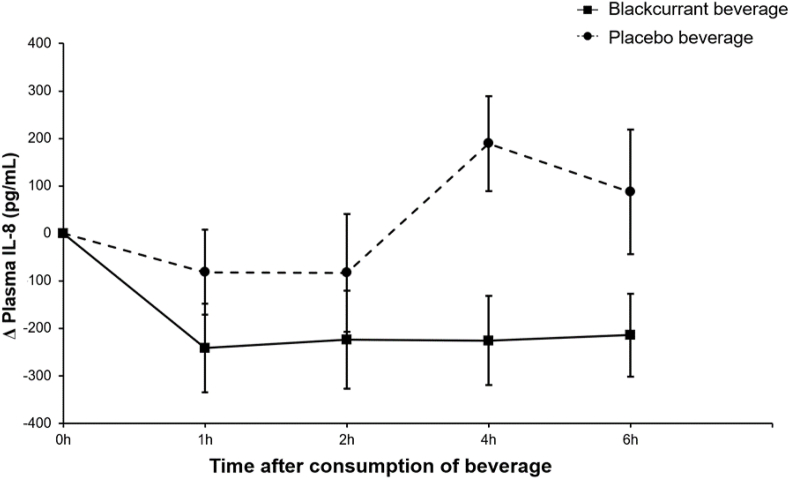
There was a significant cumulative improvement in FMD following consumption of an anthocyanin-rich blackcurrant beverage compared with a matched placebo in conjunction with a high-fat meal over a 6 h postprandial period. There was a trend for an inhibitory effect of the blackcurrant beverage on agonist-induced platelet aggregation and significant effects on the secondary outcomes, systolic BP and IL-8, although these were exploratory and not adjusted for multiple testing. Plasma concentrations of hippuric acid and isovanillic acid were strong independent predictors of FMD, and 4-hydroxybenzaldehyde and isoferulic acid glucuronide were predictors of systolic BP and diastolic BP.
An anthocyanin-rich blackcurrant beverage mitigates the effects of a high-fat meal on vascular function and markers of CVD risk, and this is associated with the appearance of specific plasma anthocyanin phenolic metabolites. This trial was registered at classic.
gov as NCT02459756.
流行病学证据表明花青素摄入量与心血管疾病(CVD)风险呈负相关。血管功能和止血的调节可能对此有作用,但临床证据有限。
本研究调查了富含花青素的黑加仑饮料与匹配的安慰剂相比,对健康中年受试者在高脂餐后心血管疾病风险选定标志物的急性影响。
23名年龄为39.9±8.1岁[体重指数(BMI)(kg/m²)为22.9±2.3]的志愿者完成了一项双盲、随机、安慰剂对照、交叉试验。志愿者饮用200毫升黑加仑饮料(744毫克多酚,包括711毫克花青素和32毫克原花青素)或安慰剂,同时食用高脂早餐(52.3克脂肪),3小时后再食用午餐(30克脂肪),然后比较餐后血管反应。主要终点是通过血流介导的血管舒张(FMD)评估血管功能以及抑制胶原和二磷酸腺苷诱导的血小板聚集。次要结果包括血压(BP)、数字体积脉搏波形、内皮细胞和血小板衍生细胞外囊泡的循环数量、白细胞介素(IL)-8的血浆浓度,以及多酚及其代谢物的血浆和尿液浓度也进行了评估。
与匹配的安慰剂加高脂餐相比,在餐后6小时内,饮用富含花青素的黑加仑饮料后FMD有显著的累积改善。黑加仑饮料对激动剂诱导的血小板聚集有抑制作用趋势,对次要结果收缩压和IL-8有显著影响,尽管这些是探索性的且未针对多重检验进行调整。马尿酸和异香草酸的血浆浓度是FMD的强独立预测因子,4-羟基苯甲醛和异阿魏酸葡萄糖醛酸是收缩压和舒张压的预测因子。
富含花青素的黑加仑饮料可减轻高脂餐对血管功能和心血管疾病风险标志物的影响,这与特定血浆花青素酚类代谢物的出现有关。该试验在ClinicalTrials.gov上注册,注册号为NCT02459756。