Melin Henrik, Moore Luke, Fletcher Leigh N, Hammel Heidi B, O'Donoghue James, Stallard Tom S, Milam Stephanie N, Roman Michael, King Oliver R T, Rowe-Gurney Naomi, Thomas Emma E, Wang Ruoyan, Tiranti Paola I, Harkett Jake, Knowles Katie L
Department of Maths, Physics, and Electrical Engineering, Northumbria University, Newcastle upon Tyne, UK.
Department of Astronomy, Boston University, Boston, MA USA.
Nat Astron. 2025;9(5):666-671. doi: 10.1038/s41550-025-02507-9. Epub 2025 Mar 26.
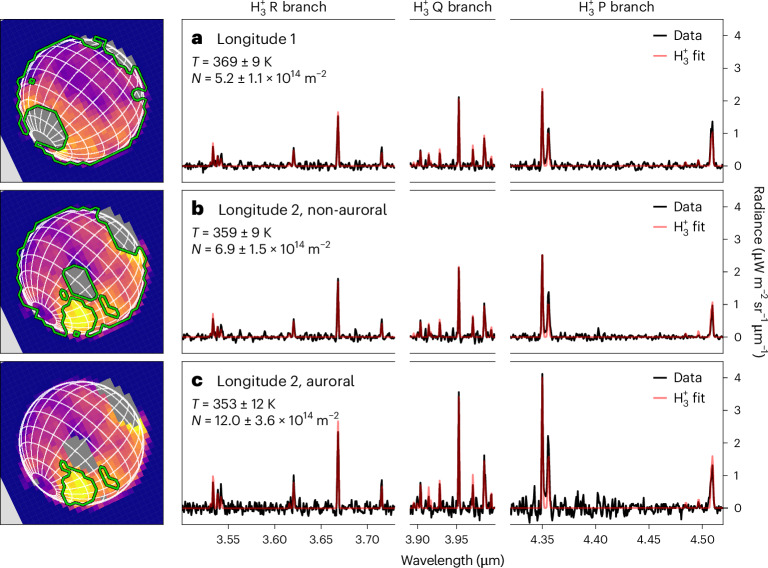
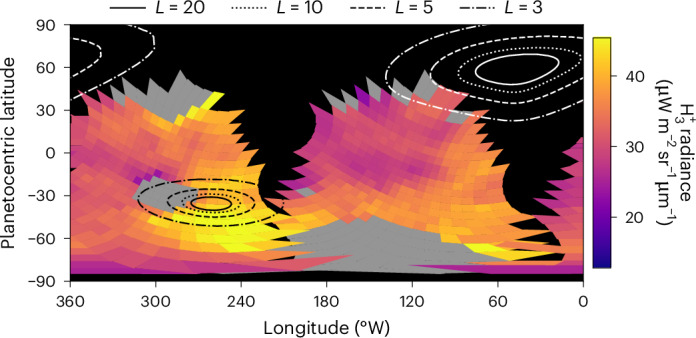
Emissions from the upper-atmospheric molecular ion have been used to study the global-scale interactions of Jupiter, Saturn and Uranus with their surrounding space environments for over 30 years, revealing the processes shaping the aurorae. However, despite repeated attempts, and contrary to models that predict it should be present, this ion has proven elusive at Neptune. Here, using observations from the James Webb Space Telescope, we detect at Neptune, as well as distinct infrared southern auroral emissions. The average upper-atmosphere temperature is a factor of two cooler than those derived 34 years ago by Voyager 2, showing that the energy balance of this region is regulated by physical processes acting on a timescale shorter than both Neptunian seasons (40 yr) and the solar cycle.
30多年来,高层大气分子离子的辐射一直被用于研究木星、土星和天王星与其周围空间环境的全球尺度相互作用,揭示了塑造极光的过程。然而,尽管经过多次尝试,且与预测其应该存在的模型相反,这种离子在海王星上却难以捉摸。在这里,利用詹姆斯·韦布空间望远镜的观测结果,我们在海王星上探测到了这种离子,以及独特的红外南极极光辐射。高层大气的平均温度比34年前旅行者2号测得的温度低一半,这表明该区域的能量平衡受作用时间尺度短于海王星季节(40年)和太阳周期的物理过程调节。