Zhang Binzheng, Delamere Peter A, Yao Zhonghua, Bonfond Bertrand, Lin D, Sorathia Kareem A, Brambles Oliver J, Lotko William, Garretson Jeff S, Merkin Viacheslav G, Grodent Denis, Dunn William R, Lyon John G
Department of Earth Sciences, The University of Hong Kong, Hong Kong SAR, China.
Laboratory for Space Research, The University of Hong Kong, Hong Kong SAR, China.
Sci Adv. 2021 Apr 9;7(15). doi: 10.1126/sciadv.abd1204. Print 2021 Apr.
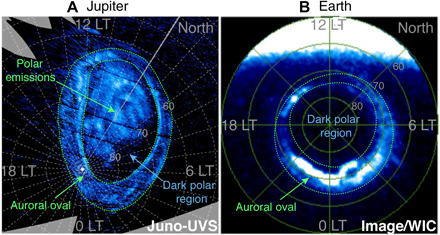
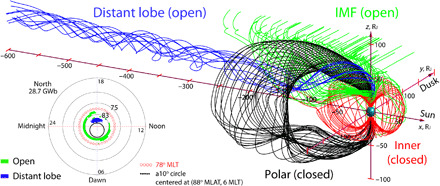
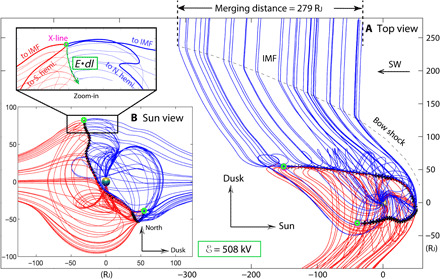
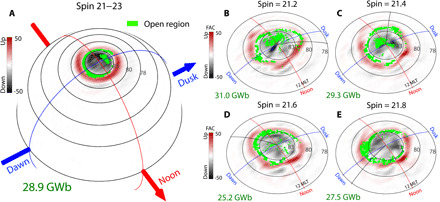
Jupiter's bright persistent polar aurora and Earth's dark polar region indicate that the planets' magnetospheric topologies are very different. High-resolution global simulations show that the reconnection rate at the interface between the interplanetary and jovian magnetic fields is too slow to generate a magnetically open, Earth-like polar cap on the time scale of planetary rotation, resulting in only a small crescent-shaped region of magnetic flux interconnected with the interplanetary magnetic field. Most of the jovian polar cap is threaded by helical magnetic flux that closes within the planetary interior, extends into the outer magnetosphere, and piles up near its dawnside flank where fast differential plasma rotation pulls the field lines sunward. This unusual magnetic topology provides new insights into Jupiter's distinctive auroral morphology.
木星明亮且持久的极区极光以及地球黑暗的极地地区表明,这两颗行星的磁层拓扑结构截然不同。高分辨率全球模拟显示,行星际磁场与木星磁场之间界面处的重联速率过慢,以至于在行星自转的时间尺度上无法产生一个磁层开放、类似地球的极冠,仅形成了一个与行星际磁场相互连接的小月牙形磁通量区域。木星的极冠大部分由螺旋形磁通量贯穿,这些磁通量在行星内部闭合,延伸至外磁层,并在其晨侧边缘堆积,在那里快速的差动等离子体旋转将磁力线拉向太阳方向。这种不同寻常的磁拓扑结构为木星独特的极光形态提供了新的见解。