Hesham Walaa, Elzayat Emad M, Hosney Mohamed, Abo-Elghiet Fatma
Allergy and Immunology Lab, Vacsera, Giza, Egypt.
Biotechnology Department, Faculty of Science, Cairo University, Giza, Egypt.
BMC Complement Med Ther. 2025 May 26;25(1):189. doi: 10.1186/s12906-025-04920-z.
Cervical cancer remains a global health challenge with persistently high incidence and mortality rates despite advancements in conventional treatments. The therapeutic potential of natural products has gained attention, particularly for their selective cytotoxicity and ability to modulate cancer pathways. Alnus incana (L.) Moench, a species-rich in bioactive compounds, shows potential as an anticancer agent; however, the cytotoxic effects of its leaves dichloromethane (DCM) extract remain underexplored. This study investigates the DCM fraction's cytotoxicity on various cancer cell lines, with a primary focus on HeLa cells.
The cytotoxic effects of the A. incana DCM fraction were evaluated in a dose-dependent manner using the MTT assay on several cancer cell lines, with particular emphasis on HeLa cells. Flow cytometry was used to assess cell cycle arrest and apoptosis, while RT-qPCR quantified changes in the expression of apoptotic markers (Bax, Bcl-2, and p53). Chemical composition analysis was conducted using gas chromatography-mass spectrometry/flame ionization detection (GC-MS/FID) to identify the major bioactive compounds within the fraction.
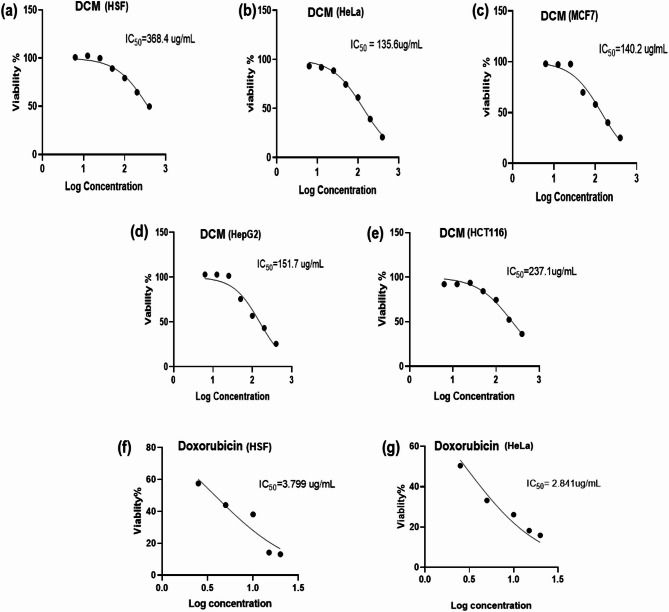
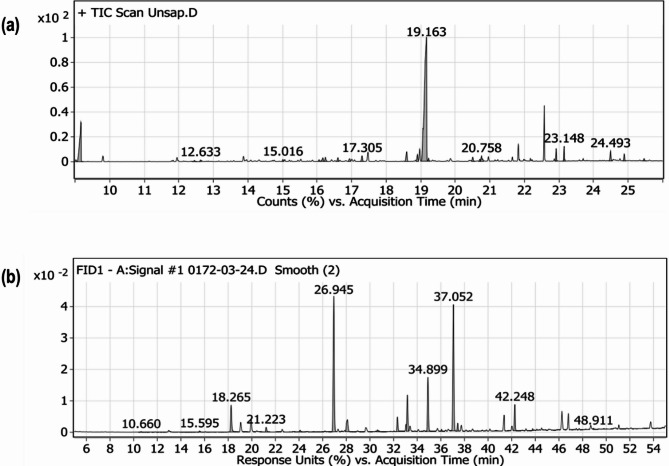
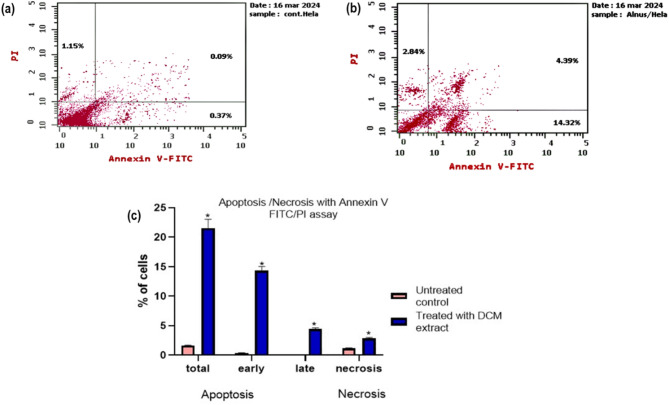
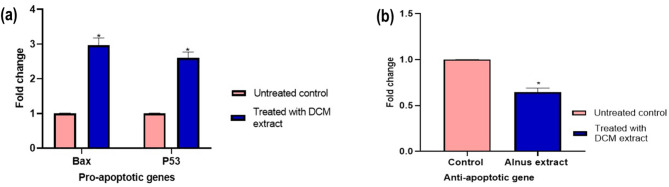
The DCM fraction exhibited dose-dependent cytotoxicity in HeLa cells, with an IC value of 135.6 µg/mL and a selectivity index (SI) of 2.72 relative to normal cells. Flow cytometry analysis revealed G0/G1 cell cycle arrest, significantly hindering progression through the S and G2/M phases. Moreover, there was a significant increase in both early and late apoptotic cell populations, correlating with the upregulation of pro-apoptotic genes (Bax and p53) and the downregulation of the anti-apoptotic gene Bcl-2. The chemical analysis identified 22 compounds in the unsaponifiable fraction, chiefly terpenoids such as phytol (65.74%). The saponifiable fraction presented a balanced composition of saturated (48.69%) and unsaturated (51.29%) fatty acids, with palmitic acid, linolenic acid, and linoleic acid as the predominant compounds.
While the DCM fraction's relatively high IC value may limit its utility as a standalone treatment, its ability to induce cell cycle arrest and apoptosis demonstrates its promise as a co-therapeutic agent with conventional anticancer drugs. Further research is essential to elucidate its precise mechanisms of action and to evaluate its efficacy in combination therapies, potentially advancing its role in cervical cancer treatment.
尽管传统治疗方法有所进步,但宫颈癌仍然是一项全球性的健康挑战,其发病率和死亡率持续居高不下。天然产物的治疗潜力受到关注,尤其是因其具有选择性细胞毒性以及调节癌症相关通路的能力。灰桤木(Alnus incana (L.) Moench)富含生物活性化合物,显示出作为抗癌剂的潜力;然而,其叶片二氯甲烷(DCM)提取物的细胞毒性作用仍未得到充分研究。本研究调查了DCM组分对多种癌细胞系的细胞毒性,主要聚焦于HeLa细胞。
采用MTT法以剂量依赖方式评估灰桤木DCM组分对多种癌细胞系的细胞毒性,尤其着重于HeLa细胞。运用流式细胞术评估细胞周期阻滞和凋亡情况,同时通过逆转录定量聚合酶链反应(RT-qPCR)对凋亡标志物(Bax、Bcl-2和p53)的表达变化进行定量分析。使用气相色谱-质谱联用/火焰离子化检测(GC-MS/FID)进行化学成分分析,以鉴定该组分中的主要生物活性化合物。
DCM组分在HeLa细胞中呈现出剂量依赖性细胞毒性,IC值为135.6 μg/mL,相对于正常细胞的选择性指数(SI)为2.72。流式细胞术分析显示出现G0/G1期细胞周期阻滞,显著阻碍细胞通过S期和G2/M期。此外,早期和晚期凋亡细胞群体均显著增加,这与促凋亡基因(Bax和p53)的上调以及抗凋亡基因Bcl-2的下调相关。化学分析在不皂化部分鉴定出22种化合物,主要为萜类化合物,如叶绿醇(65.74%)。皂化部分呈现出饱和脂肪酸(48.69%)和不饱和脂肪酸(51.29%)的平衡组成,其中棕榈酸、亚麻酸和亚油酸为主要化合物。
虽然DCM组分相对较高的IC值可能限制其作为单一治疗方法的效用,但其诱导细胞周期阻滞和凋亡的能力表明它有望作为与传统抗癌药物联合使用的辅助治疗剂。进一步的研究对于阐明其确切作用机制以及评估其在联合治疗中的疗效至关重要,这可能推动其在宫颈癌治疗中的作用。