
用于通过吸收光谱法测定阴离子多糖与脂筏结构域结合的甲苯胺蓝
Toluidine Blue for the Determination of Binding of Anionic Polysaccharides to Lipid Raft Domains by Absorption Spectroscopy.
作者信息
Gębczyńska Sandra, Gdowska Julia, Mikos Agata, Gawrońska Iga, Janas Teresa, Czogalla Aleksander, Janas Tadeusz
机构信息
Institute of Biology, University of Opole, Kominka 6, 45-032 Opole, Poland.
Department of Cytobiochemistry, Faculty of Biotechnology, University of Wroclaw, F. Joliot-Curie 14a, 50-383 Wrocław, Poland.
出版信息
Membranes (Basel). 2025 May 2;15(5):139. doi: 10.3390/membranes15050139.
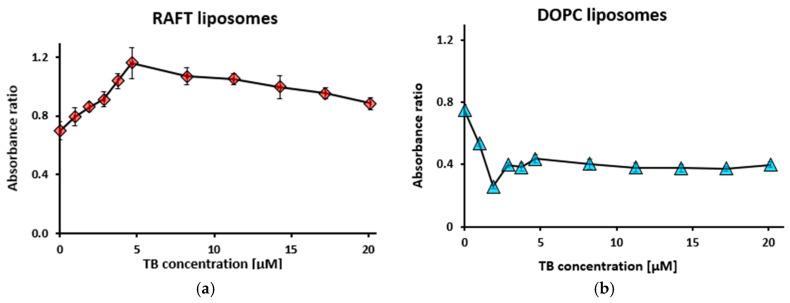
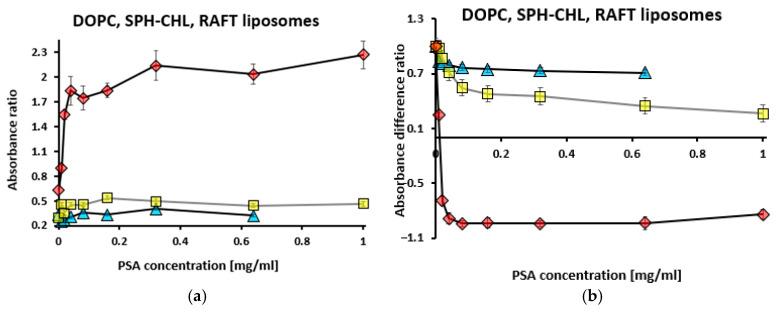
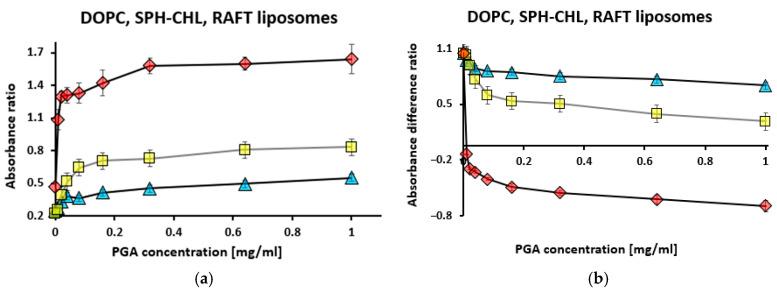
The complexes of negatively charged polysaccharides with lipid vesicles have been shown to have applications in medicine, bioremediation, water purification, and construction of nano-biosensors. This article presents research on the formation of these complexes based on the interactions between three types of liposomes, DOPC liposomes (which contain a lipid bilayer in the liquid-disordered (Ld) state), RAFT liposomes (which contain liquid-ordered (Lo) lipid raft domains surrounded by lipids in the Ld state) and SPH-CHL liposomes (which contain a lipid bilayer in the Lo state), and two selected anionic polysaccharides, polysialic acid (PSA) and polygalacturonic acid (PGA). The analysis was conducted using a toluidine blue (TB) probe and the absorption spectroscopy technique. In contrast to DOPC and SPH-CHL liposomes, binding of negatively charged PSA or PGA chains to RAFT liposomes induced a TB absorption maximum shift from 630 nm to 560 nm. The obtained results indicate that toluidine blue can be applied for monitoring the formation of these nano-complexes, and that the boundaries between Ld/Lo domains within membranes in RAFT liposomes can significantly enhance the binding affinity of negatively charged polysaccharides to the lipid bilayer surface. The observed metachromatic shift in TB absorption suggests that negatively charged PSA and PGA chains interact with the Ld/Lo boundaries within RAFT liposome membranes.
带负电荷的多糖与脂质囊泡的复合物已被证明在医学、生物修复、水净化和纳米生物传感器构建等方面有应用。本文介绍了基于三种脂质体(二油酰磷脂酰胆碱(DOPC)脂质体,其含有处于液态无序(Ld)状态的脂质双层;筏式(RAFT)脂质体,其含有被处于Ld状态的脂质包围的液态有序(Lo)脂质筏结构域;以及鞘磷脂-胆固醇(SPH-CHL)脂质体,其含有处于Lo状态的脂质双层)与两种选定的阴离子多糖(聚唾液酸(PSA)和聚半乳糖醛酸(PGA))之间的相互作用对这些复合物形成的研究。分析采用甲苯胺蓝(TB)探针和吸收光谱技术进行。与DOPC和SPH-CHL脂质体不同,带负电荷的PSA或PGA链与RAFT脂质体的结合导致TB吸收最大值从630 nm移至560 nm。所得结果表明甲苯胺蓝可用于监测这些纳米复合物的形成,并且RAFT脂质体膜内Ld/Lo结构域之间的边界可显著增强带负电荷的多糖与脂质双层表面的结合亲和力。观察到的TB吸收中的变色位移表明带负电荷的PSA和PGA链与RAFT脂质体膜内的Ld/Lo边界相互作用。



 Zotero 插件