Jose Joemet, Kannaujiya Ajit Kumar, Kumar Kaushalendra, McDougal Lotus, Hay Katherine, Singh Abhishek
Center on Gender Equity and Health, University of California San Diego, La Jolla, California, United States of America.
Karnataka Health Promotion Trust (KHPT), Bangalore, India.
PLoS One. 2025 May 27;20(5):e0322784. doi: 10.1371/journal.pone.0322784. eCollection 2025.
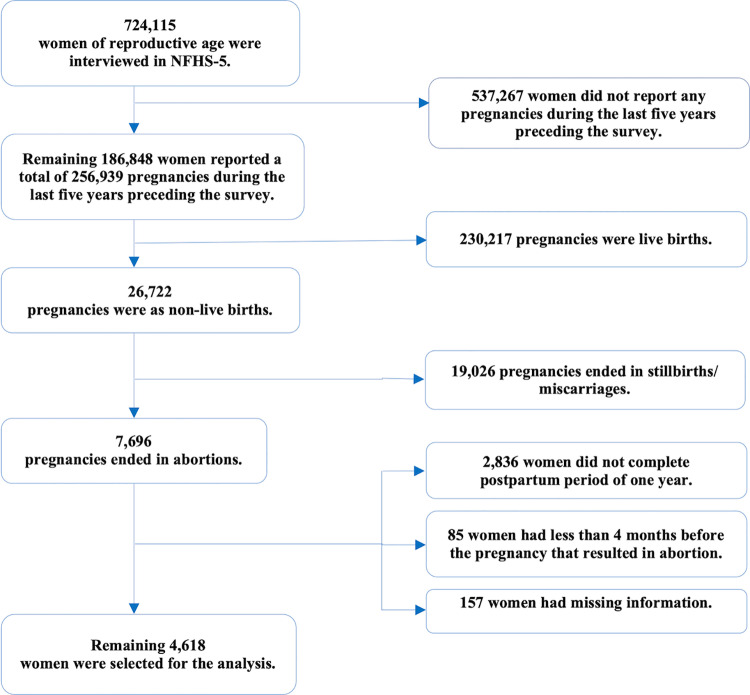
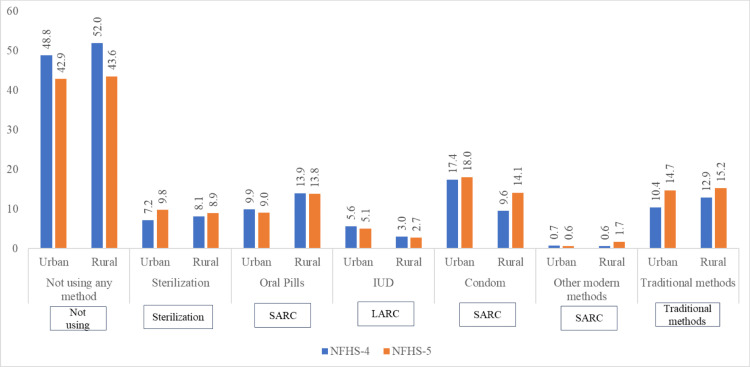
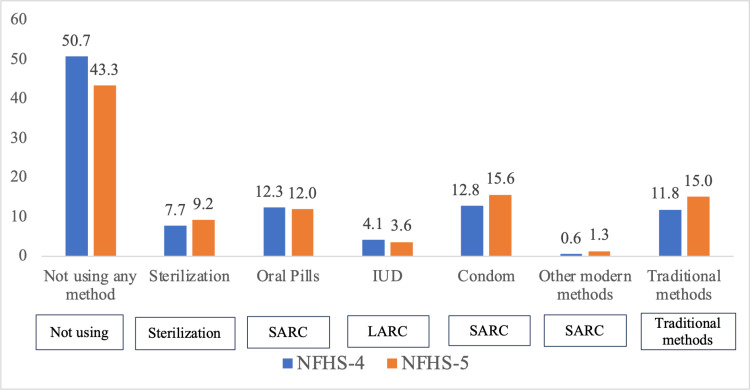
Post-abortion contraceptive use is a critical element of reproductive healthcare aimed at preventing unintended pregnancies and promoting reproductive agency. This study investigates changes in post-abortion contraceptive use and factors associated with that use. We use reproductive calendars implemented in 2015-16 and 2019-21 National Family Health Surveys (NFHS) to investigate changes in post-abortion contraceptive use among currently married women age 15-49 in India. We then use 2019-21 NFHS to examine the factors associated with post-abortion contraceptive use. Our analysis is based on a weighted sample of 5,473 women from NFHS-4 and 5,103 women from NFHS-5. The study employs a two-stage estimation procedure using the Inverse Mills Ratio (IMR) framework to address potential biases in abortion reporting. In the second stage, we used a multinomial probit regression model to assess factors influencing post-abortion contraceptive use. Post-abortion contraceptive use increased from 49% in NFHS-4 to 57% in NFHS-5. Multinomial probit regression analysis revealed that gestational age of abortion was negatively associated with post-abortion contraceptive use, while factors such as having a son or prior contraceptive use increased the likelihood. Women who had abortions in private or non-health facilities were less likely to use post-abortion Long-Acting Reversible Contraceptives (LARC), compared to public health facilities. Those who reported unplanned pregnancy or contraceptive failure as the reason for abortion were more likely to use traditional methods of post-abortion contraception. Our findings highlight the importance of integrating family planning services into abortion care and ensuring comprehensive information and counselling on contraceptive options during the post-abortion period, as crucial measures to improve women's health.
流产后避孕措施的使用是生殖健康护理的关键要素,旨在防止意外怀孕并促进生殖自主权。本研究调查了流产后避孕措施使用情况的变化以及与该使用情况相关的因素。我们利用在2015 - 16年和2019 - 21年全国家庭健康调查(NFHS)中实施的生殖日历,来调查印度15 - 49岁已婚妇女流产后避孕措施使用情况的变化。然后我们使用2019 - 21年NFHS来检查与流产后避孕措施使用相关的因素。我们的分析基于来自NFHS - 4的5473名妇女和来自NFHS - 5的5103名妇女的加权样本。该研究采用两阶段估计程序,使用逆米尔斯比率(IMR)框架来解决流产报告中的潜在偏差。在第二阶段,我们使用多项probit回归模型来评估影响流产后避孕措施使用的因素。流产后避孕措施的使用率从NFHS - 4的49%上升到了NFHS - 5的57%。多项probit回归分析显示,流产时的孕周与流产后避孕措施的使用呈负相关,而诸如育有儿子或先前使用过避孕措施等因素则增加了使用的可能性。与在公共卫生机构流产的妇女相比,在私立或非卫生机构流产的妇女使用流产后长效可逆避孕方法(LARC)的可能性较小。那些报告意外怀孕或避孕失败为流产原因的妇女更有可能使用传统的流产后避孕方法。我们的研究结果强调了将计划生育服务纳入流产护理以及在流产后时期确保提供关于避孕选择的全面信息和咨询的重要性,这是改善妇女健康的关键措施。