
适应性人类行为和信息可得性的延迟会自主调节疫情波。
Adaptive human behavior and delays in information availability autonomously modulate epidemic waves.
作者信息
Mahmud Md Shahriar, Eshun Solomon, Espinoza Baltazar, Kadelka Claus
机构信息
Department of Mathematics, Iowa State University, Ames, IA 50011, USA.
Biocomplexity Institute, University of Virginia, Charlottesville, VA 22911, USA.
出版信息
PNAS Nexus. 2025 May 27;4(5):pgaf145. doi: 10.1093/pnasnexus/pgaf145. eCollection 2025 May.
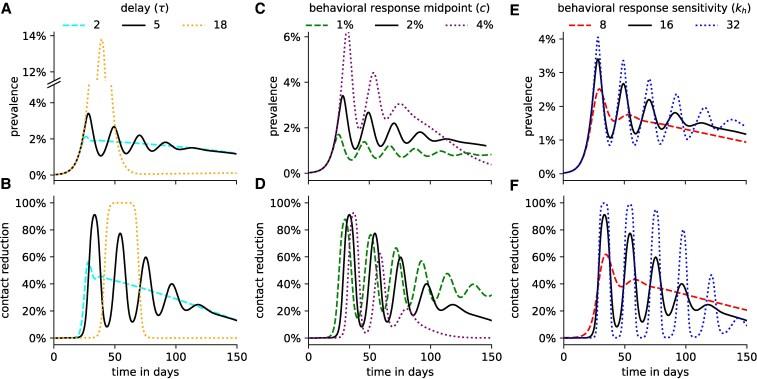
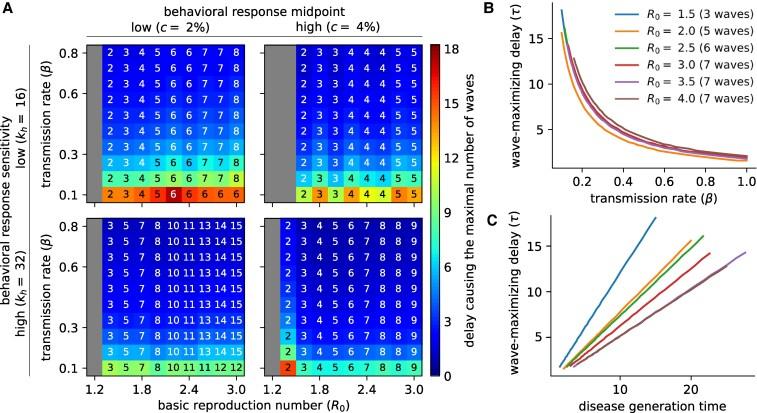
The recurrence of epidemic waves has been a hallmark of infectious disease outbreaks. Repeated surges in infections pose significant challenges to public health systems, yet the mechanisms that drive these waves remain insufficiently understood. Most prior models attribute epidemic waves to exogenous factors, such as transmission seasonality, viral mutations, or implementation of public health interventions. We show that epidemic waves can emerge autonomously from the feedback loop between infection dynamics and human behavior. Our results are based on a behavioral framework in which individuals continuously adjust their level of risk mitigation subject to their perceived risk of infection, which depends on information availability and disease severity. We show that delayed behavioral responses alone can lead to the emergence of multiple epidemic waves. The magnitude and frequency of these waves depend on the interplay between behavioral factors (delay, severity, and sensitivity of responses) and disease factors (transmission and recovery rates). Notably, if the response is either too prompt or excessively delayed, multiple waves cannot emerge. Our results further align with previous observations that adaptive human behavior can produce nonmonotonic final epidemic sizes, shaped by the trade-offs between various biological and behavioral factors-namely, risk sensitivity, response stringency, and disease generation time. Interestingly, we found that the minimal final epidemic size occurs on regimes that exhibit a few damped oscillations. Altogether, our results emphasize the importance of integrating social and operational factors into infectious disease models, in order to capture the joint evolution of adaptive behavioral responses and epidemic dynamics.
疫情浪潮的反复出现一直是传染病爆发的一个特征。感染的反复激增给公共卫生系统带来了重大挑战,但驱动这些浪潮的机制仍未得到充分理解。大多数先前的模型将疫情浪潮归因于外部因素,如传播季节性、病毒突变或公共卫生干预措施的实施。我们表明,疫情浪潮可以从感染动态和人类行为之间的反馈回路中自主出现。我们的结果基于一个行为框架,在这个框架中,个体根据他们感知到的感染风险不断调整他们的风险缓解水平,而感染风险取决于信息的可获得性和疾病的严重程度。我们表明,仅延迟的行为反应就可能导致多次疫情浪潮的出现。这些浪潮的规模和频率取决于行为因素(反应的延迟、严重程度和敏感性)和疾病因素(传播率和恢复率)之间的相互作用。值得注意的是,如果反应要么过于迅速要么过度延迟,就不会出现多次浪潮。我们的结果进一步与先前的观察结果一致,即适应性人类行为可以产生非单调的最终疫情规模,这是由各种生物和行为因素之间的权衡塑造的——即风险敏感性、反应严格性和疾病产生时间。有趣的是,我们发现最小的最终疫情规模出现在表现出一些衰减振荡的情况下。总之,我们的结果强调了将社会和运营因素纳入传染病模型的重要性,以便捕捉适应性行为反应和疫情动态的联合演变。



 Zotero 插件