Vedunova Maria, Borysova Olga, Mitroshina Elena, Morgunov Ivan, Fedintsev Alexander, Moskalev Alexey
National Research Lobachevsky State University of Nizhniy Novgorod, (Lobachevsky University), Nizhny Novgorod, Russia.
Longaevus Technologies LTD, London, UK.
Brain Behav. 2025 Jun;15(6):e70573. doi: 10.1002/brb3.70573.
Targeting partial cellular reprogramming pathways through specific small molecule combinations holds promise for lifespan extension in model organisms. Chemical cocktails like RepSox and tranylcypromine (TCP) may induce beneficial age-related changes without the risks of full reprogramming. This study investigated the effects of RepSox and TCP on neurological markers, physical activity, skeletal health, and survival in aging C3H female mice.
Female C3H mice were divided into two age groups: "old" (16-20 months) and "senior" (10-13 months). They received intraperitoneal injections of RepSox (5 mg/kg) and TCP (3 mg/kg) or DMSO (control) every 72 h for 30 days. Physiological state, neurological scores, open field test performance, skeletal deformation, and survival were assessed. Histological analyses of organs (brain, liver, heart, kidneys, lungs, muscles) were performed post-treatment. Statistical analyses included Mann-Whitney tests, mixed-effects linear regression, Kaplan-Meier survival analysis, and the Gao-Allison test.
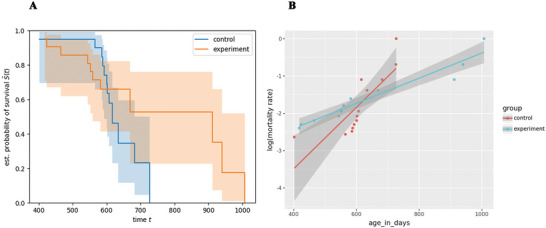
In the "old" group, treated mice showed enhanced neurological status, fur and skeletal health, and increased cortical angiogenesis, though with some adverse histological changes in the liver and brain. In the "senior" group, treated mice displayed a plateau in mortality after month seven, while deaths continued in controls. Although overall survival was not significantly different, maximum lifespan significantly increased in treated mice (p = 0.039, Gao-Allison test). Histological findings revealed localized adaptive changes rather than major toxic effects. These results suggest that the combination of RepSox and TCP exerts protective effects on aging phenotypes and may potentially slow systemic aging processes in C3H mice.
通过特定的小分子组合靶向部分细胞重编程途径有望延长模式生物的寿命。像RepSox和反苯环丙胺(TCP)这样的化学混合物可能会诱导有益的与年龄相关的变化,而没有完全重编程的风险。本研究调查了RepSox和TCP对衰老C3H雌性小鼠神经标志物、身体活动、骨骼健康和存活率的影响。
将雌性C3H小鼠分为两个年龄组:“老年”组(16 - 20个月)和“年长”组(10 - 13个月)。它们每72小时接受一次腹腔注射RepSox(5毫克/千克)和TCP(3毫克/千克)或二甲基亚砜(对照),共注射30天。评估生理状态、神经评分、旷场试验表现、骨骼变形和存活率。治疗后对器官(脑、肝、心、肾、肺、肌肉)进行组织学分析。统计分析包括曼 - 惠特尼检验、混合效应线性回归、卡普兰 - 迈耶生存分析和高 - 艾利森检验。
在“老年”组中,接受治疗的小鼠神经状态、皮毛和骨骼健康得到改善,皮质血管生成增加,尽管肝脏和脑出现了一些不良组织学变化。在“年长”组中,接受治疗的小鼠在第7个月后死亡率趋于平稳,而对照组小鼠继续死亡。虽然总体存活率没有显著差异,但治疗组小鼠的最大寿命显著增加(p = 0.039,高 - 艾利森检验)。组织学结果显示为局部适应性变化而非重大毒性作用。这些结果表明,RepSox和TCP的组合对衰老表型具有保护作用,并可能潜在地减缓C3H小鼠的全身衰老过程。