Fitzpatrick Kathryn E, Bowen Liza, Li Yangmei, Kwok Chun Hei, Alderdice Fiona, Dealmeida Suresha, Gale Chris, Kenyon Sara, Quigley Maria A, Sanders Julia, Siassakos Dimitrios, Carson Claire
NIHR Policy Research Unit in Maternal and Neonatal Health and Care, National Perinatal Epidemiology Unit, Nuffield Department of Population Health, University of Oxford, Oxford, United Kingdom.
Population Health Research Institute, St George's, University of London, London, United Kingdom.
PLoS One. 2025 May 30;20(5):e0323135. doi: 10.1371/journal.pone.0323135. eCollection 2025.
To examine the prevalence of the maternal postnatal six-week check (SWC) in women with epilepsy compared to a sample of the postnatal population without epilepsy, and assess whether the SWC is associated with health outcomes in the first year postpartum.
Clinical Practice Research Datalink Aurum and Hospital Episode Statistics data were used to identify births between January1998-March2020 to women with epilepsy (n = 23,533) and a random sample of births to women without epilepsy (n = 317,369). The adjusted risk ratio (aRR) for not having a SWC in women with compared to without epilepsy was estimated using modified Poisson regression. The association between receiving a SWC and postpartum health outcomes was assessed using Cox regression.
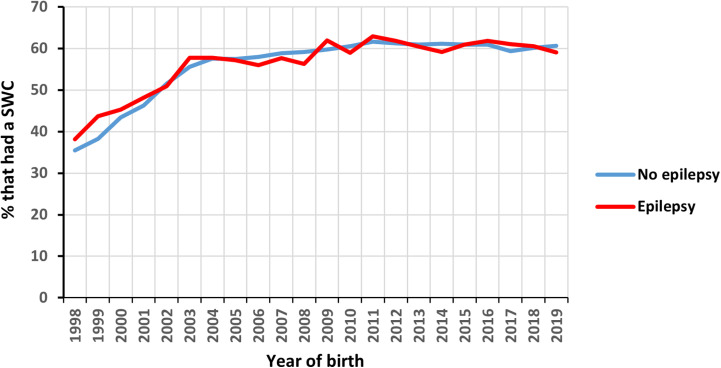
The likelihood of not having a SWC did not differ between those with and without epilepsy (42.7% vs 43.4%, aRR = 1.01, 95%CI = 0.99-1.03). Among all women, not having a SWC was associated with a lower subsequent likelihood of being prescribed prophylactic (aHR = 0.59, 95%CI = 0.58-0.60) and emergency (aHR = 0.95, 95%CI = 0.91-0.99) contraception and having urinary and/or faecal incontinence (aHR = 0.67, 95%CI = 0.61-0.73) or dyspareunia, perineal and/or pelvic pain (aHR = 0.70, 95%CI = 0.65-0.75) recorded in the year postpartum, with no evidence these associations differed according to whether a woman had epilepsy. Not having a SWC was also associated with a lower likelihood of having depression and/or anxiety recorded in the first year postpartum among those without (aHR = 0.86, 95%CI = 0.84-0.89) but not with epilepsy (aHR = 1.01, 95%CI = 0.93-1.09). The SWC was not associated with epilepsy relevant outcomes (Accident and emergency visits or unplanned hospital admission for epilepsy, mortality).
Around 2 in every 5 women had no evidence of a maternal SWC, with no evidence epileptic women had a different prevalence to the general postnatal population. The maternal SWC may play a role in increasing the use of contraception and the detection or treatment of adverse health outcomes in the first year postpartum.
与无癫痫的产后人群样本相比,研究癫痫女性产后六周检查(SWC)的普及率,并评估SWC是否与产后第一年的健康结局相关。
使用临床实践研究数据链Aurum和医院事件统计数据,确定1998年1月至2020年3月期间癫痫女性的分娩情况(n = 23,533)以及无癫痫女性分娩的随机样本(n = 317,369)。使用修正泊松回归估计癫痫女性与无癫痫女性未进行SWC的调整风险比(aRR)。使用Cox回归评估接受SWC与产后健康结局之间的关联。
有癫痫和无癫痫的女性未进行SWC的可能性没有差异(42.7%对43.4%,aRR = 1.01,95%CI = 0.99 - 1.03)。在所有女性中,未进行SWC与产后一年内开具预防性(aHR = 0.59,95%CI = 0.58 - 0.60)和紧急(aHR = 0.95,95%CI = 0.91 - 0.99)避孕药具的可能性较低以及存在尿失禁和/或大便失禁(aHR = 0.67,95%CI = 0.61 - 0.73)或性交困难、会阴和/或盆腔疼痛(aHR = 0.70,95%CI = 0.65 - 0.75)相关,没有证据表明这些关联因女性是否患有癫痫而有所不同。未进行SWC还与无癫痫女性产后第一年记录有抑郁和/或焦虑的可能性较低相关(aHR = 0.86,95%CI = 0.84 - 0.89),但与癫痫女性无关(aHR = 1.01,95%CI = 0.93 - 1.09)。SWC与癫痫相关结局(癫痫的急诊就诊或非计划住院、死亡率)无关。
每5名女性中约有2名没有进行产妇SWC的证据,没有证据表明癫痫女性的普及率与一般产后人群不同。产妇SWC可能在增加避孕药具的使用以及产后第一年不良健康结局的检测或治疗中发挥作用。