Rombey Tanja, Eckhardt Helene, Felgner Susanne, Dreger Marie, Campione Alessandro, Ermann Hanna, Ehlig David, Rödiger Hendrikje, Panteli Dimitra, Henschke Cornelia
Department of Health Care Management, Technische Universität Berlin, Berlin, Germany.
Department of Health Care Management and Berlin Centre for Health Economics Research (BerlinHECOR), Technische Universität Berlin, Berlin, Germany.
Health Res Policy Syst. 2025 May 30;23(1):72. doi: 10.1186/s12961-025-01342-8.
Hospitals play a major role in generating clinical evidence on new medical technologies. Thus far, the extent of German hospitals' contribution to the evidence base has not been sufficiently investigated. This study aims to: (1) examine the utilization of new medical technologies in German hospitals and its relationship to different hospital characteristics; (2) investigate the participation of German hospitals in research on these technologies and the association between hospital characteristics and research involvement; and (3) investigate the contribution of German hospitals to international research activities, including the levels of evidence of any studies conducted.
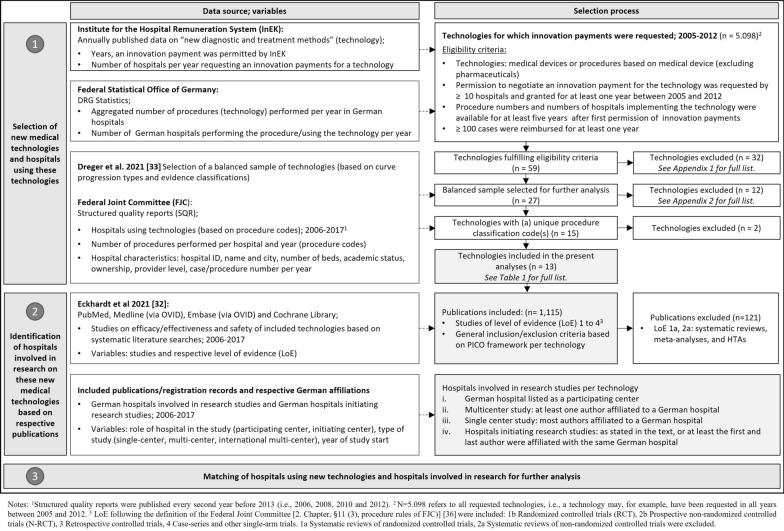
Using a systematically derived sample of 13 new medical technologies and various data sources, we retrospectively analyzed the utilization of and research activities by German hospitals between 2005 and 2017 and explored which hospital characteristics they were associated with. The data were analyzed descriptively and are expressed as bar plots, box plots, quartiles, and crude odds ratios (ORs).
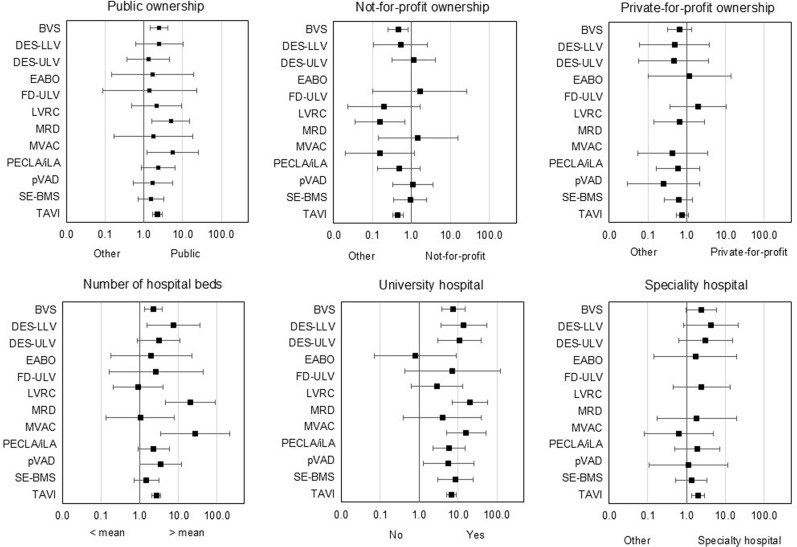
The proportion of German hospitals using new technologies while also being involved in related clinical research was relatively low (ranging from 0.3% to 29.4%, except for transcatheter aortic valve implantation (TAVI), with 60.7%), particularly for prospective studies. Research involvement was positively associated with university hospital status, larger bed capacity, and public ownership. Overall, the research involving German hospitals predominantly consisted of single-arm studies and not randomized controlled trials (RCTs).
Our study identified a gap between hospitals using new medical technologies and their involvement in evidence generation. This imbalance can contribute to uncertainty regarding the actual efficacy, effectiveness and safety of new medical technologies. To ensure evidence-based patient care, it is therefore essential to strengthen the link between research and practice, in both directions. A first step to achieve this could entail restricting the use of new medical technologies to specialized innovation centers (e.g., university hospitals, specialized hospitals) during the initial years of their utilization to ensure an adequate evidence base is generated before widespread implementation.
医院在生成有关新医疗技术的临床证据方面发挥着重要作用。到目前为止,德国医院对证据库的贡献程度尚未得到充分研究。本研究旨在:(1)考察德国医院对新医疗技术的使用情况及其与不同医院特征的关系;(2)调查德国医院对这些技术研究的参与情况以及医院特征与研究参与度之间的关联;(3)调查德国医院对国际研究活动的贡献,包括所开展任何研究的证据水平。
我们使用从13种新医疗技术中系统抽取的样本以及各种数据源,回顾性分析了2005年至2017年德国医院的技术使用情况和研究活动,并探讨了它们与哪些医院特征相关。对数据进行描述性分析,并以柱状图、箱线图、四分位数和粗比值比(OR)表示。
德国医院在使用新技术的同时还参与相关临床研究的比例相对较低(范围从0.3%至29.4%,经导管主动脉瓣植入术(TAVI)除外,其比例为60.7%),前瞻性研究尤其如此。研究参与度与大学医院地位、更大的床位容量和公有制呈正相关。总体而言,涉及德国医院的研究主要由单臂研究组成,而非随机对照试验(RCT)。
我们的研究发现了使用新医疗技术的医院与其参与证据生成之间的差距。这种不平衡可能导致新医疗技术实际疗效、有效性和安全性方面的不确定性。因此,为确保基于证据的患者护理,必须在两个方向上加强研究与实践之间的联系。实现这一目标的第一步可能是在新医疗技术使用的最初几年将其使用限制在专门的创新中心(如大学医院、专科医院),以确保在广泛实施之前生成充分的证据基础。