Lacrampe Alexander, Hou Dan, Perez Isis G, Gong Belvin, Franco-Hernandez Natalia, Yee Angie, Chen Wenzhe, Young-Chapon Maxime Ah, Lin Hening, Hu Fenghua
Department of Molecular Biology and Genetics, Weill Institute for Cell and Molecular Biology, Cornell University, Ithaca, New York, USA.
Department of Chemistry and Chemical Biology, Cornell University, Ithaca, New York, USA.
J Biol Chem. 2025 May 30;301(7):110322. doi: 10.1016/j.jbc.2025.110322.
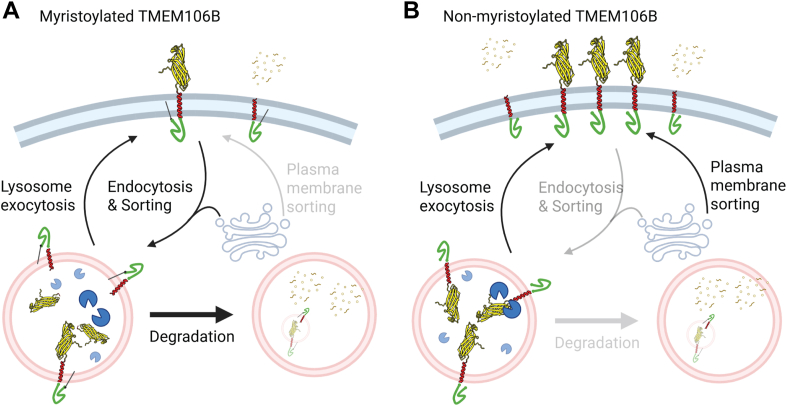
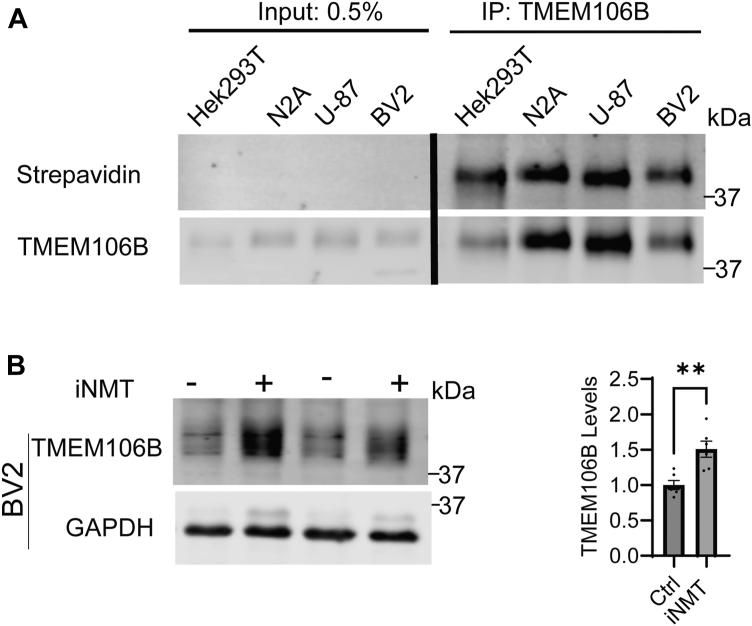
TMEM106B, a type II transmembrane protein localized on the lysosomal membrane, has been identified as a central player in neurodegeneration and brain aging during the past decade. TMEM106B variants that increase TMEM106B expression levels are linked to several neurodegenerative diseases, including frontotemporal lobar degeneration (FTLD). Additionally, the C-terminal lumenal fragment of TMEM106B was recently shown to form amyloid fibrils during aging and neurodegeneration. However, the mechanisms regulating TMEM106B levels are not well understood. Here we show that TMEM106B is myristoylated by NMT1/2 enzymes at its glycine 2 α-amino group and its lysine 3 ε-amino group. Myristoylation decreases TMEM106B levels by promoting its lysosomal degradation. Furthermore, we demonstrate that TMEM106B C-terminal fragments (CTFs) can be detected under physiological conditions, and the levels of CTFs are regulated by myristoylation and lysosomal activities. In addition, we show that non-myristoylated TMEM106B accumulates on the cell surface, indicating that myristoylation affects TMEM106B trafficking within the cell. Taken together, these findings suggest that TMEM106B myristoylation is an important mechanism regulating its function, trafficking, and turnover.
跨膜蛋白106B(TMEM106B)是一种定位于溶酶体膜上的II型跨膜蛋白,在过去十年中已被确定为神经退行性变和脑老化的关键因素。增加TMEM106B表达水平的TMEM106B变体与几种神经退行性疾病有关,包括额颞叶痴呆(FTLD)。此外,最近发现TMEM106B的C末端腔内片段在衰老和神经退行性变过程中会形成淀粉样纤维。然而,调节TMEM106B水平的机制尚不清楚。在这里,我们表明TMEM106B在其甘氨酸2的α-氨基和赖氨酸3的ε-氨基处被NMT1/2酶肉豆蔻酰化。肉豆蔻酰化通过促进其溶酶体降解来降低TMEM106B水平。此外,我们证明在生理条件下可以检测到TMEM106B的C末端片段(CTF),并且CTF的水平受肉豆蔻酰化和溶酶体活性的调节。此外,我们表明未肉豆蔻酰化的TMEM106B在细胞表面积累,这表明肉豆蔻酰化影响TMEM106B在细胞内的运输。综上所述,这些发现表明TMEM106B肉豆蔻酰化是调节其功能、运输和周转的重要机制。