Luo Fang, Xu Wenyao, Xu Yaqin, Lou Lingdi, Xu Chunyan
Department of Rehabilitation Medicine - Cerebrovascular Accident Rehabilitation Ward, Zhejiang Provincial People's Hospital, Hangzhou, Zhejiang, 310024, People's Republic of China.
Convalescence Zone 1, Air Force Hangzhou Special Service Convalescence Center, Hangzhou, Zhejiang Province, 310007, People's Republic of China.
Ther Clin Risk Manag. 2025 May 27;21:793-805. doi: 10.2147/TCRM.S518683. eCollection 2025.
Cerebral infarction is a prevalent disabling condition among the elderly, often leading to limb dysfunction and psychological challenges that significantly impair quality of life. Traditional nursing approaches have primarily focused on physical rehabilitation; however, growing evidence highlights the importance of psychological factors-such as emotional well-being and rehabilitation confidence-in influencing recovery outcomes. Positive collaboration in rehabilitation nursing, which involves coordinated efforts among patients, healthcare providers, and family members, has emerged as a holistic approach to enhance both physical and psychological recovery.
To analyze the effects of positive collaboration concept rehabilitation nursing on elderly patients with cerebral infarction, focusing on fall efficacy and rehabilitation confidence.
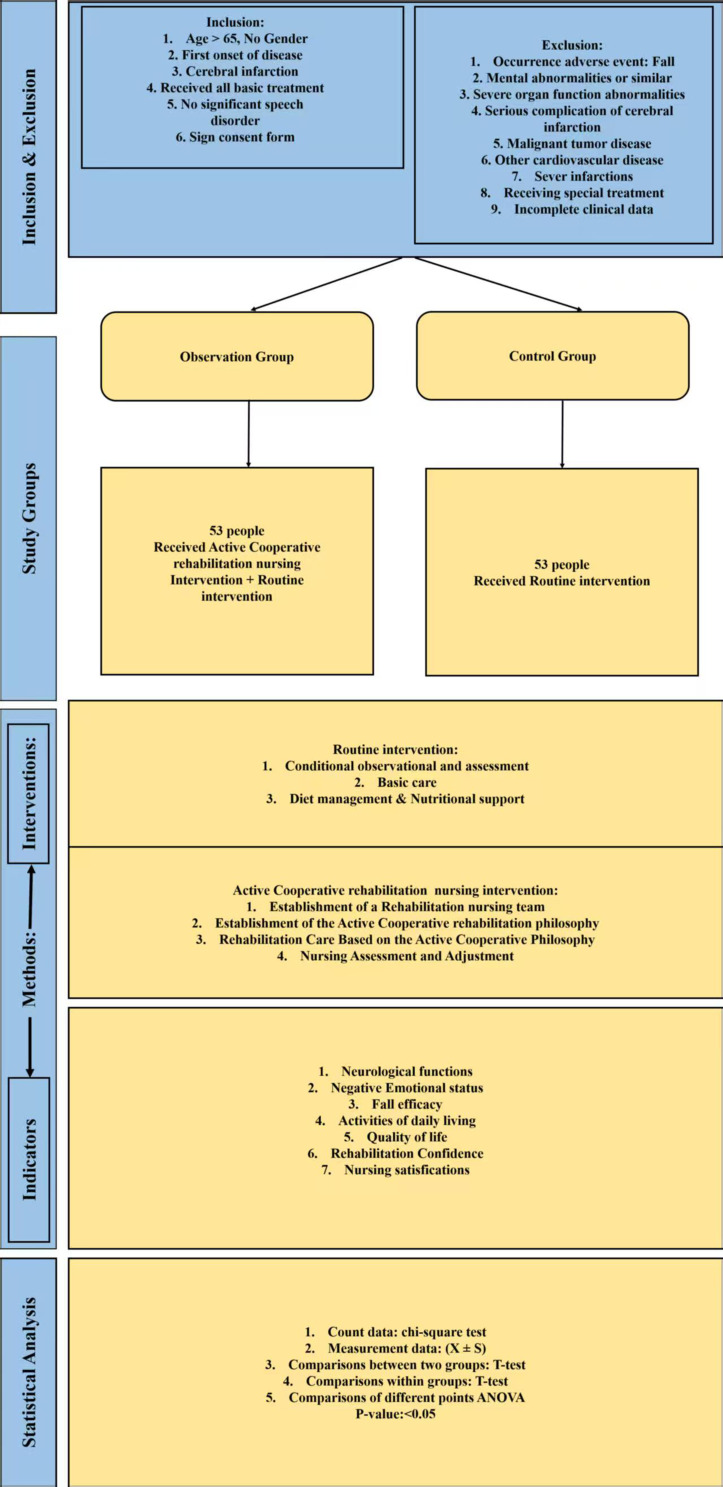
A retrospective analysis was conducted on clinical data from 106 elderly patients with cerebral infarction, admitted from October 2022 to April 2024. Patients were divided into a control group (n=53, receiving routine care) and an observation group (n=53, receiving positive collaboration rehabilitation nursing). Neurological function (NIHSS), negative emotions (SAS, SDS), fall efficacy (MFES), activities of daily living (ADL), quality of life (SS-QOL), rehabilitation confidence (CaSM), and nursing satisfaction (NSNS) were compared between the two groups.
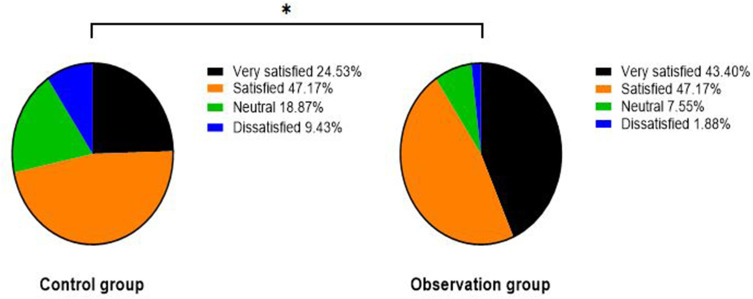
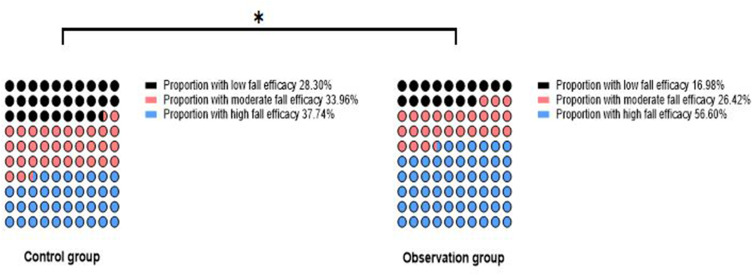
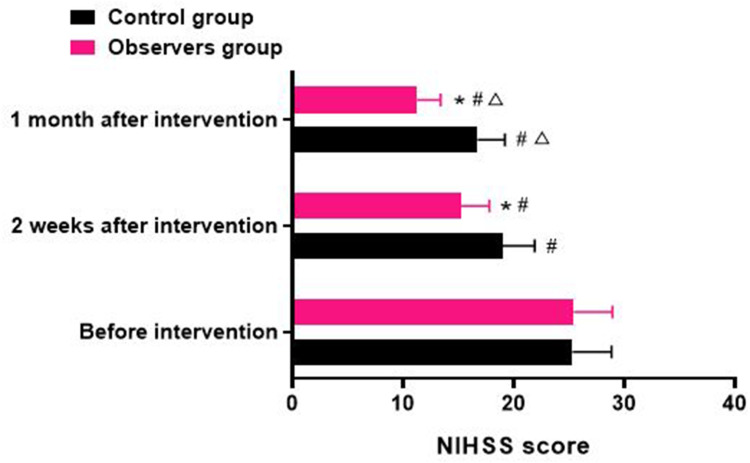
The observation group showed significantly lower NIHSS scores at 2 weeks and 1 month post-intervention (P<0.05). Both groups demonstrated reduced SAS and SDS scores, with the observation group showing greater improvement (P<0.05). A higher proportion of patients in the observation group (56.60%) showed excellent fall efficacy compared to the control group (37.74%) (P<0.05). The observation group also had greater improvements in ADL, SS-QOL, and rehabilitation confidence, with higher patient satisfaction (90.57% vs 71.70%, P<0.05).
Positive collaboration rehabilitation nursing significantly improves neurological function, emotional well-being, fall efficacy, and quality of life in elderly patients with cerebral infarction. This approach increases patient and family satisfaction, highlighting the potential benefits of integrating collaborative care into clinical practice.
脑梗死是老年人中常见的致残性疾病,常导致肢体功能障碍和心理问题,严重影响生活质量。传统护理方法主要侧重于身体康复;然而,越来越多的证据表明,情绪健康和康复信心等心理因素对康复结果有重要影响。康复护理中的积极协作,涉及患者、医护人员和家庭成员的共同努力,已成为促进身体和心理康复的整体方法。
分析积极协作理念康复护理对老年脑梗死患者的影响,重点关注跌倒效能和康复信心。
对2022年10月至2024年4月收治的106例老年脑梗死患者的临床资料进行回顾性分析。将患者分为对照组(n = 53,接受常规护理)和观察组(n = 53,接受积极协作康复护理)。比较两组患者的神经功能(美国国立卫生研究院卒中量表[NIHSS])、负性情绪(焦虑自评量表[SAS]、抑郁自评量表[SDS])、跌倒效能(改良跌倒效能量表[MFES])、日常生活活动能力(ADL)、生活质量(生活质量综合评定问卷[SS-QOL])、康复信心(自我管理信心量表[CaSM])及护理满意度(护理满意度量表[NSNS])。
干预后2周和1个月时,观察组NIHSS评分显著降低(P < 0.05)。两组SAS和SDS评分均降低,观察组改善更明显(P < 0.05)。观察组跌倒效能优秀的患者比例(56.60%)高于对照组(37.74%)(P < 0.05)。观察组在ADL、SS-QOL及康复信心方面也有更大改善,患者满意度更高(90.57%对71.70%,P < 0.05)。
积极协作康复护理可显著改善老年脑梗死患者的神经功能、情绪健康、跌倒效能及生活质量。该方法提高了患者及家属的满意度,凸显了将协作护理纳入临床实践的潜在益处。