Tao Xiangkun, Li Zhuocan, Wang Dongfang, Pu Juncai, Liu Yiyun, Gui Siwen, Zhong Xiaogang, Yang Dan, Zhou Haipeng, Tao Wei, Chen Weiyi, Chen Xiaopeng, Chen Yue, Chen Xiang, Xie Peng
Department of Neurology, NHC Key Laboratory of Diagnosis and Treatment on Brain Functional Diseases, The First Affiliated Hospital of Chongqing Medical University, Chongqing, China.
Jinfeng Laboratory, Chongqing, China.
Front Neurosci. 2025 May 16;19:1448478. doi: 10.3389/fnins.2025.1448478. eCollection 2025.
Autism spectrum disorder (ASD) is a neurological and developmental disorder commonly accompanied by gut dysbiosis and gastrointestinal symptoms. Accumulating evidence supports a crucial role of gut microbiota dysbiosis in the pathophysiological mechanisms of ASD. However, the alteration of gut microbiota shows high heterogeneity across different studies. This study aims to identify potential biomarkers in the gut microbiota of patients with ASD.
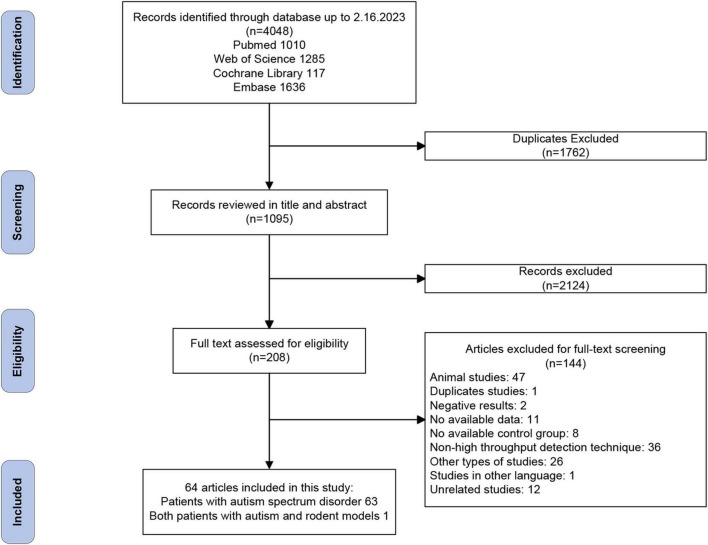
We conducted a comprehensive analysis by searching the PubMed, Web of Science, Cochrane Library, and Embase databases, for studies assessing the changes of gut microbial diversity and taxa in ASD patients and healthy controls using high-throughput sequencing. Vote counting analyses were performed to identify consistently altered gut microbes associated with ASD.
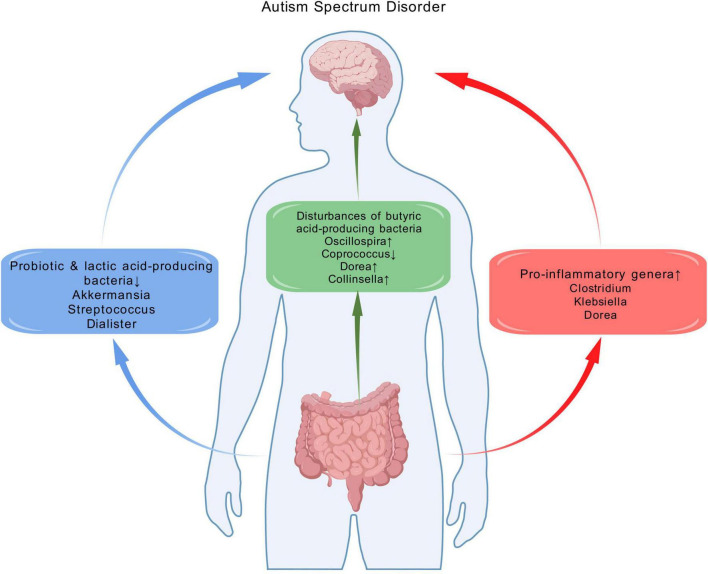
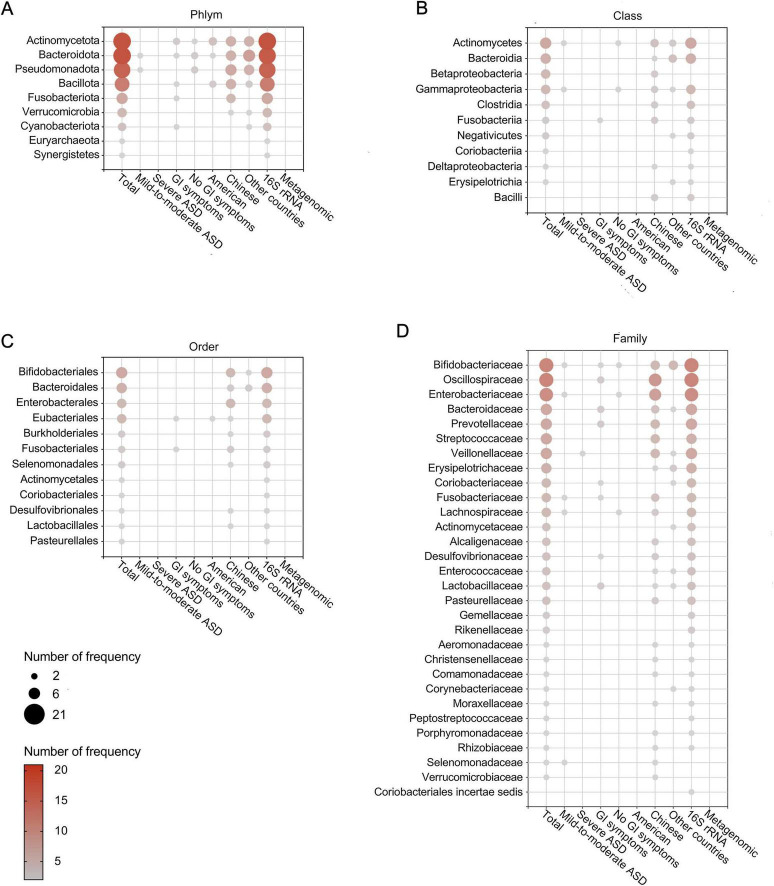
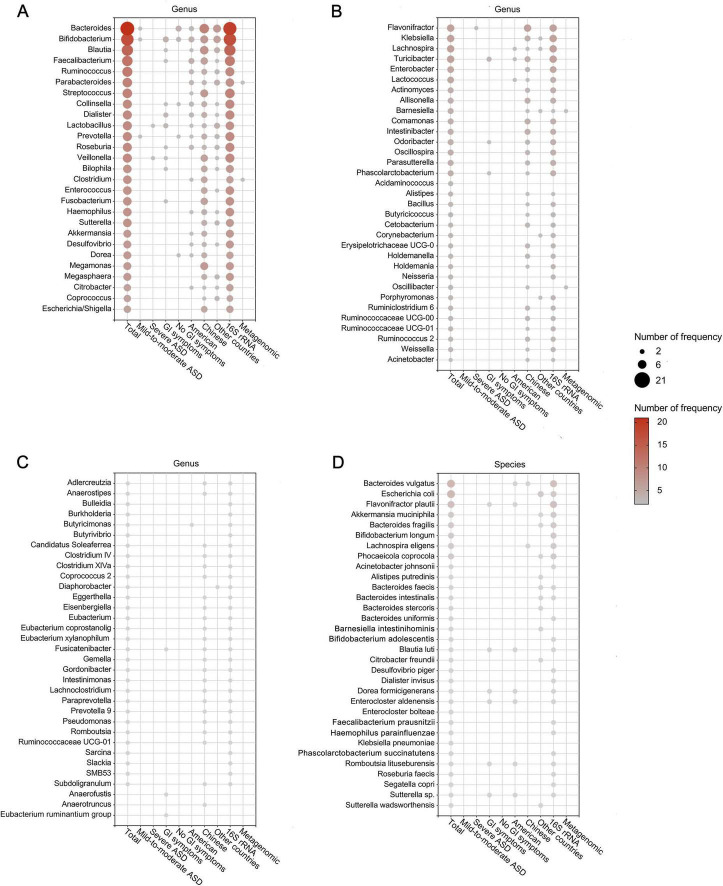
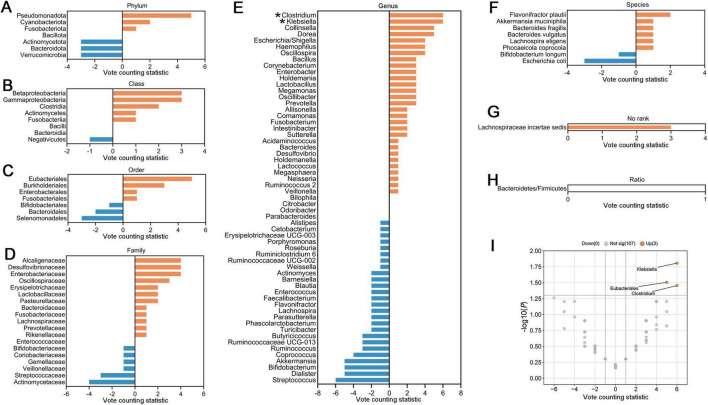
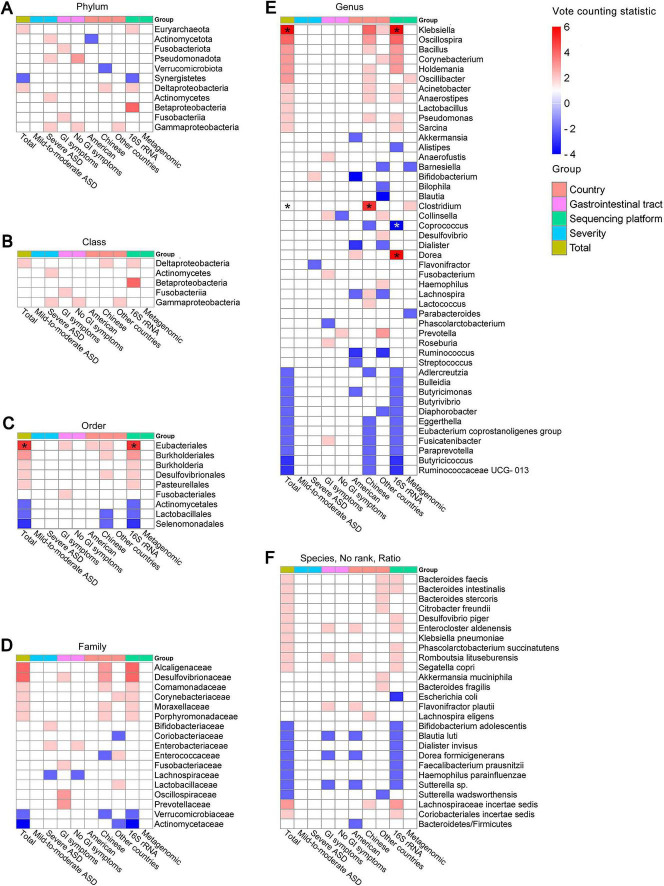
Sixty-four studies involving 189 differentially abundant gut microbial taxa were included. Our synthesis provided no strong evidence for a difference in α-diversity between ASD patients and healthy controls, while studies were relatively consistent in reporting differences in β-diversity. Among 189 taxa, we identified three significantly increased taxa in ASD patients: Eubacteriales, , and . Additionally, there were enriched trends of , , and , and depleted trends of , , , and . These findings suggest that the disrupted intestinal microecology and functional changes in ASD are characterized by an enrichment of pro-inflammatory genera, a reduction of specific probiotics, lactic acid-producing and utilizing bacteria, and an imbalance of anti-inflammatory butyrate-producing bacteria. Substantial heterogeneity across studies concerning demographics and methodologies was also observed.
This systematic review contribute to a further understanding of the role of gut microbiota in ASD and support the development of microbiota-based diagnostic and therapeutic strategies for ASD.
自闭症谱系障碍(ASD)是一种神经发育障碍,常伴有肠道菌群失调和胃肠道症状。越来越多的证据支持肠道微生物群失调在ASD病理生理机制中起关键作用。然而,不同研究中肠道微生物群的改变显示出高度的异质性。本研究旨在确定ASD患者肠道微生物群中的潜在生物标志物。
我们通过检索PubMed、Web of Science、Cochrane图书馆和Embase数据库进行了全面分析,以查找使用高通量测序评估ASD患者和健康对照中肠道微生物多样性和分类群变化的研究。进行投票计数分析以确定与ASD相关的持续改变的肠道微生物。
纳入了64项涉及189个差异丰富的肠道微生物分类群的研究。我们的综合分析没有提供有力证据表明ASD患者和健康对照之间的α多样性存在差异,而各研究在报告β多样性差异方面相对一致。在189个分类群中,我们确定了ASD患者中三个显著增加的分类群:真杆菌目、[此处原文缺失两个分类群名称]和[此处原文缺失一个分类群名称]。此外,[此处原文缺失四个分类群名称]有富集趋势,[此处原文缺失四个分类群名称]有减少趋势。这些发现表明,ASD中肠道微生态的破坏和功能变化的特征是促炎菌属的富集增加、特定益生菌、产乳酸和利用乳酸的细菌减少,以及抗炎产丁酸细菌的失衡。研究还观察到在人口统计学和方法学方面存在大量异质性。
本系统评价有助于进一步了解肠道微生物群在ASD中的作用,并支持开发基于微生物群的ASD诊断和治疗策略。