Wang Rui, Ren Zhenhui, Li Yamin
Xiangya School of Nursing, Central South University, Changsha, Hunan, China.
Hunan Provincial People's Hospital and The First-Affiliated Hospital of Hunan Normal University, Changsha, Hunan, China.
EXCLI J. 2025 Apr 7;24:542-557. doi: 10.17179/excli2025-8239. eCollection 2025.
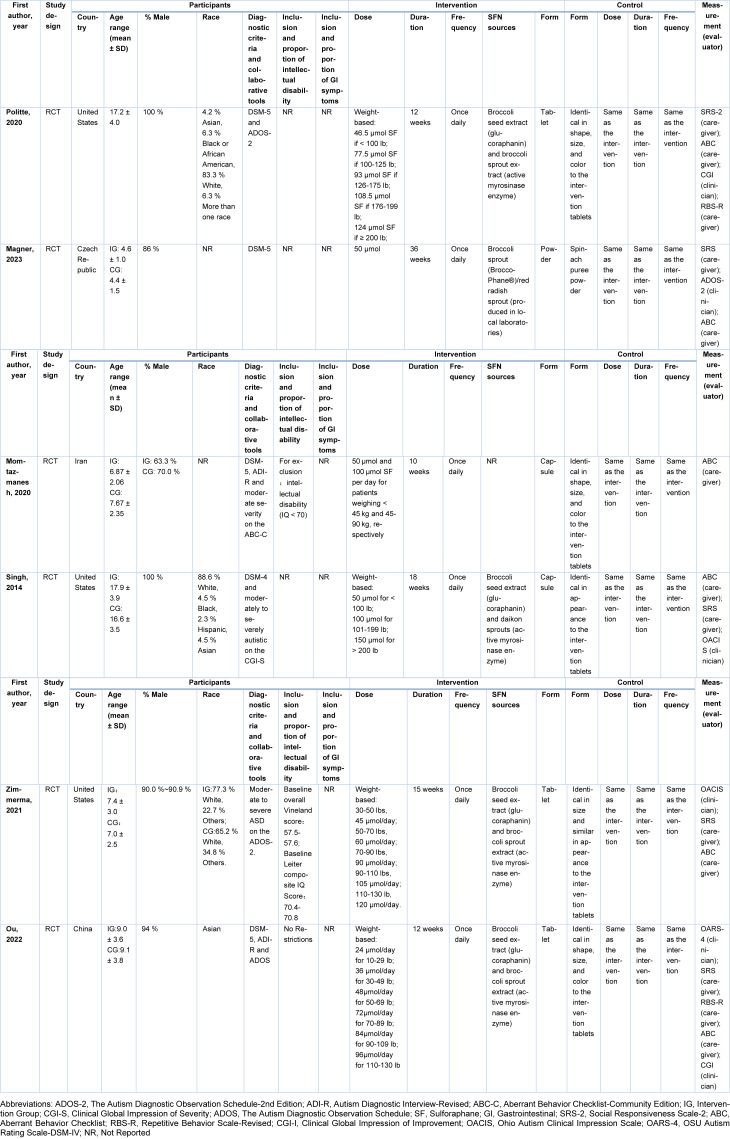
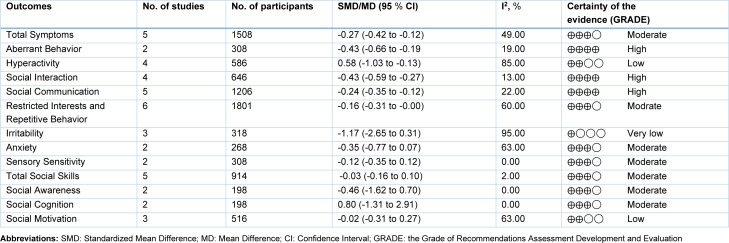
Autism spectrum disorder (ASD) is a complex neurodevelopmental disorder lacking effective treatments. This systematic review and meta-analysis assesses the efficacy and safety of sulforaphane (SFN) for ASD. Eight databases were searched from inception to September 2024, identifying six randomized controlled trials for inclusion. Efficacy outcomes included ASD symptoms measured by the mean difference (MD) or standardized mean difference (SMD), while safety outcomes included adverse events measured by relative risk. Risk of bias was assessed using the Cochrane tool, and evidence certainty was evaluated via the Grade of Recommendations Assessment Development and Evaluation (GRADE). Results showed that SFN significantly improved total symptoms (SMD = -0.27, 95 % confidence interval (CI), -0.42, -0.12), aberrant behavior (SMD = -0.43, 95 % CI, -0.66, -0.19), hyperactivity (SMD = -0.58, 95 % CI, -1.03, -0.13), social interaction (SMD = -0.43, 95 % CI, -0.59, -0.27), social communication (SMD = -0.24, 95 % CI, -0.35, - 0.12), and restricted and repetitive behaviors (RRB) (SMD = -0.16, 95 % CI, -0.31, -0.00). Effects on irritability, anxiety, sensory sensitivity, total social skills, social awareness, social cognition, and social motivation were not statistically significant. Adverse events were similar between intervention and control groups. In conclusion, SFN shows potential in improving ASD symptoms without significant adverse effects. However, results should be interpreted cautiously due to potential influences from assessment tools, outcome assessors, and treatment duration. Further research is needed to confirm the long-term efficacy and safety of SFN for ASD.
自闭症谱系障碍(ASD)是一种缺乏有效治疗方法的复杂神经发育障碍。本系统评价和荟萃分析评估了萝卜硫素(SFN)治疗ASD的疗效和安全性。检索了从数据库建立至2024年9月的八个数据库,确定纳入六项随机对照试验。疗效指标包括用平均差(MD)或标准化平均差(SMD)衡量的ASD症状,而安全性指标包括用相对风险衡量的不良事件。使用Cochrane工具评估偏倚风险,并通过推荐分级评估、制定和评价(GRADE)来评估证据的确定性。结果显示,SFN显著改善了总症状(SMD = -0.27,95%置信区间(CI),-0.42,-0.12)、异常行为(SMD = -0.43,95%CI,-0.66,-0.19)、多动(SMD = -0.58,95%CI,-1.03,-0.13)、社交互动(SMD = -0.43,95%CI,-0.59,-0.27)、社交沟通(SMD = -0.24,95%CI,-0.35,-0.12)以及局限和重复行为(RRB)(SMD = -0.16,95%CI,-0.31,-0.00)。对易怒、焦虑、感觉敏感性、总社交技能、社交意识、社交认知和社交动机的影响无统计学意义。干预组和对照组之间的不良事件相似。总之,SFN在改善ASD症状方面显示出潜力,且无显著不良影响。然而,由于评估工具、结果评估者和治疗持续时间的潜在影响,结果应谨慎解读。需要进一步研究以确认SFN治疗ASD的长期疗效和安全性。