Rogelj Peter
Faculty of Mathematics, Natural Sciences and Information Technologies, University of Primorska, Glagoljaška 8, Koper, SI-6000, Slovenia.
Neuroinformatics. 2025 Jun 3;23(2):33. doi: 10.1007/s12021-025-09733-6.
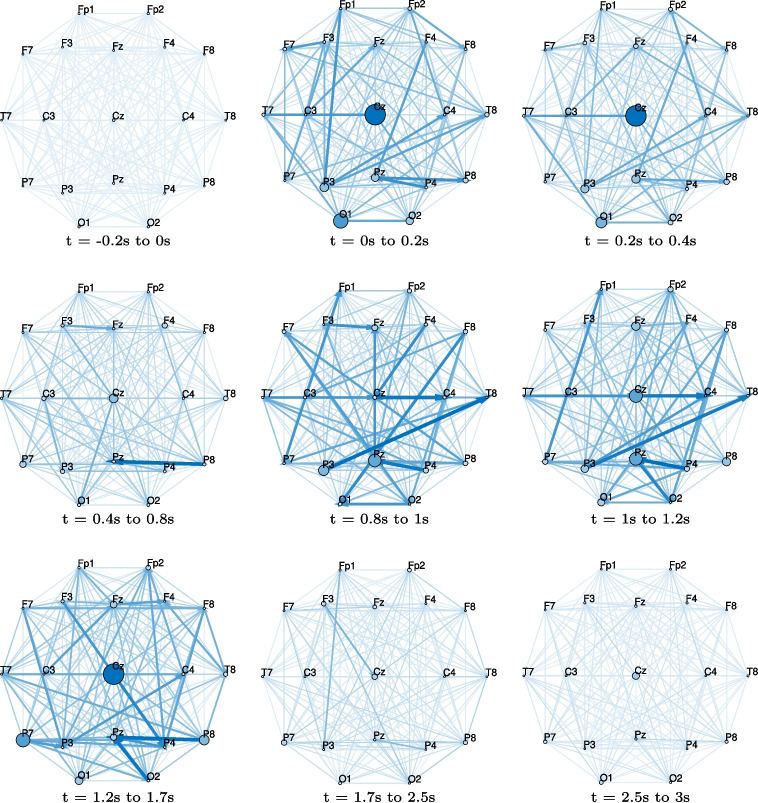
Study of brain function often involves analyzing task-related switching between intrinsic brain networks, which connect various brain regions. Functional brain connectivity analysis methods aim to estimate these networks but are limited by the statistical constraints of windowing functions, which reduce temporal resolution and hinder explainability of highly dynamic processes. In this work, we propose a novel approach to functional connectivity analysis through the explainability of EEG classification. Unlike conventional methods that condense raw data into extracted features, our approach inflates raw EEG data by decomposition into meaningful components that explain processes in the application domain. To uncover the brain connectivity that affects classification decisions, we introduce a new method of dynamic influence data inflation (DIDI), which extracts signals representing interactions between electrode regions. These inflated data are then classified using an end-to-end neural network classifier architecture designed for raw EEG signals. Saliency map estimation from trained classifiers reveals the connectivity dynamics affecting classification decisions, which can be visualized as dynamic connectivity support maps for improved interpretability. The methodology is demonstrated on two publicly available datasets: one for imagined motor movement classification and the other for emotion classification. The results highlight the dual benefits of our approach: in addition to providing interpretable insights into connectivity dynamics it increases classification accuracy.
对大脑功能的研究通常涉及分析内在大脑网络之间与任务相关的切换,这些网络连接着大脑的各个区域。功能性脑连接分析方法旨在估计这些网络,但受到加窗函数统计约束的限制,加窗函数会降低时间分辨率并阻碍对高度动态过程的可解释性。在这项工作中,我们通过脑电图分类的可解释性提出了一种功能性连接分析的新方法。与将原始数据浓缩为提取特征的传统方法不同,我们的方法通过分解为解释应用领域过程的有意义组件来扩展原始脑电图数据。为了揭示影响分类决策的大脑连接性,我们引入了一种动态影响数据扩展(DIDI)的新方法,该方法提取表示电极区域之间相互作用的信号。然后,使用为原始脑电图信号设计的端到端神经网络分类器架构对这些扩展数据进行分类。从训练好的分类器估计显著性图,可以揭示影响分类决策的连接动力学,这可以可视化为动态连接支持图,以提高可解释性。该方法在两个公开可用的数据集上得到了验证:一个用于想象运动分类,另一个用于情感分类。结果突出了我们方法的双重优势:除了提供对连接动力学的可解释见解外,还提高了分类准确率。