Murrugarra David, Veliz-Cuba Alan, Dimitrova Elena, Kadelka Claus, Wheeler Matthew, Laubenbacher Reinhard
Department of Mathematics, University of Kentucky, Lexington, KY, 40506, USA.
Department of Mathematics, University of Dayton, Dayton, OH, 45469, USA.
Bull Math Biol. 2025 Jun 3;87(7):91. doi: 10.1007/s11538-025-01471-9.
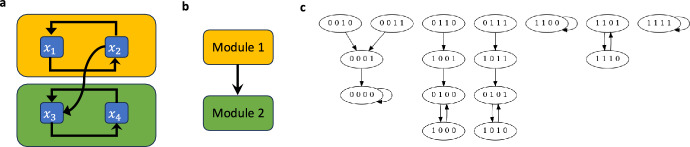
The concept of control is crucial for effectively understanding and applying biological network models. Key structural features relate to control functions through gene regulation, signaling, or metabolic mechanisms, and computational models need to encode these. Applications often focus on model-based control, such as in biomedicine or metabolic engineering. In a recent paper, the authors developed a theoretical framework of modularity in Boolean networks, which led to a canonical semidirect product decomposition of these systems. In this paper, we present an approach to model-based control that exploits this modular structure, as well as the canalizing features of the regulatory mechanisms. We show how to identify control strategies from the individual modules, and we present a criterion based on canalizing features of the regulatory rules to identify modules that do not contribute to network control and can be excluded. For even moderately sized networks, finding global control inputs is computationally challenging. Our modular approach leads to an efficient approach to solving this problem. We apply it to a published Boolean network model of blood cancer large granular lymphocyte (T-LGL) leukemia to identify a minimal control set that achieves a desired control objective.
控制概念对于有效理解和应用生物网络模型至关重要。关键结构特征通过基因调控、信号传导或代谢机制与控制功能相关,计算模型需要对这些进行编码。应用通常侧重于基于模型的控制,例如在生物医学或代谢工程中。在最近的一篇论文中,作者开发了布尔网络中模块化的理论框架,这导致了这些系统的规范半直积分解。在本文中,我们提出了一种基于模型的控制方法,该方法利用了这种模块化结构以及调控机制的渠化特征。我们展示了如何从各个模块中识别控制策略,并提出了一个基于调控规则渠化特征的标准,以识别对网络控制没有贡献且可以排除的模块。对于即使是中等规模的网络,找到全局控制输入在计算上也具有挑战性。我们的模块化方法导致了一种解决这个问题的有效方法。我们将其应用于已发表的血癌大颗粒淋巴细胞(T-LGL)白血病的布尔网络模型,以识别实现所需控制目标的最小控制集。