Tang Yujing, Li Qin, Ren Zhengyun, Wu Nianwei, Zhu Hongmei, Zhang Tongtong, Yi Wei, Ju Wantao, Liu Yanjun, Hu Junqing
Obesity and Metabolism Medicine-Engineering Integration Laboratory, Department of General Surgery, The Third People's Hospital of Chengdu, Chengdu, 610031, PR China.
Center of Gastrointestinal and Minimally Invasive Surgery, Department of General Surgery, The Third People's Hospital of Chengdu, Chengdu, 610031, PR China.
J Med Microbiol. 2025 Jun;74(6). doi: 10.1099/jmm.0.002020.
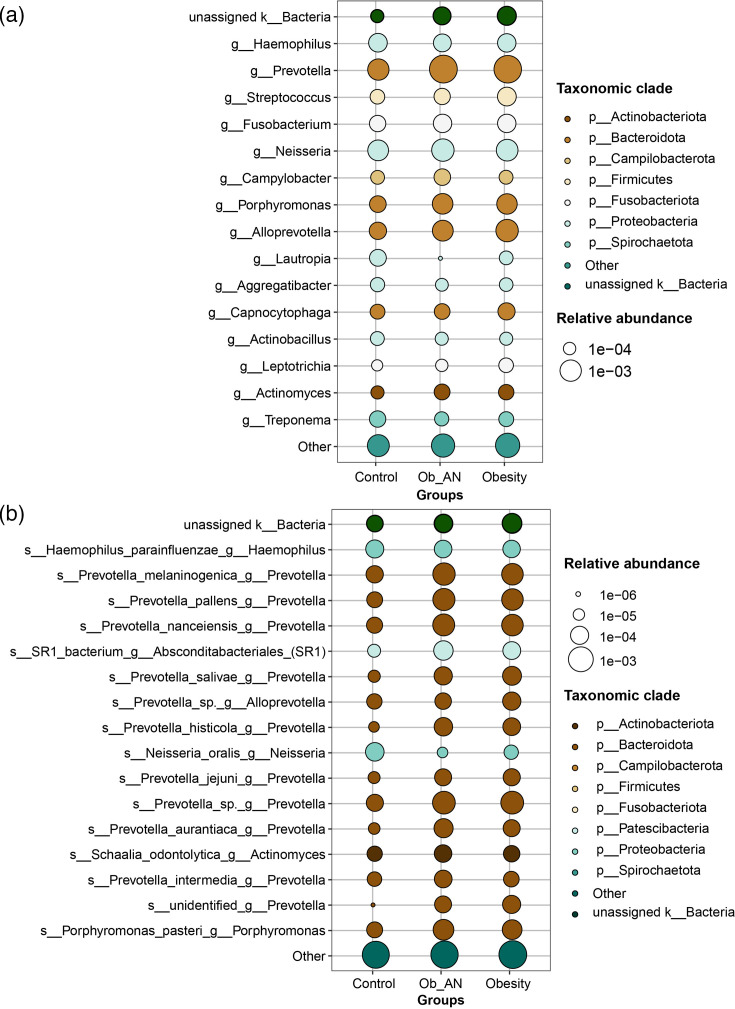
The oral microbiota is the second most complex microbial community in the human body. It has been suggested that poor oral health may be associated with an increased risk of obesity. However, both previous observational and mechanistic studies on oral microbiota do not take into account the obesity-related acanthosis nigricans (AN), which is the most common dermatological manifestation in individuals with obesity. This study aimed to investigate the altered composition, function and diagnostic value of the oral microbiota in obesity with or without acanthosis nigricans (AN). We characterized the oral bacteria signature in a Chinese cohort (ChiCTR2300073353) of 99 patients with obesity and obesity-related AN (Ob_AN) and 50 healthy controls using 16S rRNA gene V3-V4 region sequencing. The microbial richness (abundance-based coverage estimators and observed species indices) was significantly greater in the Ob_AN and obesity groups than in the control group; however, microbial diversity (Shannon index) did not differ significantly. Distinct separation in the microbial community amongst the three groups was observed. species, including , and , were associated with composition alterations and predicted functions (significant downregulation of ATP-binding cassette transporters) associated with microbial dysbiosis in the obesity and Ob_AN groups. Moreover, and genera assessments could indicate obesity and obesity-related AN risk. The notable reduction of plenty of oral microbiota and high levels of spp. may play a critical role in obesity with AN. Oral microbiota may serve as biomarkers for diagnosing, preventing and even treating obesity-related AN.
口腔微生物群是人体中第二复杂的微生物群落。有人提出,口腔健康不佳可能与肥胖风险增加有关。然而,先前关于口腔微生物群的观察性研究和机制研究均未考虑与肥胖相关的黑棘皮病(AN),这是肥胖个体中最常见的皮肤病表现。本研究旨在调查伴有或不伴有黑棘皮病(AN)的肥胖患者口腔微生物群的组成、功能变化及诊断价值。我们使用16S rRNA基因V3-V4区域测序对99例肥胖及肥胖相关AN(Ob_AN)患者和50例健康对照的中国队列(ChiCTR2300073353)中的口腔细菌特征进行了表征。Ob_AN组和肥胖组的微生物丰富度(基于丰度的覆盖度估计值和观测物种指数)显著高于对照组;然而,微生物多样性(香农指数)没有显著差异。观察到三组之间微生物群落存在明显分离。包括[具体物种1]、[具体物种2]和[具体物种3]在内的物种与肥胖组和Ob_AN组中与微生物失调相关的组成变化和预测功能(ATP结合盒转运体显著下调)有关。此外,[具体属1]和[具体属2]的评估可以指示肥胖和肥胖相关AN的风险。大量口腔微生物群的显著减少和[具体菌属]的高水平可能在伴有AN的肥胖中起关键作用。口腔微生物群可作为诊断、预防甚至治疗肥胖相关AN的生物标志物。