Pekľanská Miriama, Kuníková Kateřina, Vlčková Romana, Slabová Hana, Hartmann David, Volfová Karolina, Rudolf Ivo, Šikutová Silvie, Rego Ryan O M, Noriega Fernando Gabriel, Hajdušek Ondřej, Perner Jan, Votýpka Jan, Nouzová Marcela, Šíma Radek
Institute of Parasitology, Biology Centre of the Czech Academy of Sciences, Branišovská 31, 370 05, České Budějovice, Czech Republic.
Faculty of Science, University of South Bohemia, Branišovská 1645/31a, 370 05, České Budějovice, Czech Republic.
Parasit Vectors. 2025 Jun 4;18(1):206. doi: 10.1186/s13071-025-06823-x.
Lyme disease, caused by Borrelia burgdorferi sensu lato (s.l.), is the most common vector-borne disease in the Northern Hemisphere, with Ixodes ticks as its primary vectors. However, many patients do not recall tick bites, fueling speculation about alternative transmission routes, particularly via mosquito bites. This belief is reinforced by studies reporting Borrelia presence in mosquitoes. This study evaluates whether three mosquito species can acquire, maintain, and transmit Borrelia spirochetes.
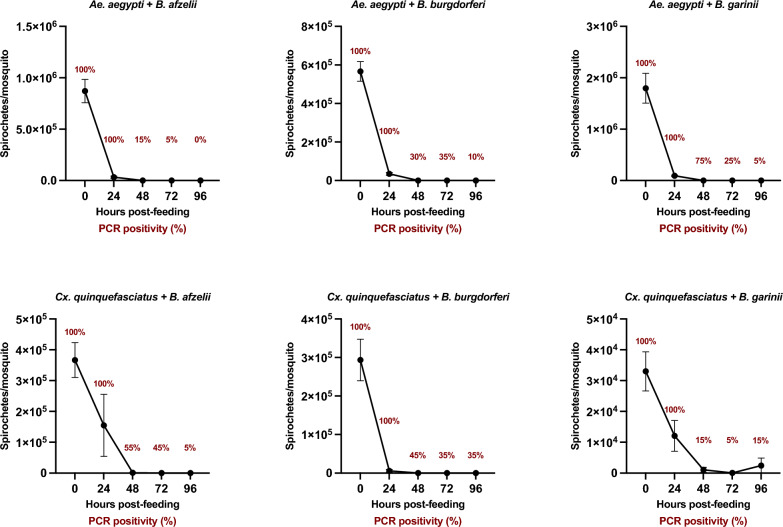
Mosquitoes (Aedes aegypti, Culex quinquefasciatus, and Culex pipiens biotype molestus) were fed on Borrelia-infected mice to assess pathogen acquisition. Additional experiments involved ex vivo feeding on Borrelia-enriched blood to examine spirochete persistence in the mosquito gut. The potential for mechanical transmission was tested by simulating interrupted feeding between infected and naive hosts. The role of trypsin in Borrelia survival and infectivity was also investigated.
Mosquitoes exhibited low efficiency in acquiring Borrelia from infected hosts. Spirochetes artificially introduced through ex vivo blood meals were rapidly eliminated during digestion, primarily due to trypsin activity. Inhibition of trypsin prolonged spirochete persistence and infectivity in the mosquito gut. Mechanical transmission experiments revealed no evidence of Borrelia transmission from infected to naive hosts.
Our findings demonstrate that mosquitoes lack the biological capacity to efficiently acquire and maintain B. burgdorferi s.l. spirochetes and are unable to transmit them through natural or mechanical means. This study provides compelling evidence against mosquito-borne transmission of Lyme disease and reinforces Ixodes ticks as the sole competent vectors, which is crucial for targeted public health interventions and accurate risk communication.
莱姆病由伯氏疏螺旋体复合群(Borrelia burgdorferi sensu lato,s.l.)引起,是北半球最常见的媒介传播疾病,以硬蜱属蜱类作为主要传播媒介。然而,许多患者不记得被蜱叮咬过,这引发了对其他传播途径的猜测,尤其是通过蚊虫叮咬传播。报告称在蚊子体内发现伯氏疏螺旋体的研究进一步强化了这种观点。本研究评估三种蚊虫是否能够获取、维持并传播伯氏疏螺旋体。
让蚊子(埃及伊蚊、致倦库蚊和骚扰库蚊生物型)吸食感染伯氏疏螺旋体的小鼠血液,以评估病原体获取情况。另外的实验包括对富含伯氏疏螺旋体的血液进行离体喂食,以检查螺旋体在蚊子肠道内的存活情况。通过模拟在感染宿主和未感染宿主之间的中断喂食来测试机械传播的可能性。还研究了胰蛋白酶在伯氏疏螺旋体存活和感染性方面的作用。
蚊子从感染宿主获取伯氏疏螺旋体的效率较低。通过离体血餐人工引入的螺旋体在消化过程中迅速被清除,主要原因是胰蛋白酶的活性。抑制胰蛋白酶可延长螺旋体在蚊子肠道内的存活时间和感染性。机械传播实验未发现伯氏疏螺旋体从感染宿主传播到未感染宿主的证据。
我们的研究结果表明,蚊子缺乏有效获取和维持伯氏疏螺旋体复合群螺旋体的生物学能力,并且无法通过自然或机械方式传播它们。本研究提供了有力证据反对莱姆病通过蚊虫传播,并强化了硬蜱属蜱类作为唯一有效传播媒介的地位,这对于有针对性的公共卫生干预措施和准确的风险沟通至关重要。