Palombo Francesco, Del Gado Francesca, Rugolo Francesca, Lasaponara Stefano, Busan Pierpaolo, Tomaiuoli Donatella, Conversi David
Department of Psychology, La Sapienza University of Rome, Rome, Italy.
Centro Ricerca e Cura, Rome, Italy.
Front Psychol. 2025 May 21;16:1576681. doi: 10.3389/fpsyg.2025.1576681. eCollection 2025.
People Who Stutter (PWS) are often characterized by the presence of cognitive-emotional issues, resulting in conditions such as social phobia and avoidance behaviors. Emotions have been demonstrated to have a role in modulating speech-motor systems. Thus, in PWS, emotion and cognition (i.e., higher levels of trait-stable-neuroticism-and contextual-anticipation-anxiety) could negatively influence speech-motor networks, resulting in an increased number of dysfluencies.
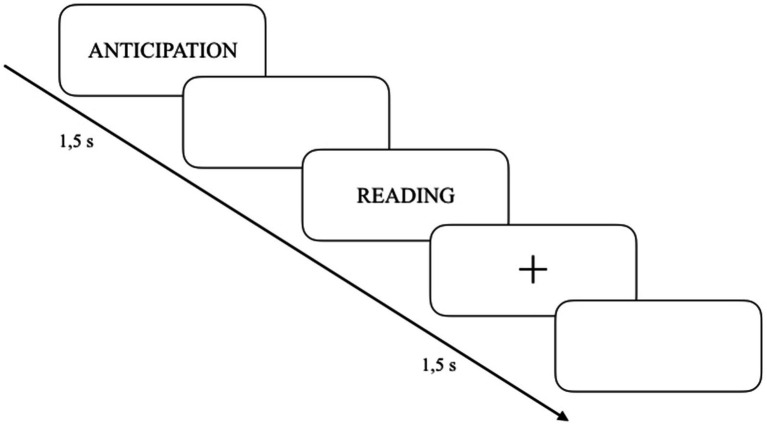
To test this hypothesis, we recruited 13 PWS who were matched to 13 Fluent Speakers (FS). Participants were all Italian speakers and completed the NEO-PI-3 scale to assess neuroticism, and the ASI-3 scale for anxiety sensitivity. Successively, participants considered 55 words (repeated two times) and 55 sentences, and completed a task in which they had to evaluate their anticipation of stuttering before reading them aloud. Anticipation scores, reading times, and frequency of stuttering were evaluated and used for analyses.
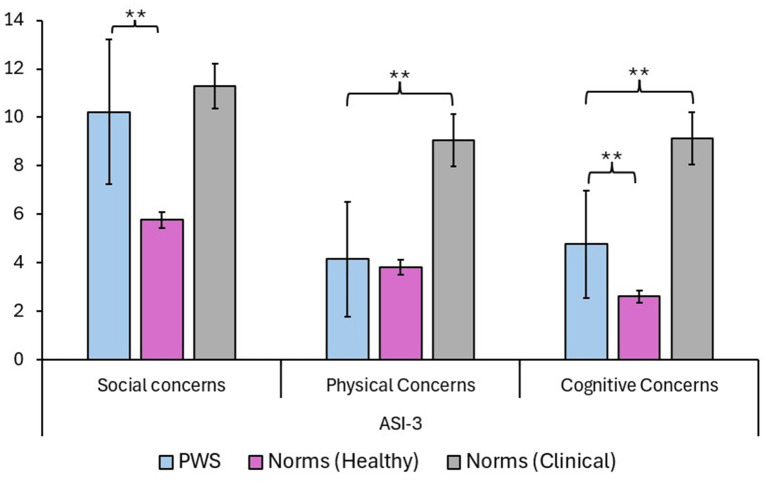
Findings suggest that PWS mainly had higher social concern than the fluent speakers. Moreover, a tendency toward higher levels of neuroticism is evident. Linear regressions suggest that reading times in PWS (positively related to frequency of stuttering) may be mainly explained by stuttering anticipation scores and, secondarily, by neuroticism levels. Stuttering anticipation was also positively related to the recorded frequencies of dysfluencies.
Stuttering anticipation and neuroticism may be useful indexes for predicting dysfluencies and speech behavior, in PWS. Surely, this may be related to long-life stuttering and adaptive/maladaptive compensation attempts. In every case, in a clinical context, this also suggests the importance of fully evaluating behavioral/emotional aspects of stuttering, to obtain a more complete picture of patients' needs and "tailored"/multidisciplinary interventions.
口吃者(PWS)通常具有认知 - 情感问题,导致社交恐惧症和回避行为等情况。情绪已被证明在调节言语运动系统中起作用。因此,在口吃者中,情绪和认知(即较高水平的特质稳定神经质和情境预期焦虑)可能会对言语运动网络产生负面影响,导致言语不流畅次数增加。
为了验证这一假设,我们招募了13名口吃者,并与13名流利说话者(FS)进行匹配。参与者均为意大利语使用者,完成了用于评估神经质的NEO - PI - 3量表和用于评估焦虑敏感性的ASI - 3量表。随后,参与者考虑55个单词(重复两次)和55个句子,并完成一项任务,即在大声朗读之前评估他们对口吃的预期。评估预期分数、阅读时间和口吃频率,并用于分析。
研究结果表明,口吃者主要比流利说话者有更高的社会关注度。此外,神经质水平有升高的趋势。线性回归表明,口吃者的阅读时间(与口吃频率呈正相关)可能主要由口吃预期分数解释,其次由神经质水平解释。口吃预期也与记录的言语不流畅频率呈正相关。
口吃预期和神经质可能是预测口吃者言语不流畅和言语行为的有用指标。当然,这可能与长期口吃以及适应性/适应不良的补偿尝试有关。在任何情况下,在临床环境中,这也表明全面评估口吃的行为/情感方面的重要性,以便更全面地了解患者的需求并进行“量身定制”的/多学科干预。