
具有增强类过氧化物酶催化活性用于口腔疾病检测的硅酸铜纳米酶的原位价态工程
In Situ Valence Engineering of Copper Silicate Nanozymes with Enhanced Peroxidase-Like Catalytic Activity for Oral Disease Detection.
作者信息
Liu Xiaocan, Ding Zhen, Xu Chengjing, Zhang Jinming, Liu Yufu, Chen Tianyan, Dai Shuang, Bao Xingfu, Hu Min, Liu Zhen
机构信息
Jilin Provincial Key Laboratory of Tooth Development and Bone Remodeling, School and Hospital of Stomatology, Jilin University, Changchun, 130021, China.
Beijing Advanced Innovation Center for Soft Matter Science and Engineering, College of Life Science and Technology, Beijing University of Chemical Technology, Beijing, 100029, China.
出版信息
Adv Sci (Weinh). 2025 Sep;12(33):e03237. doi: 10.1002/advs.202503237. Epub 2025 Jun 5.
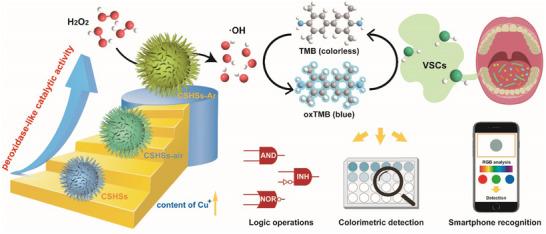
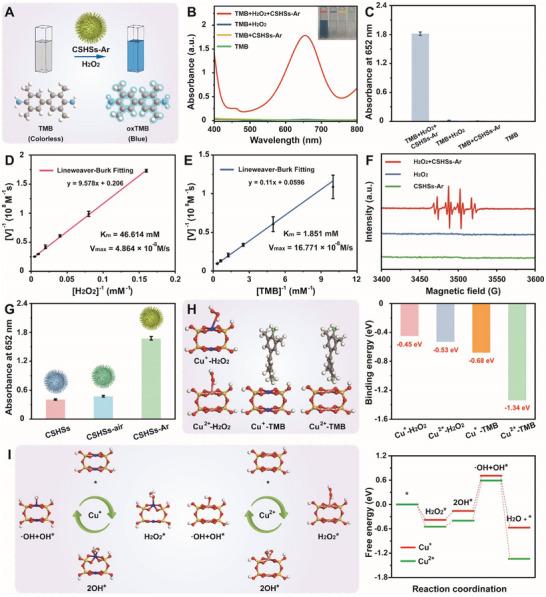
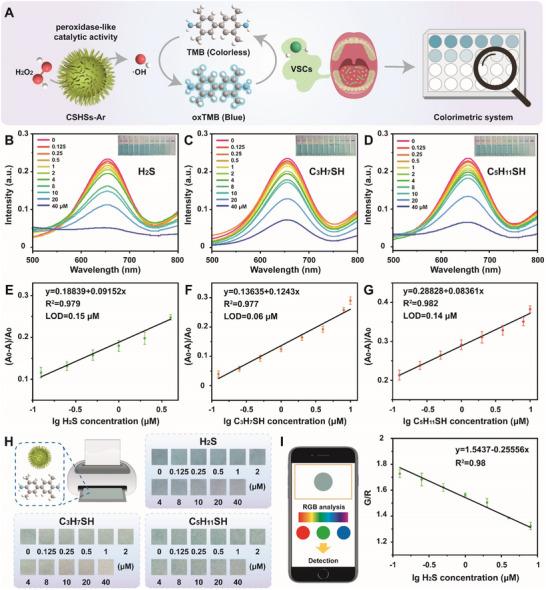
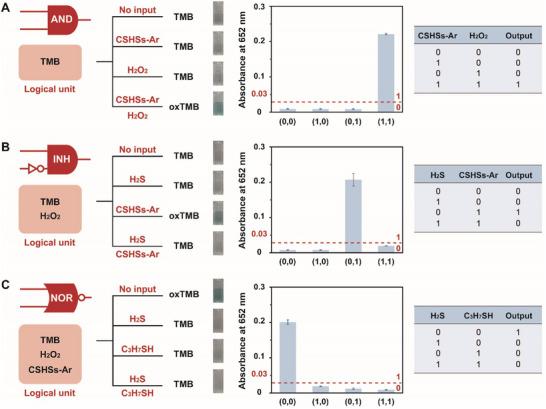
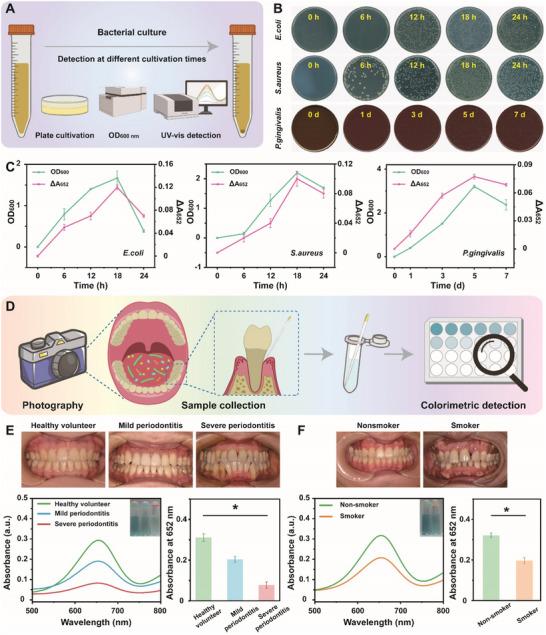
As a series of attractive nanomaterials, nanozymes with great catalytic activity and specificity are well developed in the field of biosensors. Although promising, the lack of appropriate structural design strategy and limitation of sensing performance in the clinical samples remain challenging for the practical application of nanozymes. Herein, a novel copper silicate nanozyme (CSHSs-Ar) with enhanced peroxidase-like catalytic activity is synthesized through a facile in situ valence-engineered approach. After the optimization of synthesis, the resultant CSHSs-Ar nanozymes containing nearly 60% of Cu hold a higher peroxidase-like catalytic activity and a better catalytic specificity than the other two derivatives (CSHSs and CSHSs-air). Theoretical calculations also demonstrate that CSHSs-Ar nanozymes are more beneficial toward the activation of HO compared with CSHSs and CSHSs-air. On this basis, the well-developed CSHSs-Ar nanozyme-involved system is employed as an efficient colorimetric sensor for the detection of volatile sulfur compounds (VSCs) and prediction for periodontitis. Moreover, several visual molecular logic gates are explored as a proof of concept to the application of CSHSs-Ar nanozymes with superior peroxidase-like catalytic activity. This study not only provides guidance for the development of novel nanozymes, but also broadens the biomedical application potential of nanozymes including the detection of oral diseases.
作为一系列具有吸引力的纳米材料,具有高催化活性和特异性的纳米酶在生物传感器领域得到了很好的发展。尽管前景广阔,但缺乏合适的结构设计策略以及临床样本中传感性能的局限性,仍然是纳米酶实际应用面临的挑战。在此,通过一种简便的原位价态工程方法合成了一种具有增强过氧化物酶样催化活性的新型硅酸铜纳米酶(CSHSs-Ar)。经过合成优化后,所得含有近60%铜的CSHSs-Ar纳米酶比其他两种衍生物(CSHSs和CSHSs-air)具有更高的过氧化物酶样催化活性和更好的催化特异性。理论计算还表明,与CSHSs和CSHSs-air相比,CSHSs-Ar纳米酶对HO的活化更有利。在此基础上,构建了基于CSHSs-Ar纳米酶的高效比色传感器用于检测挥发性硫化合物(VSCs)并预测牙周炎。此外,还探索了几种视觉分子逻辑门作为具有优异过氧化物酶样催化活性的CSHSs-Ar纳米酶应用的概念验证。本研究不仅为新型纳米酶的开发提供了指导,还拓宽了纳米酶在生物医学领域的应用潜力,包括口腔疾病的检测。
 Zotero 插件