
通过多尺度拓扑学习发现超离子导体
Superionic Ionic Conductor Discovery via Multiscale Topological Learning.
作者信息
Chen Dong, Wang Bingxu, Li Shunning, Zhang Wentao, Yang Kai, Song Yongli, Wei Guo-Wei, Pan Feng
机构信息
School of Advanced Materials, Peking University, Shenzhen Graduate School, Shenzhen 518055, China.
Department of Mathematics, Michigan State University, East Lansing, Michigan 48824, United States.
出版信息
J Am Chem Soc. 2025 Jun 18;147(24):20888-20898. doi: 10.1021/jacs.5c04828. Epub 2025 Jun 5.
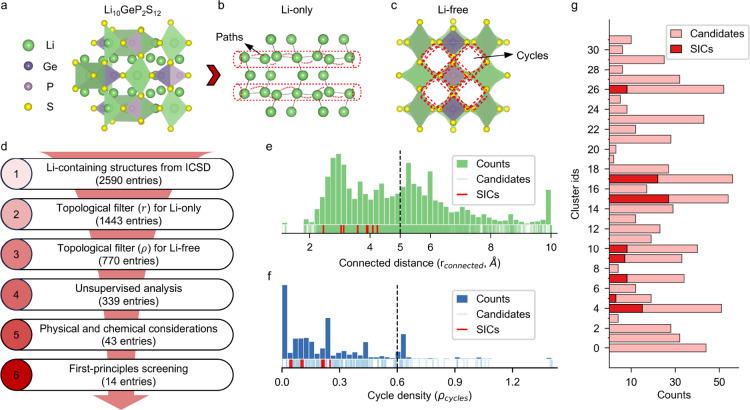
Lithium superionic conductors (LSICs) are crucial for next-generation solid-state batteries, offering exceptional ionic conductivity and enhanced safety for renewable energy and electric vehicles. However, their discovery is extremely challenging due to the vast chemical space, limited labeled data, and understanding of complex structure-function relationships required for optimizing ion transport. This study introduces a multiscale topological learning (MTL) framework that integrates algebraic topology and unsupervised learning to efficiently tackle these challenges. By modeling lithium-only and lithium-free substructures, the framework extracts multiscale topological features and introduces two topological screening metrics, cycle density and minimum connectivity distance, to ensure structural connectivity and ion diffusion compatibility. Promising candidates are clustered via unsupervised algorithms to identify those that resemble known superionic conductors. For final refinement, candidates that pass chemical screening undergo ab initio molecular dynamics simulations for validation. This approach led to the discovery of 14 novel LSICs, four of which have been independently validated in recent experiments. This success accelerates the identification of LSICs and demonstrates broad adaptability, offering a scalable tool for addressing complex material discovery challenges.
锂超离子导体(LSICs)对于下一代固态电池至关重要,可为可再生能源和电动汽车提供卓越的离子导电性并增强安全性。然而,由于巨大的化学空间、有限的标记数据以及优化离子传输所需的复杂结构 - 功能关系的理解,它们的发现极具挑战性。本研究引入了一种多尺度拓扑学习(MTL)框架,该框架整合了代数拓扑和无监督学习,以有效应对这些挑战。通过对仅含锂和不含锂的子结构进行建模,该框架提取多尺度拓扑特征,并引入两个拓扑筛选指标,即循环密度和最小连通距离,以确保结构连通性和离子扩散兼容性。有前景的候选物通过无监督算法进行聚类,以识别那些与已知超离子导体相似的候选物。为了进行最终优化,通过化学筛选的候选物进行从头算分子动力学模拟以进行验证。这种方法导致发现了14种新型LSICs,其中四种已在最近的实验中得到独立验证。这一成功加速了LSICs的识别,并展示了广泛的适应性,为应对复杂的材料发现挑战提供了一种可扩展的工具。



 Zotero 插件