Almarghlani Ammar, Fakhri Jumana, Almarhoon Abeer, Ghonaim Ghazzal, Abed Hassan, Sharka Rayan
Department of Periodontics, Faculty of Dentistry, King Abdulaziz University, Jeddah, KSA.
Teaching Dental Hospital, Faculty of Dentistry, King Abdulaziz University, Jeddah, KSA.
J Taibah Univ Med Sci. 2025 May 9;20(3):272-279. doi: 10.1016/j.jtumed.2025.04.001. eCollection 2025 Jun.
Integrating artificial intelligence (AI) in the dental field can potentially enhance the efficiency of dental care. However, few studies have investigated whether AI software can achieve results comparable to those obtained by dental practitioners (general practitioners (GPs) and specialists) when assessing alveolar bone loss in a clinical setting. Thus, this study compared the performance of AI in assessing periodontal bone loss with those of GPs and specialists.
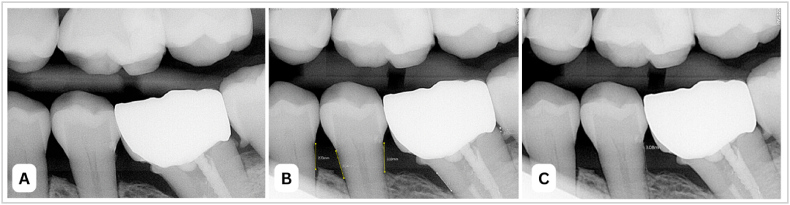
This comparative cross-sectional study evaluated the performance of dental practitioners and AI software in assessing alveolar bone loss. Radiographs were randomly selected to ensure representative samples. Dental practitioners independently evaluated the radiographs, and the AI software "Second Opinion Software" was tested using the same set of radiographs evaluated by the dental practitioners. The results produced by the AI software were then compared with the baseline values to measure their accuracy and allow direct comparison with the performance of human specialists.
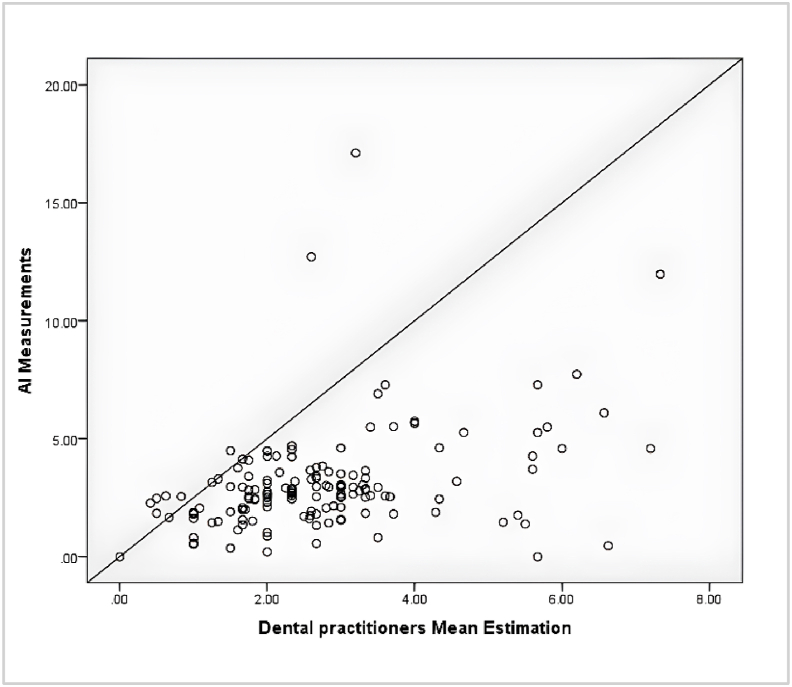
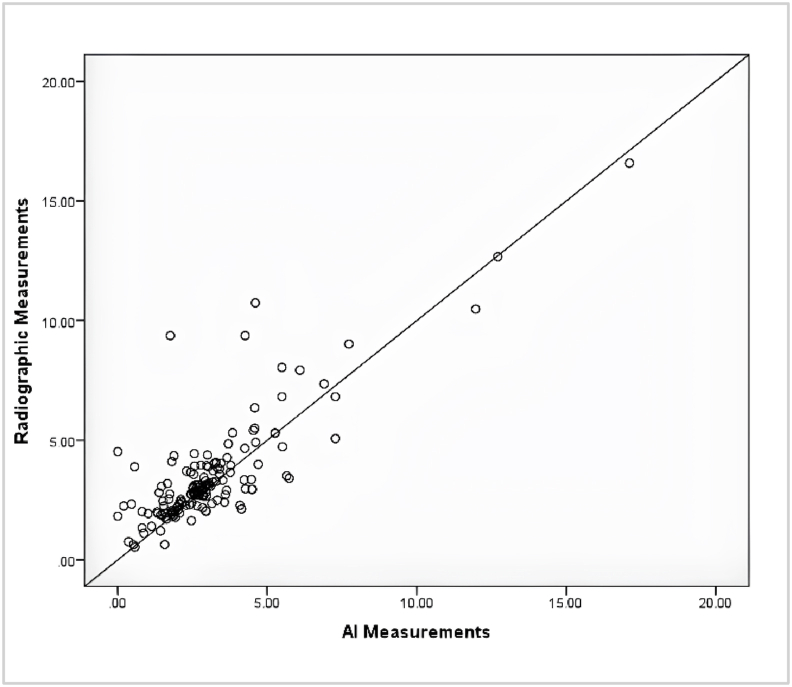
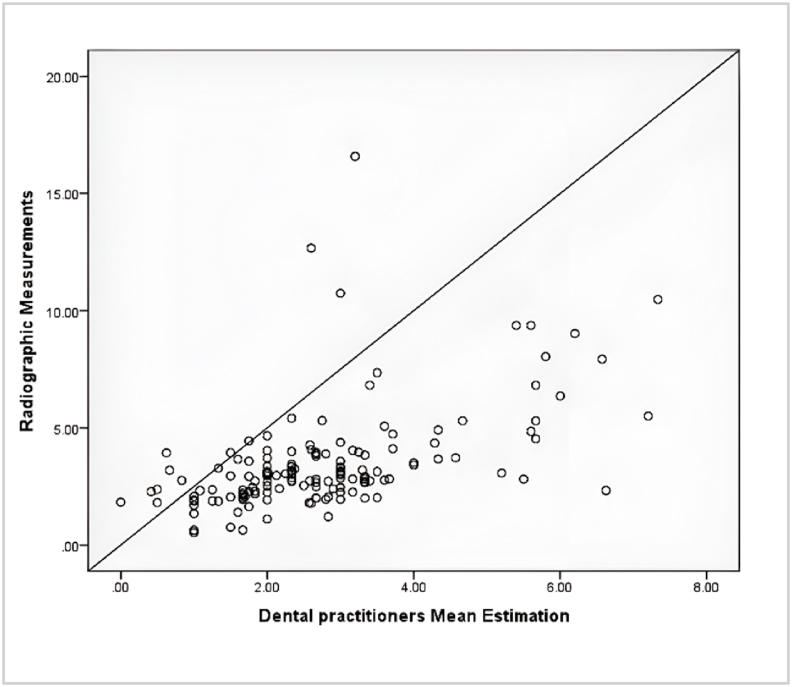
The survey received 149 responses, where each answered 10 questions to compare the measurements made by AI and dental practitioners when assessing the amount of bone loss radiographically. The mean estimates of the participants had a moderate positive correlation with the radiographic measurements (rho = 0.547, < 0.001) and a weaker but still significant correlation with AI measurements (rho = 0.365, < 0.001). AI measurements had a stronger positive correlation with the radiographic measurements (rho = 0.712, < 0.001) compared with their correlation with the estimates of dental practitioners.
This study highlights the capacity of AI software to enhance the accuracy and efficiency of radiograph-based evaluations of alveolar bone loss. Dental practitioners are vital for the clinical experience but AI technology provides a consistent and replicable methodology. Future collaborations between AI experts, researchers, and practitioners could potentially optimize patient care.
将人工智能(AI)整合到牙科领域可能会提高牙科护理的效率。然而,很少有研究调查在临床环境中评估牙槽骨丧失时,人工智能软件能否取得与牙科从业者(全科医生(GPs)和专科医生)相当的结果。因此,本研究比较了人工智能在评估牙周骨丧失方面与全科医生和专科医生的表现。
这项比较性横断面研究评估了牙科从业者和人工智能软件在评估牙槽骨丧失方面的表现。随机选择X光片以确保样本具有代表性。牙科从业者独立评估X光片,并使用牙科从业者评估的同一组X光片测试人工智能软件“第二意见软件”。然后将人工智能软件产生的结果与基线值进行比较,以衡量其准确性,并与人类专家的表现进行直接比较。
该调查共收到149份回复,每份回复回答10个问题,以比较人工智能和牙科从业者在通过X光片评估骨丧失量时的测量结果。参与者的平均估计值与X光片测量结果呈中度正相关(rho = 0.547,< 0.001),与人工智能测量结果的相关性较弱但仍显著(rho = 0.365,< 0.001)。与人工智能测量结果和牙科从业者估计值的相关性相比,人工智能测量结果与X光片测量结果的正相关性更强(rho = 0.712,< 0.001)。
本研究突出了人工智能软件在提高基于X光片的牙槽骨丧失评估的准确性和效率方面的能力。牙科从业者对于临床经验至关重要,但人工智能技术提供了一种一致且可重复的方法。未来人工智能专家、研究人员和从业者之间的合作可能会优化患者护理。