Holbig Heike
Goethe University, Frankfurt/Main, Germany.
Z Vgl Polit. 2022;16(4):707-731. doi: 10.1007/s12286-023-00555-x. Epub 2023 Feb 6.
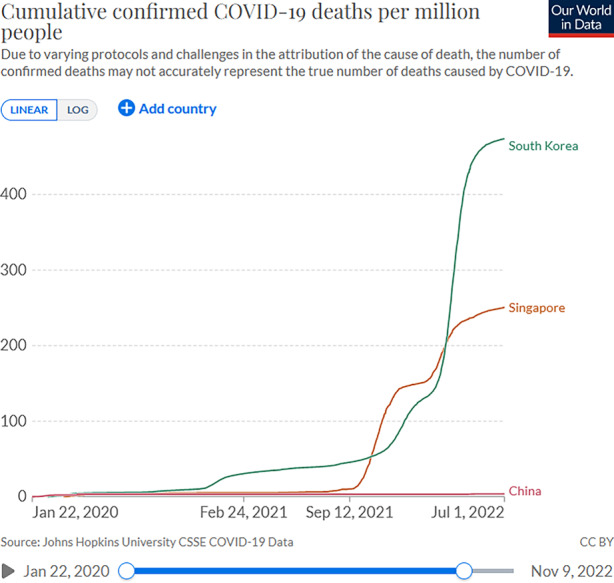
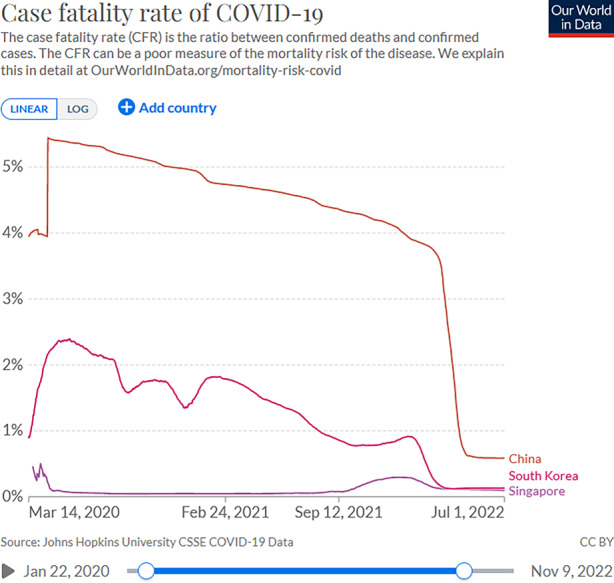
The COVID-19 pandemic has created a dual dilemma for governments worldwide: between the protection of lives and of individual rights, and more long-term between safeguarding lives and preserving livelihoods. Taking a dynamic approach, this paper asks how different regime types have navigated this dual dilemma by adjusting their pandemic-response strategies over the course of time. Three case studies from East Asia are selected to represent different regime types-autocratic China, hybrid Singapore, and democratic South Korea-that share experience with previous coronavirus episodes. Comparing the three cases between late 2019 to mid-2022, remarkable differences are found in the adaptability of response strategies. China's authoritarian regime appeared to be at a clear strategic advantage due to its indifference toward individual rights during the first COVID-19 wave. In the longer run, however, the picture has changed substantially. While China has exclusively prioritized the protection of lives, fixating on its "Zero-COVID" strategy, Singapore has attached at least equal weight to sustaining livelihoods, experiencing a drawn-out zigzagging before pivoting to a "Living with COVID" strategy. Among the three cases, only South Korea has made consistent efforts to protecting individual rights while gradually recalibrating lives and livelihoods. Over time, the high degree of responsiveness of South Korea's democratic regime has allowed for a relatively smooth transition to coexisting with the virus. The paper concludes with some lessons that European democracies might learn from pandemic responses in East Asia in a longitudinal perspective.
一方面是保护生命与个人权利之间的抉择,从更长远来看,则是保障生命与维持生计之间的权衡。本文采用动态分析方法,探究不同政体类型如何通过适时调整疫情应对策略来应对这一双重困境。选取东亚地区的三个案例研究,分别代表不同政体类型——专制的中国、混合政体的新加坡和民主的韩国——它们都有应对过往冠状病毒疫情的经验。对比2019年末至2022年年中的这三个案例,发现应对策略的适应性存在显著差异。在新冠疫情第一波期间,中国的威权政体由于对个人权利的漠视,似乎在战略上具有明显优势。然而,从长远来看,情况发生了很大变化。中国一味地将保护生命置于首位,执着于其“动态清零”策略,而新加坡至少同样重视维持生计,在转向“与新冠共存”策略之前经历了漫长的波折。在这三个案例中,只有韩国在逐步重新调整生命与生计平衡的同时,始终致力于保护个人权利。随着时间推移,韩国民主政体的高度响应能力使其相对平稳地过渡到与病毒共存的状态。本文最后总结了欧洲民主国家从东亚地区疫情应对中可能吸取的一些纵向经验教训。