Lend Kristina, Twisk Jos Wr, Kumar Nupur, Dijkshoorn Bas, Lampa Jon, Rudin Anna, Hetland Merete Lund, Uhlig Till, Nordström Dan, Østergaard Mikkel, Gudbjornsson Bjorn, Sokka-Isler Tuulikki, Grondal Gerdur, Hørslev-Petersen Kim, Nurmohamed Michael T, Frostegård Johan, van Vollenhoven Ronald F
Department of Rheumatology and Clinical Immunology, Amsterdam University Medical Centers, Amsterdam, The Netherlands
Division of Rheumatology, Department of Medicine, Karolinska Institute, Stockholm, Sweden.
RMD Open. 2025 Jun 5;11(2):e005129. doi: 10.1136/rmdopen-2024-005129.
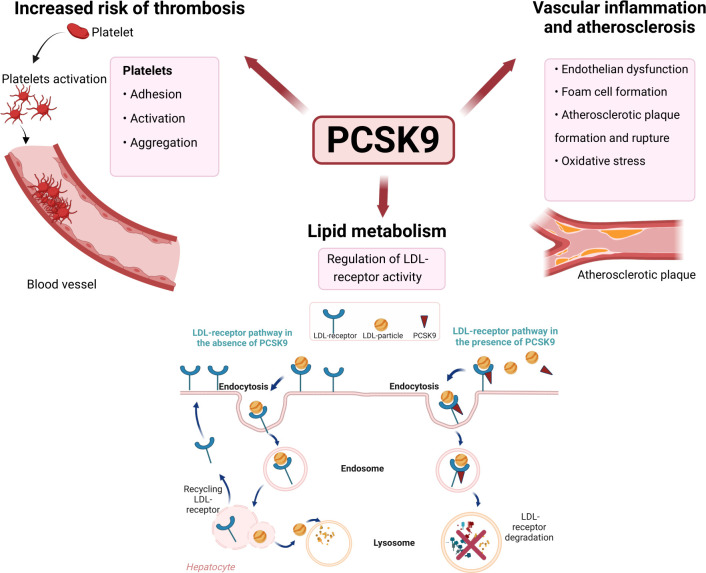
Rheumatoid arthritis elevates cardiovascular disease risk. Proprotein convertase subtilisin/kexin type 9 (PCSK9), a regulator of low-density lipoprotein (LDL) metabolism, increases LDL-receptor breakdown in the liver, which elevates LDL-cholesterol levels. In addition, PCSK9 has direct effects on thrombogenesis and atherosclerotic plaque formation.We aimed to investigate (1) the impact of glucocorticoids and biological disease-modifying antirheumatic drug (bDMARD) treatments on PCSK9 and LDL-cholesterol levels, (2) whether this influence is different when autoantibodies are present and (3) the association between PCSK9 and LDL cholesterol.
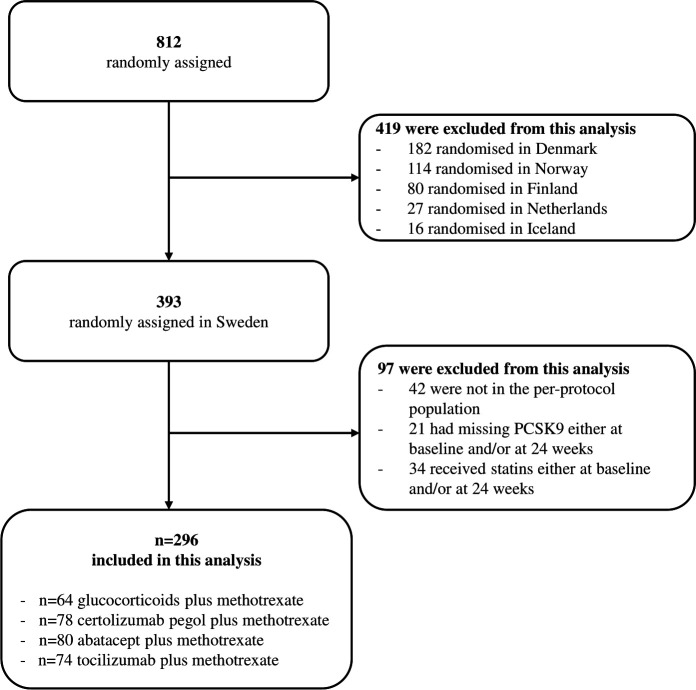
In this post hoc analysis of the NORD-STAR trial, 296 newly diagnosed patients starting methotrexate with glucocorticoids, certolizumab pegol, abatacept or tocilizumab were included. Serum PCSK9 and LDL-cholesterol levels were measured at baseline and 24 weeks. Linear regression models were used to analyse the difference in PCSK9 and LDL cholesterol between glucocorticoid and bDMARD treatments at 24 weeks. In the second analysis, the interactions between the treatment groups and autoantibody status were added to the model.
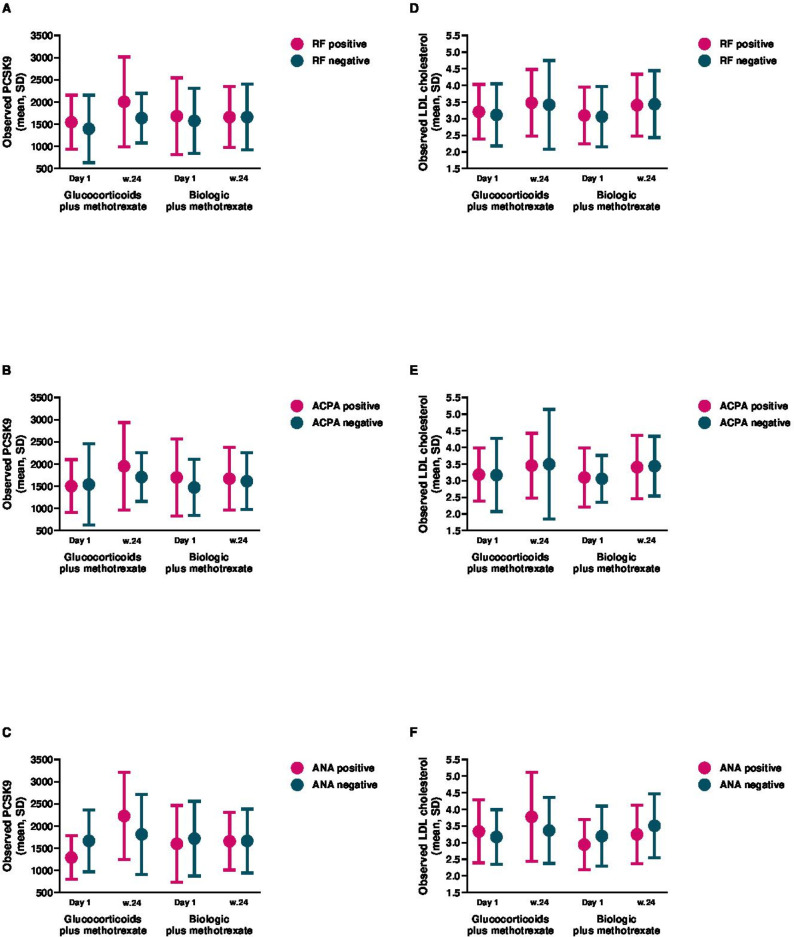
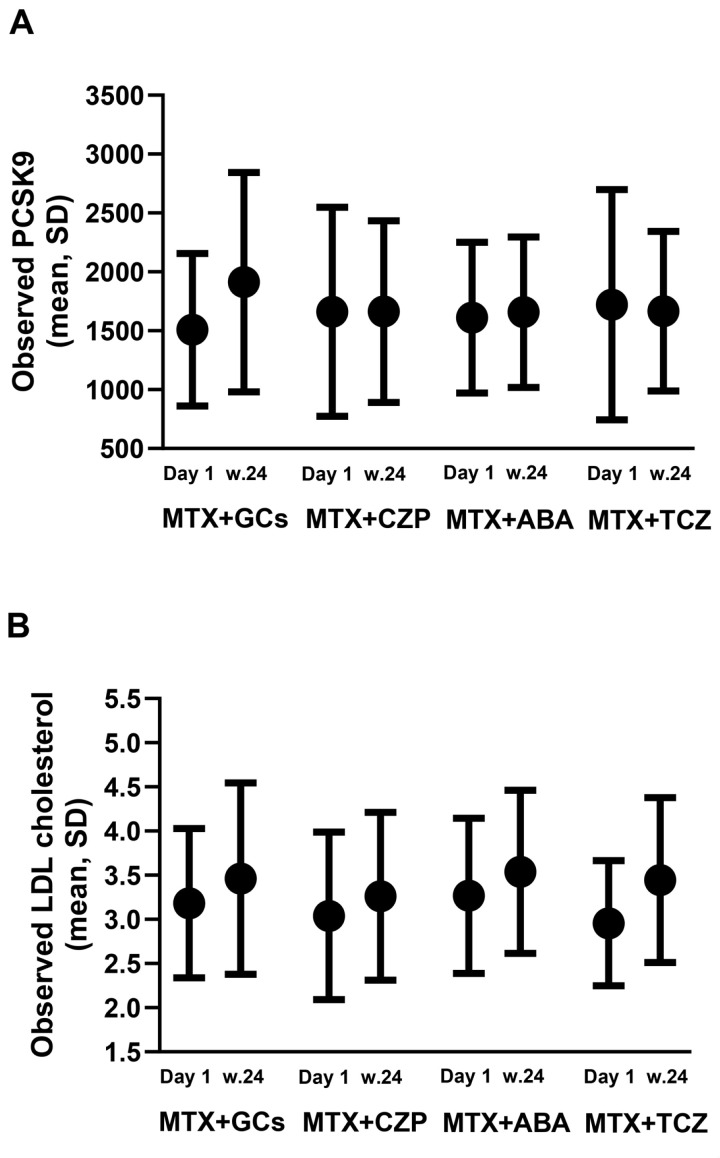
After 24 weeks, PCSK9 levels were higher in the glucocorticoid group than in the combined bDMARD treatment group (-276.0 (95% CI -468.2 to -83.9)). When compared with the bDMARD treatment, these increases were more pronounced in autoantibody-positive patients. Changes in LDL cholesterol exhibited a pattern distinct from PCSK9, as it increased in all treatments.
Glucocorticoid treatment was associated with increased PCSK9 levels after 24 weeks. When compared with the bDMARD treatments, these increases were more pronounced in rheumatoid factor, anticitrullinated protein antibody and antinuclear antibody-positive patients. Our data provide a potential mechanistic link between glucocorticoid treatment and cardiovascular disease.
Inger Bendix Foundation for Medical Research.
EudraCT2011-004720-35, NCT01491815.
类风湿关节炎会增加心血管疾病风险。前蛋白转化酶枯草溶菌素/克新9型(PCSK9)是低密度脂蛋白(LDL)代谢的调节剂,它会增加肝脏中LDL受体的分解,从而提高LDL胆固醇水平。此外,PCSK9对血栓形成和动脉粥样硬化斑块形成有直接影响。我们旨在研究(1)糖皮质激素和生物改善病情抗风湿药物(bDMARD)治疗对PCSK9和LDL胆固醇水平的影响,(2)当存在自身抗体时这种影响是否不同,以及(3)PCSK9与LDL胆固醇之间的关联。
在对NORD - STAR试验的这项事后分析中,纳入了296例开始使用甲氨蝶呤联合糖皮质激素、赛妥珠单抗聚乙二醇化、阿巴西普或托珠单抗的新诊断患者。在基线和24周时测量血清PCSK9和LDL胆固醇水平。使用线性回归模型分析24周时糖皮质激素和bDMARD治疗之间PCSK9和LDL胆固醇的差异。在第二项分析中,将治疗组与自身抗体状态之间的相互作用添加到模型中。
24周后,糖皮质激素组的PCSK9水平高于联合bDMARD治疗组(-276.0(95%CI -468.2至-83.9))。与bDMARD治疗相比,这些升高在自身抗体阳性患者中更为明显。LDL胆固醇的变化呈现出与PCSK9不同的模式,因为它在所有治疗中均升高。
24周后糖皮质激素治疗与PCSK9水平升高有关。与bDMARD治疗相比,类风湿因子、抗瓜氨酸化蛋白抗体和抗核抗体阳性患者中这些升高更为明显。我们的数据提供了糖皮质激素治疗与心血管疾病之间潜在的机制联系。
英格·本迪克斯医学研究基金会。
EudraCT2011 - 004720 - 35,NCT01491815。