Wang Ziyang, Zhang Renwei, Hu Yangming, Xing Yihui, Jiang Xiaochen, Wang Weifeng, Qiu Xueling, Tang Lu, Shi Shumei
Shandong Second Medical University, Weifang, Shandong, China.
Department of Stomatology, PLA 960th Hospital, Jinan, Shandong, China.
BMJ Open. 2025 Jun 6;15(6):e092498. doi: 10.1136/bmjopen-2024-092498.
To explore rehabilitation training adherence as well as its related influencing factors among adult patients with traumatic limb fractures to provide a basis for clinical intervention strategies.
Cross-sectional study.
Department of Rehabilitation Medicine.
Adults within 1 year postoperative for traumatic limb fractures and who underwent rehabilitation training were included in this study.
Not applicable.
Patient information was collected using a self-designed general information form. Rehabilitation training adherence was evaluated using the Exercise Adherence Rating Scale (0/64, higher values=higher adherence). Barriers to and facilitators of rehabilitation were assessed using sociodemographic data, ability to perform daily life (ADL), General Self-Efficacy Scale (GSES) and Visual Analogue Scale. Pearson's (r) and determination (R) correlation coefficients were calculated to determine the strength of associations between variables. Potential correlates were explored using multiple linear regression analysis.
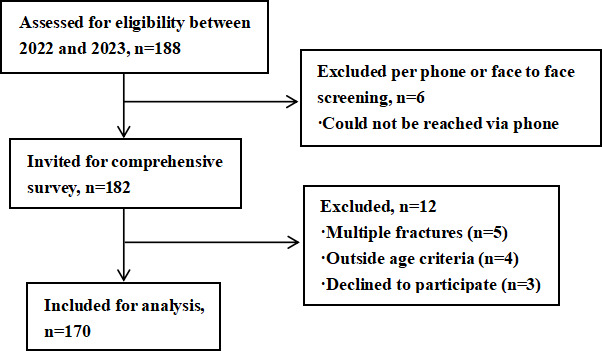
Between December 2022 and December 2023, 180 subjects were recruited. The age of the participants ranged from 18 to 93 years, with a mean age of 41.5 years (SD 15.6). The mean Exercise Adherence score was 30.31 (SD 5.8). Adherence to postoperative rehabilitation training tended to be lower in participants of older age (-1.30; 95% CI -2.14 to -0.46; p=0.003), and those who had higher pain scores on the movement (moderate pain (-3.25; 95% CI -4.56 to -1.95; p<0.001) to severe pain (-5.42; 95% CI -7.31 to -3.54; p<0.001)), less education (-2.90; 95% CI -4.17 to -1.64; p<0.001), fewer family income (-1.82; 95% CI -2.77 to -0.87; p<0.001), treated at home (-1.90; 95% CI -3.35 to -0.45; p=0.011) and with lower GSES scores (0.25; 95% CI 0.16 to 0.34; p<0.001).
Patients with limb fractures require rehabilitation but often struggle with adherence to interventions. Strategies that focus on targeted education programmes, pain management and self-efficacy improvement may be considered to guide future research and programmatic approaches to enhance adherence to rehabilitation training.
探讨成年创伤性肢体骨折患者的康复训练依从性及其相关影响因素,为临床干预策略提供依据。
横断面研究。
康复医学科。
纳入创伤性肢体骨折术后1年内且接受康复训练的成年人。
不适用。
使用自行设计的一般信息表收集患者信息。采用运动依从性评定量表(0/64,分数越高依从性越高)评估康复训练依从性。使用社会人口学数据、日常生活活动能力(ADL)、一般自我效能感量表(GSES)和视觉模拟量表评估康复的障碍因素和促进因素。计算Pearson相关系数(r)和决定系数(R)以确定变量之间关联的强度。采用多元线性回归分析探索潜在的相关因素。
在2022年12月至2023年12月期间,招募了180名受试者。参与者年龄在18至93岁之间,平均年龄为41.5岁(标准差15.6)。运动依从性平均得分为30.31(标准差5.8)。年龄较大的参与者(-1.30;95%置信区间-2.14至-0.46;p=0.003)、运动时疼痛评分较高的参与者(中度疼痛(-3.25;95%置信区间-4.56至-1.95;p<0.001)至重度疼痛(-5.42;95%置信区间-7.31至-3.54;p<0.001))、受教育程度较低者(-2.90;95%置信区间-4.17至-1.64;p<0.001)、家庭收入较少者(-1.82;95%置信区间-2.77至-0.87;p<0.001)、在家接受治疗者(-1.90;95%置信区间-3.35至-0.45;p=0.011)以及GSES得分较低者(-0.25;95%置信区间-0.34至-0.16;p<0.001)术后康复训练的依从性往往较低。
肢体骨折患者需要康复治疗,但往往难以坚持干预措施。可考虑采取侧重于针对性教育计划、疼痛管理和自我效能感提升的策略,以指导未来的研究和规划方法,提高康复训练的依从性。