Santos-Pereira Mariana, Pereira Sara C, Matos Bárbara, Fardilha Margarida, Oliveira Pedro F, Alves Marco G
Institute of Biomedicine, Department of Medical Sciences, University of Aveiro, Aveiro, 3810-193, Portugal.
School of Medicine and Biomedical Sciences (ICBAS), University of Porto, Porto, 4050-313, Portugal.
Eur J Nutr. 2025 Jun 7;64(5):212. doi: 10.1007/s00394-025-03737-3.
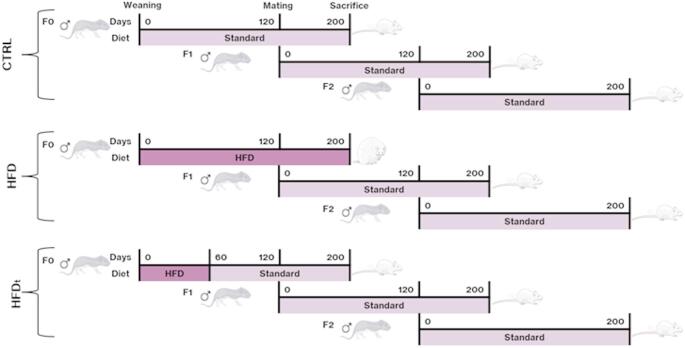
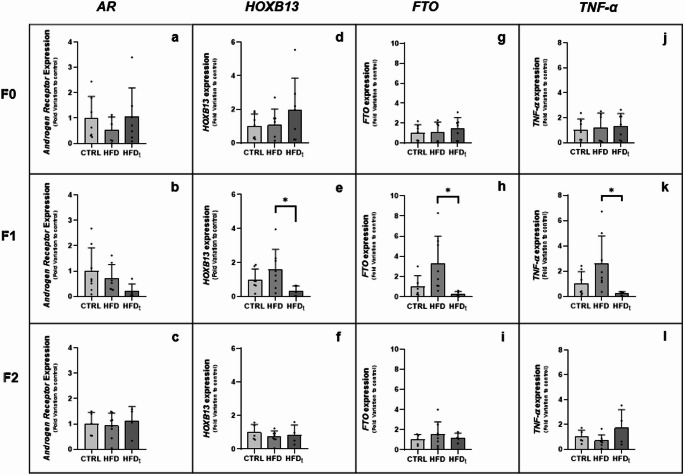
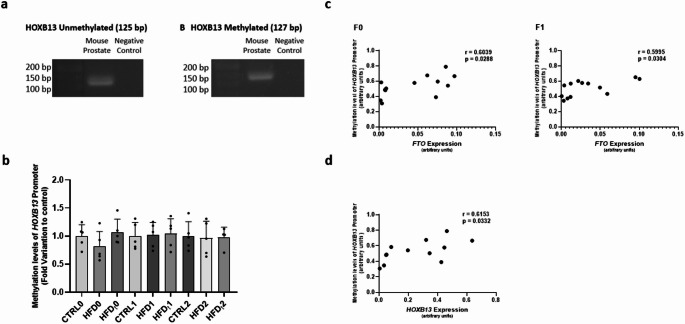
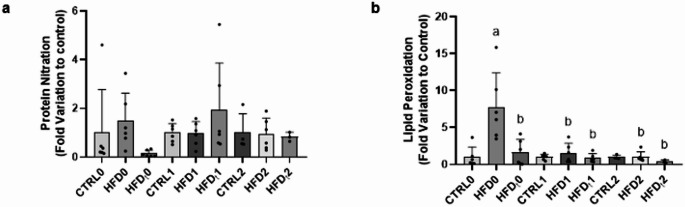
Obesity exacerbates hormonal dysregulation, inflammation, and oxidative stress, factors associated with Prostate Cancer (PCa) development. The (epi)genetic influences of obesity may be transgenerationally transmitted, potentially impacting PCa susceptibility in the offspring of fathers with obesity. Thus, we studied the impact of early-life or lifelong exposure to a high-fat diet (HFD) on PCa biomarkers [Homeobox B13 (HOXB13) and the Androgen Receptor (AR)] and their correlation with obesity-related markers. Furthermore, we focused on the offspring's PCa biomarkers outcomes and explored their potential link with paternal diet. A transgenerational Mus musculus model was established, with F0 males exposed to different diets (200 days): standard chow, lifelong HFD (HFD), and transient diet (60 days HFD, plus 140 days of standard chow) (HFD). AR expression in the prostates was unaffected, whereas HOXB13, Fat Mass and Obesity Associated gene (FTO), and Tumor Necrosis Factor-Alpha (TNF-α) expression decreased in the F1 HFD group. HOXB13 and AR prostate expression were positively correlated. There was also a positive correlation between FTO prostate expression and PCa biomarkers, and between TNF-α expression and FTO and PCa biomarkers. HOXB13 promoter methylation levels were unaffected, however, were positively correlated with FTO and HOXB13 expression. Finally, protein nitration remained unchanged in the prostates, while lipid peroxidation was increased in the F0 HFD group and decreased in the F1 and F2 HFD and HFD groups. Our study highlights the intergenerational interplay between obesity-related factors and PCa biomarkers, suggesting that offspring of male progenitors subjected to HFD may face an increased risk for elevated PCa biomarkers expression.
肥胖会加剧激素失调、炎症和氧化应激,这些都是与前列腺癌(PCa)发生相关的因素。肥胖的(表观)遗传影响可能会跨代传递,有可能影响肥胖父亲后代患PCa的易感性。因此,我们研究了早年或终生暴露于高脂饮食(HFD)对PCa生物标志物[同源盒B13(HOXB13)和雄激素受体(AR)]的影响,以及它们与肥胖相关标志物的相关性。此外,我们关注后代的PCa生物标志物结果,并探讨它们与父本饮食的潜在联系。建立了一个跨代小家鼠模型,F0雄性小鼠暴露于不同饮食(200天):标准饲料、终生HFD(HFD)和短暂饮食(60天HFD,加140天标准饲料)(HFD)。前列腺中AR的表达未受影响,而F1 HFD组中HOXB13、脂肪量与肥胖相关基因(FTO)和肿瘤坏死因子-α(TNF-α)的表达降低。HOXB13和AR在前列腺中的表达呈正相关。FTO在前列腺中的表达与PCa生物标志物之间,以及TNF-α表达与FTO和PCa生物标志物之间也存在正相关。HOXB13启动子甲基化水平未受影响,但与FTO和HOXB13表达呈正相关。最后,前列腺中的蛋白质硝化作用保持不变,而脂质过氧化在F0 HFD组中增加,在F1和F2 HFD及HFD组中降低。我们的研究突出了肥胖相关因素与PCa生物标志物之间的代际相互作用,表明接受HFD的雄性祖先后代可能面临PCa生物标志物表达升高的风险增加。