Schuler Eric, Grooten Lars, Kasireddy Mohanreddy, More Santosh, Shiju N Raveendran, Tanielyan Setrak K, Augustine Robert L, Oulego Paula, Gruter Gert-Jan M
Van 't Hoff Institute for Molecular Sciences, University of Amsterdam, Science Park 904, 1090 GD Amsterdam, The Netherlands.
Department of Chemistry and Biochemistry, Center for Applied Catalysis and Green Chemistry, Seton Hall University, South Orange, New Jersey 07079, United States.
ACS Omega. 2025 May 21;10(21):21213-21226. doi: 10.1021/acsomega.4c10268. eCollection 2025 Jun 3.
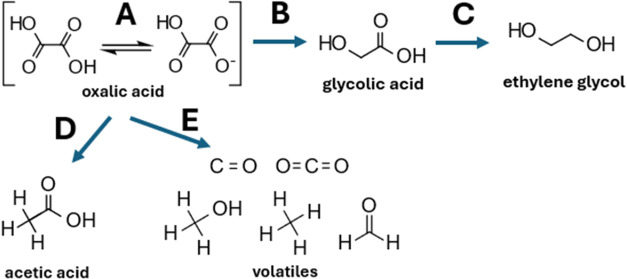
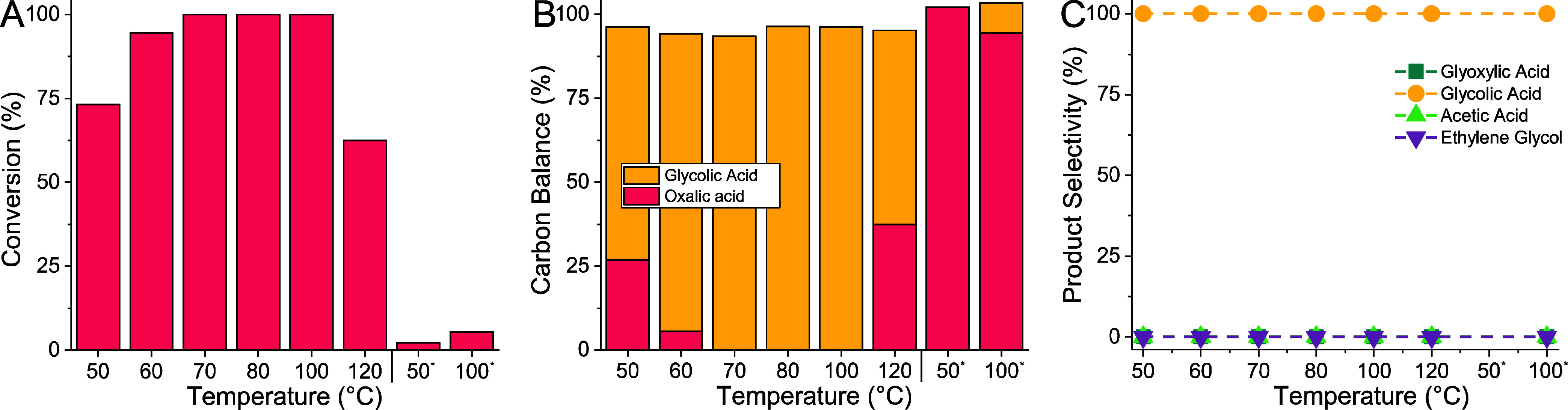
If we want to address climate change and loss of biodiversity, we need to move toward a circular economy that uses closed-loop recyclable plastics, reduces CO emissions, and replaces fossil feedstocks for chemicals and materials. Fossil-based polymers can be replaced by CO- or biobased polymers starting from monomers such as glycolic acid. Glycolic acid can be obtained from oxalic acid by the direct hydrogenation of only one of the two carboxylic acid groups with a very high selectivity up to 100%. In this work, we studied a set of improved ruthenium-tin-based two- and three-metallic catalysts. We achieved a 95% glycolic acid yield after 4 h in batch reactors (100 bar H; 75 °C), and 100% yield at 70-100 °C and 60 bar H in flow reactors, with improved selectivity toward glycolic acid consistently above 90%, acetic acid formation below 5%, and improved catalyst stability in the harsh acid environment (pH < 1). We established the ideal loading and ratio of ruthenium and tin, explored the influence of supports, and showed that avoiding the presence of chloride increases the catalyst stability. We study the electronic properties of chloride-free ruthenium-tin catalysts during the reaction and identify insufficient Ru/Sn metal reduction as the main cause of catalyst deactivation. The addition of platinum as a third metal significantly improved the catalyst stability while maintaining the high activity and selectivity reducing activity loss to only 9% over multiple uses. This work enables the efficient direct reduction of oxalic acid to glycolic acid and, consequently, the utilization of CO and biomass-derived oxalic acid as monomers for polyesters.
如果我们想要应对气候变化和生物多样性丧失问题,就需要朝着循环经济迈进,采用闭环可回收塑料,减少二氧化碳排放,并替代用于化学品和材料的化石原料。基于化石的聚合物可以被一氧化碳或生物基聚合物所取代,这些聚合物从乙醇酸等单体开始合成。乙醇酸可以通过仅对两个羧酸基团中的一个进行直接氢化,以高达100%的极高选择性从草酸中获得。在这项工作中,我们研究了一组改进的钌 - 锡基双金属和三金属催化剂。在间歇式反应器中(100巴氢气;75°C)4小时后,乙醇酸产率达到了95%,在流动反应器中,70 - 100°C和60巴氢气条件下产率达到100%,对乙醇酸的选择性持续提高,始终高于90%,乙酸生成低于5%,并且在苛刻的酸性环境(pH < 1)中催化剂稳定性得到改善。我们确定了钌和锡的理想负载量和比例,探索了载体的影响,并表明避免氯化物的存在可提高催化剂稳定性。我们研究了无氯钌 - 锡催化剂在反应过程中的电子性质,并确定钌/锡金属还原不足是催化剂失活的主要原因。添加铂作为第三种金属显著提高了催化剂稳定性,同时保持了高活性和选择性,多次使用后活性损失仅为9%。这项工作实现了将草酸高效直接还原为乙醇酸,从而能够将一氧化碳和生物质衍生的草酸用作聚酯的单体。