Narum Steven, Zhang Jiahui, Vo Binh L N, Mancuso Joseph Nicolas, Salaita Khalid
Department of Biomedical Engineering, Georgia Institute of Technology and Emory University, Atlanta, Georgia 30322, United States.
Department of Chemistry, Emory University, Atlanta, Georgia 30322, United States.
ACS Nano. 2025 Jun 24;19(24):21983-21996. doi: 10.1021/acsnano.5c00177. Epub 2025 Jun 9.
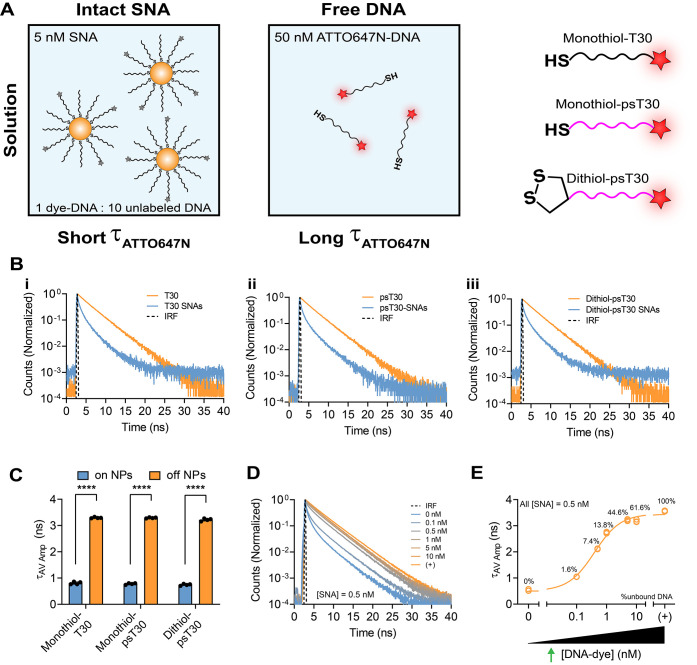
Spherical nucleic acids (SNAs) are a powerful class of nucleic acids with broad applications that span from diagnostic sensors to nanoflares and gene therapeutic agents. SNAs accomplish these varied tasks by taking advantage of the programmability of nucleic acids coupled with enhanced multivalent interactions and improved cellular delivery. Nonetheless, the intracellular trafficking of SNAs remains poorly understood, as conflicting claims in the literature suggest rapid endosomal entrapment and degradation in some cases, while others suggest SNA stability and cytoplasmic escape. One of the challenges in this area is that some of the prior literature claims rely on intensity-based fluorescence measurements, which are indirect and prone to artifacts. Here, we demonstrate the use of fluorescence lifetime imaging microscopy (FLIM) as a tool to provide additional insight into the SNA intracellular fate. We specifically employ FLIM to investigate monothiol and dithiol anchored gold nanoparticle conjugates as well as phosphorothioate backbone-modified SNAs which allow us to characterize the initial stages of SNA degradation within cells. Our work shows that internalized SNAs lose up to 20% of their nucleic acids within 24 h depending on DNase II-activity and thiol-displacement in model cell lines.
球形核酸(SNA)是一类强大的核酸,具有广泛的应用,涵盖从诊断传感器到纳米荧光探针和基因治疗剂等领域。SNA通过利用核酸的可编程性,结合增强的多价相互作用和改善的细胞递送,来完成这些多样的任务。尽管如此,SNA的细胞内运输仍知之甚少,因为文献中的相互矛盾的说法表明,在某些情况下SNA会迅速被内体捕获并降解,而另一些研究则表明SNA具有稳定性并能逃逸到细胞质中。该领域的挑战之一是,一些先前的文献说法依赖于基于强度的荧光测量,这种测量是间接的且容易产生假象。在这里,我们展示了使用荧光寿命成像显微镜(FLIM)作为一种工具,以提供对SNA细胞内命运的更多见解。我们特别使用FLIM来研究单硫醇和二硫醇锚定的金纳米颗粒缀合物以及硫代磷酸酯主链修饰的SNA,这使我们能够表征细胞内SNA降解的初始阶段。我们的研究表明,根据模型细胞系中的DNase II活性和硫醇置换情况,内化的SNA在24小时内最多会损失其20%的核酸。