Sun Qi, Xu Ling-Hao, Stocker Alan A
School of Psychology, Zhejiang Normal University, Jinhua, China.
Zhejiang Key Laboratory of Intelligent Education Technology and Application, Zhejiang Normal University, Jinhua, China.
PLoS Comput Biol. 2025 Jun 9;21(6):e1013147. doi: 10.1371/journal.pcbi.1013147. eCollection 2025 Jun.
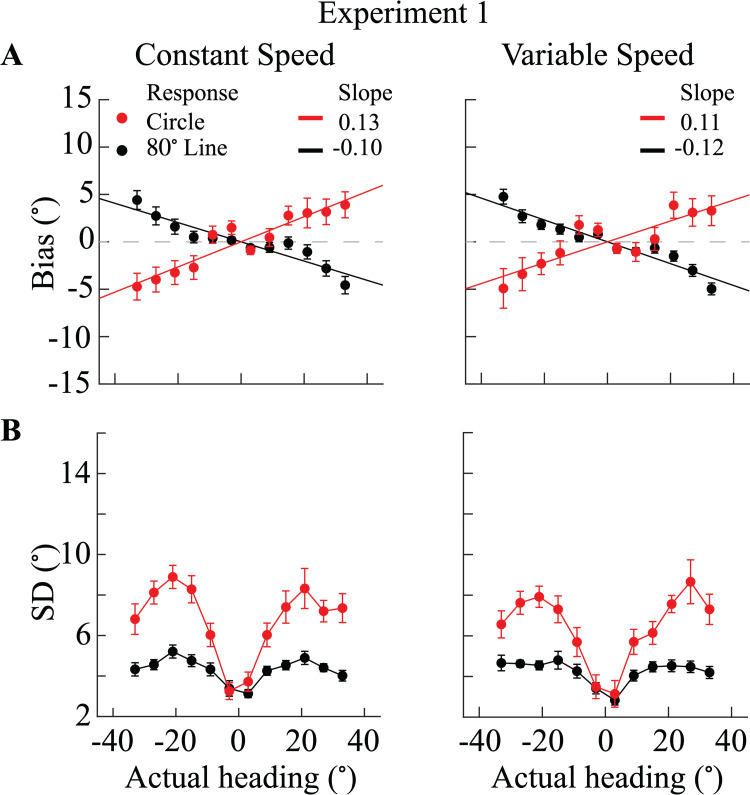
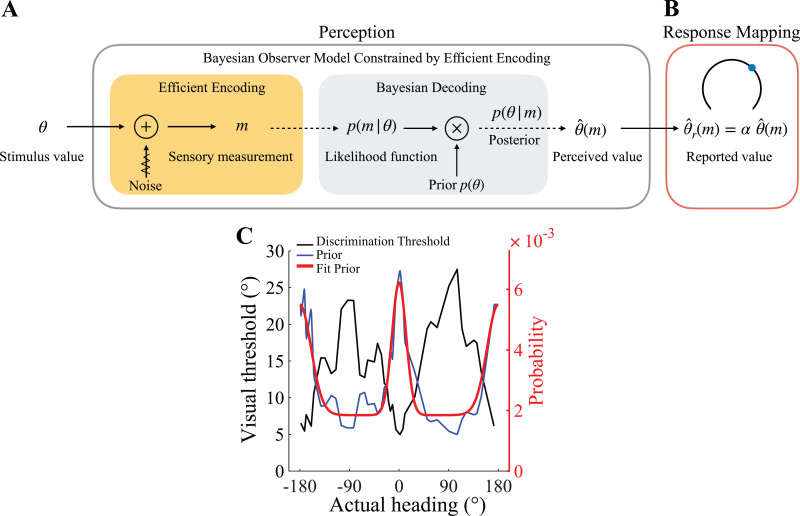
Accurate estimation of heading direction from optic flow is a crucial aspect of human spatial perception. Previous psychophysical studies have shown that humans are typically biased in their heading estimates, but the reported results are inconsistent. While some studies found that humans generally underestimate heading direction (center bias), others observed the opposite, an overestimation of heading direction (peripheral bias). We conducted three psychophysical experiments showing that these conflicting findings may not reflect inherent differences in heading perception but can be attributed to the different sizes of the response range that participants were allowed to utilize when reporting their estimates. Notably, we show that participants' heading estimates monotonically scale with the size of the response range, leading to underestimation for small and overestimation for large response ranges. Additionally, neither the speed profile of the optic flow pattern nor the response method (mouse vs. keyboard) significantly affected participants' estimates. Furthermore, we introduce a Bayesian heading estimation model that can quantitatively account for participants' heading reports. The model assumes efficient sensory encoding of heading direction according to a prior inferred from human heading discrimination data. In addition, the model assumes a response mapping that linearly scales the perceptual estimate with a scaling factor that monotonically depends on the size of the response range. This simple perception-action model accurately predicts participants' estimates both in terms of mean and variance across all experimental conditions. Our findings underscore that human heading perception follows efficient Bayesian inference; differences in participants reported estimates can be parsimoniously explained as differences in mapping percept to probe response.
从光流中准确估计航向方向是人类空间感知的一个关键方面。以往的心理物理学研究表明,人类在航向估计中通常存在偏差,但报告的结果并不一致。虽然一些研究发现人类通常低估航向方向(中心偏差),但其他研究则观察到相反的情况,即高估航向方向(周边偏差)。我们进行了三项心理物理学实验,结果表明,这些相互矛盾的发现可能并不反映航向感知的内在差异,而是可以归因于参与者在报告估计值时被允许使用的不同响应范围大小。值得注意的是,我们表明参与者的航向估计与响应范围的大小呈单调比例关系,导致在小响应范围内低估,在大响应范围内高估。此外,光流模式的速度分布和响应方法(鼠标与键盘)均未对参与者的估计产生显著影响。此外,我们引入了一个贝叶斯航向估计模型,该模型可以定量地解释参与者的航向报告。该模型假设根据从人类航向辨别数据推断出的先验信息,对航向方向进行有效的感官编码。此外,该模型假设存在一种响应映射,该映射使用一个与响应范围大小单调相关的缩放因子对感知估计进行线性缩放。这个简单的感知 - 行动模型在所有实验条件下,无论是均值还是方差方面,都能准确预测参与者的估计值。我们的研究结果强调,人类的航向感知遵循有效的贝叶斯推理;参与者报告估计值的差异可以简单地解释为感知与探测响应映射的差异。