Chu C Y Cyrus, Lin Chang-Ching, Lu Shih-Ting, Kao Ching-Yuan
Institute of Economics, Academia Sinica, Taipei City 115024, Taiwan.
Department of Economics, National Cheng Kung University, Tainan City 701410, Taiwan.
Proc Natl Acad Sci U S A. 2025 Jun 17;122(24):e2426838122. doi: 10.1073/pnas.2426838122. Epub 2025 Jun 11.
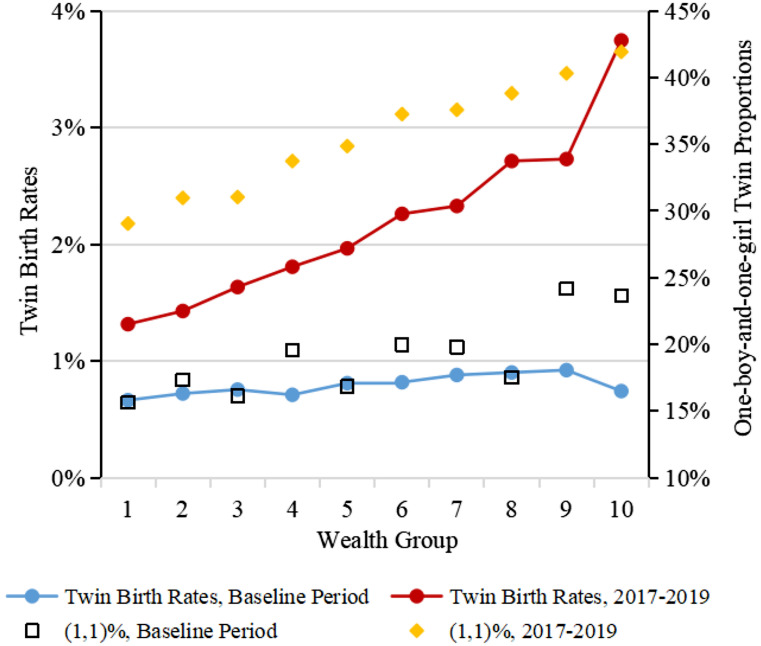
In vitro fertilization (IVF) affects human fertility by 1) increasing the probability of multiple births through the transfer of multiple embryos, 2) raising the proportion of dizygotic twins, which leads to a higher occurrence of one-boy-one-girl twins, and 3) enabling gender selection through preimplantation genetic screening (PGS) when parents have specific gender preferences. While the above-mentioned increase in multiple births is well documented, the impact on the twins' gender composition remains under-explored, partly because 2) and 3) are intertwined. This study uses millions of administrative observations from Taiwan to disentangle the effects of IVF on twin birth rates, gender composition, and parental preferences. Families are grouped by maternal age and family wealth across different periods, enabling a comparative analysis of socioeconomic and temporal factors. By examining the gender composition of first-born twins within these age-wealth-time groups, we can identify and test whether parents have gender preferences for one-boy-one-girl twins. Our empirical evidence reveals a significant increase in IVF adoption, particularly among older and wealthier mothers. The proportion of one-boy-one-girl twins among first-birth twins has risen from 20.42 to 41.86% over the past 30 y, and this proportion increases with wealth ranking, significantly exceeding expected ratios in the absence of gender preference. Parental gender preference contributed to approximately 10.95% of one-boy-one-girl twins among the wealthiest group, revealing a significant impact of parental preference on twin gender composition. These trends raise ethical and social concerns regarding reproductive technologies.
体外受精(IVF)对人类生育能力的影响体现在以下几个方面:1)通过移植多个胚胎增加多胞胎出生的概率;2)提高异卵双胞胎的比例,这导致一男一女双胞胎的出现频率更高;3)当父母有特定的性别偏好时,可通过植入前基因筛查(PGS)实现性别选择。虽然上述多胞胎出生增加的情况有充分记录,但对双胞胎性别构成的影响仍未得到充分研究,部分原因是2)和3)相互交织。本研究利用台湾数百万条行政观察数据,来厘清体外受精对双胞胎出生率、性别构成及父母偏好的影响。家庭按不同时期的母亲年龄和家庭财富进行分组,从而能够对社会经济和时间因素进行比较分析。通过考察这些年龄-财富-时间组内头胎双胞胎的性别构成,我们可以识别并检验父母是否对一男一女双胞胎有性别偏好。我们的实证证据显示体外受精的采用率显著增加,尤其是在年龄较大和较富裕的母亲中。在过去30年里,头胎双胞胎中一男一女双胞胎的比例从20.42%升至41.86%,且这一比例随财富排名上升,显著超过无性别偏好时的预期比例。在最富裕的群体中,父母的性别偏好导致了约10.95%的一男一女双胞胎出生,这表明父母偏好对双胞胎性别构成有显著影响。这些趋势引发了关于生殖技术的伦理和社会问题。