Haro Gutiérrez Pilar A, Colombi Samuele, Casanovas Jordi, Resina Leonor, Sans Jordi, Engel Elisabeth, Enshaei Hamidreza, García-Torres José, Pérez-Madrigal Maria M, Alemán Carlos
IMEM-BRT Group, Departament d'Enginyeria Química, EEBE, Universitat Politècnica de Catalunya, C/Eduard Maristany 10-14, Ed. I2, Barcelona 08019, Spain.
Departament de Química, Física i Ciències Ambientals i del Sòl, Escola Politècnica Superior, Universitat de Lleida, c/Jaume II no. 69, Lleida E-25001, Spain.
ACS Polym Au. 2025 Mar 25;5(3):247-260. doi: 10.1021/acspolymersau.4c00097. eCollection 2025 Jun 11.
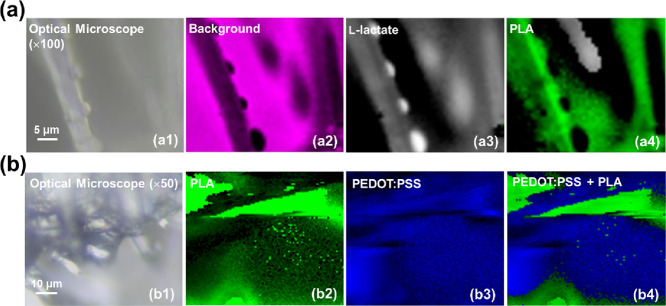
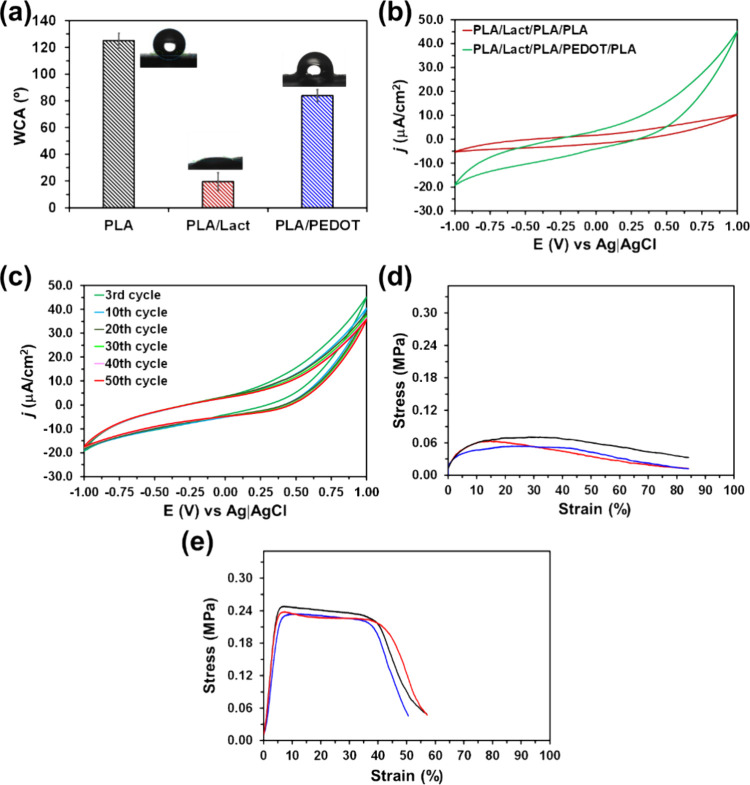
Recent studies have revealed that cardiac tissue regeneration is promoted by administering an initial dose of exogenous lactate and locally maintaining an abundant concentration of this compound for a prolonged period (i.e., around 10-14 days) through sustained release. The aim of this study is to develop a scaffold based on poly-(lactic acid) (PLA) for achieving a sustained daily release of lactate from the first day to the end of the recommended period. First, a five-layered electroresponsive scaffold has been engineered using three PLA layers (first, third, and fifth), each composed of electrospun microfibers (MFs), separated by spin coated lactate (second) and poly-(3,4-ethylenedioxythiophene):poly-(styrenesulfonate) (PEDOT:PSS) (fourth) intermediate layers. The hydrophobicity of the outer PLA layers (first and fifth) has been used to maintain the release of lactate from the intermediate second layer over 3 days, while the conducting fourth PEDOT:PSS layer has ensured a complete lactate release by electrostimulation. After that, in a second step, the same scaffold has been re-engineered to maintain the sustained release not only for a short period (3 days) but also for a prolonged period (>10 days). For this purpose, the PLA MFs of the intermediate third layer have been substituted by plasma-treated proteinase K-containing PLA MFs, obtained by electrospinning a PLA:enzyme mixture. The activity of the enzyme, which decomposes the ester bonds of PLA, combined with the effect of the plasma on the PLA structure, results in a prolonged sustained release that, in addition, can be modulated.
最近的研究表明,通过给予初始剂量的外源性乳酸,并通过持续释放使其在较长时间内(即大约10 - 14天)局部维持高浓度的该化合物,可促进心脏组织再生。本研究的目的是开发一种基于聚乳酸(PLA)的支架,以实现从第一天到推荐周期结束时乳酸的持续每日释放。首先,设计了一种五层电响应支架,使用三层PLA层(第一层、第三层和第五层),每层由电纺微纤维(MFs)组成,中间由旋涂的乳酸(第二层)和聚(3,4 - 乙撑二氧噻吩):聚(苯乙烯磺酸盐)(PEDOT:PSS)(第四层)中间层隔开。外层PLA层(第一层和第五层)的疏水性用于维持乳酸从中间第二层的释放达3天,而导电的第四层PEDOT:PSS层通过电刺激确保乳酸完全释放。之后,在第二步中,对同一支架进行了重新设计,使其不仅能在短时间(3天)内而且能在较长时间(>10天)内维持持续释放。为此,中间第三层的PLA微纤维已被经等离子体处理的含蛋白酶K的PLA微纤维替代,该微纤维通过静电纺丝PLA:酶混合物获得。分解PLA酯键的酶的活性,与等离子体对PLA结构的作用相结合,导致了延长的持续释放,此外,这种释放还可以被调节。