Yu Erlan, Chu Xuehong, Zhang Wanwan, Meng Xiangbin, Yang Yaodong, Ji Xunming, Wu Chuanjie
Department of Neurology, Xuanwu Hospital, Capital Medical University, Beijing, China.
Pengcheng Laboratory, Shenzhen 518055, P. R. China.
Int J Med Sci. 2025 May 31;22(11):2792-2801. doi: 10.7150/ijms.111780. eCollection 2025.
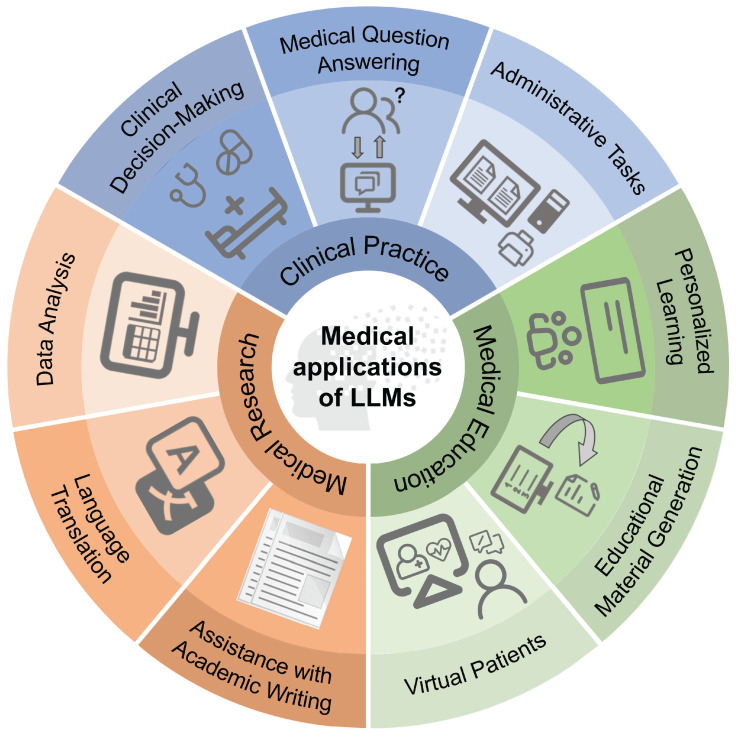
In recent years, large language models (LLMs) represented by GPT-4 have developed rapidly and performed well in various natural language processing tasks, showing great potential and transformative impact. The medical field, due to its vast data information as well as complex diagnostic and treatment processes, is undoubtedly one of the most promising areas for the application of LLMs. At present, LLMs has been gradually implemented in clinical practice, medical research, and medical education. However, in practical applications, medical LLMs still face numerous challenges, including the phenomenon of hallucination, interpretability, and ethical concerns. Therefore, in-depth exploration is still needed in areas of standardized evaluation frameworks, multimodal LLMs, and multidisciplinary collaboration in the future, so as to realize the widespread application of medical LLMs and promote the development and transformation in the field of global healthcare. This review offers a comprehensive overview of applications, challenges, and future directions of LLMs in medicine, providing new insights for the sustained development of medical LLMs.
近年来,以GPT-4为代表的大语言模型(LLMs)发展迅速,在各种自然语言处理任务中表现出色,展现出巨大的潜力和变革性影响。医学领域由于其海量的数据信息以及复杂的诊疗过程,无疑是大语言模型应用最具前景的领域之一。目前,大语言模型已逐渐在临床实践、医学研究和医学教育中得到应用。然而,在实际应用中,医学大语言模型仍面临诸多挑战,包括幻觉现象、可解释性和伦理问题。因此,未来在标准化评估框架、多模态大语言模型和多学科协作等领域仍需深入探索,以实现医学大语言模型的广泛应用,推动全球医疗保健领域的发展与变革。本综述全面概述了大语言模型在医学中的应用、挑战和未来方向,为医学大语言模型的持续发展提供了新的见解。