Shah Shalin, Chaitanya Ganne, Chin Jeston, Delcimmuto Nicholas, Gavvala Jay R
McGovern Medical School, University of Texas Health Science Center, Houston, Texas, USA.
Texas Institute for Restorative Neurotechnologies, Department of Neurology, University of Texas Health Science Center, Houston, Texas, USA.
Ann Clin Transl Neurol. 2025 Aug;12(8):1711-1716. doi: 10.1002/acn3.70109. Epub 2025 Jun 17.
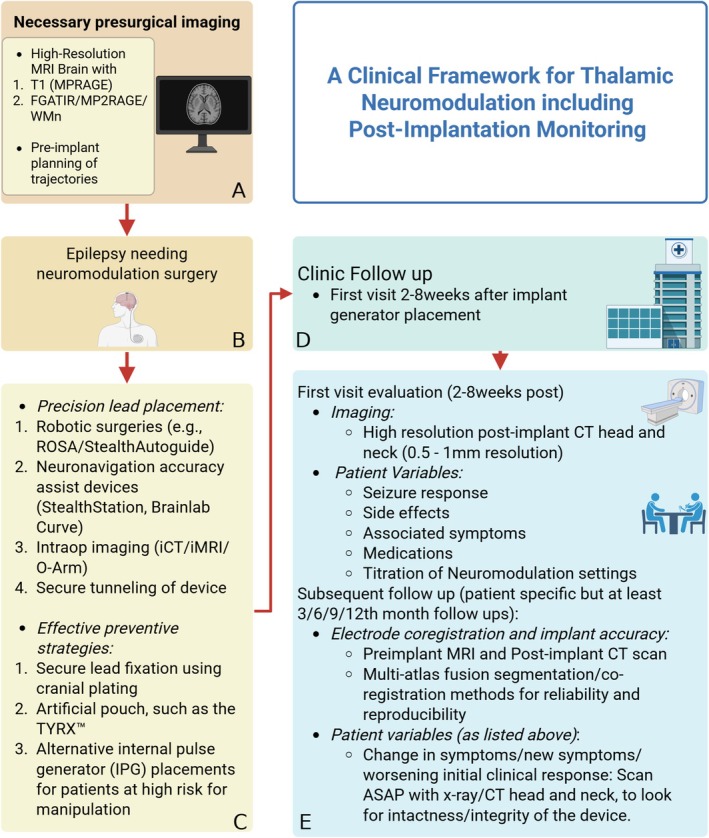
This case described a 25-year-old pregnant woman with refractory multifocal epilepsy, diagnosed in 2020 and treated with bilateral thalamic deep brain stimulation (DBS) targeting the centromedian and pulvinar nuclei. Prior to DBS, she experienced daily focal seizures, often progressing to generalized tonic-clonic seizures despite optimal medication. Presurgical evaluations revealed multifocal epilepsy with right hemispheric involvement and diffuse band heterotopia. Given the extensive neurophysiological and radiographic findings, DBS was chosen over resective surgery. Following implantation in December 2023, initial stimulation settings resulted in some seizure control but also development of new symptoms, including shock-like sensations down her neck. After 43 seizure-free days, she experienced a prolonged seizure in April 2024, prompting further investigation. Imaging revealed migration of the right pulvinar electrode, which was identified as the likely cause. This resultant displacement, called the "Twiddler's Syndrome," is a phenomenon where device manipulation causes malfunction or dislodgment. This resulted from the patient's habit of massaging her neck. After adjusting DBS settings and turning off right pulvinar stimulation, her symptoms resolved, and she remained seizure-free for two months. This case emphasizes the need for careful postimplantation monitoring, imaging, and awareness of hardware-related issues like Twiddler's Syndrome, highlighting the importance of well-planned surgical strategies to optimize outcomes in neuromodulation therapies.
该病例描述了一名25岁的难治性多灶性癫痫孕妇,于2020年确诊,接受了针对中央中核和丘脑枕核的双侧丘脑深部脑刺激(DBS)治疗。在进行DBS治疗之前,她每天都有局灶性癫痫发作,尽管使用了最佳药物治疗,但仍经常进展为全身强直阵挛性发作。术前评估显示为右半球受累的多灶性癫痫和弥漫性带状异位。鉴于广泛的神经生理学和影像学检查结果,选择了DBS而非切除性手术。2023年12月植入后,初始刺激设置在一定程度上控制了癫痫发作,但也出现了新的症状,包括颈部有电击样感觉。在43天无癫痫发作后,她于2024年4月经历了一次长时间的癫痫发作,促使进一步检查。影像学检查显示右丘脑枕电极移位,这被确定为可能的原因。这种由此产生的移位,称为“Twiddler综合征”,是一种设备操作导致故障或移位的现象。这是由患者按摩颈部的习惯引起的。调整DBS设置并关闭右丘脑枕刺激后,她的症状得到缓解,并且连续两个月无癫痫发作。该病例强调了植入后进行仔细监测、影像学检查以及了解如Twiddler综合征等与硬件相关问题的必要性,突出了精心规划手术策略以优化神经调节治疗效果的重要性。