Zhu Tieshi, He Yong, Bei Erxinxian
Department of Neurology, Zhanjiang Central Hospital, Guangdong Medical University, Zhanjiang, China.
Department of Neurology, Liuyang Jili Hospital, Changsha, China.
Front Neurol. 2025 Jun 2;16:1577077. doi: 10.3389/fneur.2025.1577077. eCollection 2025.
The Uric Acid-to-HDL Ratio (UHR), a novel index derived from serum uric acid and high-density lipoprotein, has been linked to hypertension and poor diabetes control. It has also been shown to predict ischemic heart disease and is strongly associated with collateral circulation and coronary artery flow reserve. However, fewer studies have focused on the relationship between UHR and stroke, highlighting the need for further research in this area.
The study included 33,192 individuals from the NHANES 1999-2023, of whom 1,363 had a history of stroke. The nonlinear relationship between UHR and stroke risk was assessed using restricted cubic spline (RCS) analysis, and the robustness of the findings was further tested through stratified analysis. Logistic regression was employed to analyze the relationship between UHR and stroke risk, considering both UHR as a continuous variable and its categorization into quartiles (Q1-Q4).
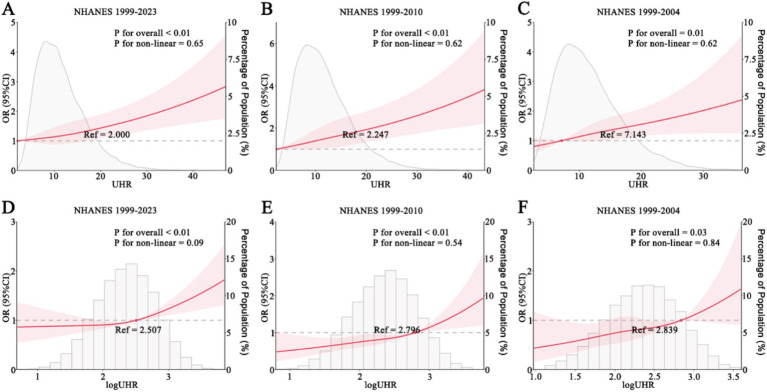
UHR was not nonlinearly associated with stroke ( for overall <0.01; for nonlinearity = 0.65), and the RCS graph approximated a straight line with a positive slope. UHR was significantly associated with an increased risk of stroke, both when analyzed as a continuous variable (Model 4: OR = 1.02, 95% CI 1.01-1.03, < 0.01) and when categorized into quartiles (Q4, OR = 1.31, 95% CI 1.11-1.55, < 0.01).
There was a significant positive correlation between UHR and stroke risk.
尿酸与高密度脂蛋白比值(UHR)是一种从血清尿酸和高密度脂蛋白得出的新指标,与高血压及糖尿病控制不佳有关。它还被证明可预测缺血性心脏病,且与侧支循环和冠状动脉血流储备密切相关。然而,较少有研究关注UHR与中风之间的关系,凸显了该领域进一步研究的必要性。
该研究纳入了1999 - 2023年美国国家健康与营养检查调查(NHANES)中的33192人,其中1363人有中风病史。使用受限立方样条(RCS)分析评估UHR与中风风险之间的非线性关系,并通过分层分析进一步检验研究结果的稳健性。采用逻辑回归分析UHR与中风风险之间的关系,将UHR视为连续变量及其分为四分位数(Q1 - Q4)进行分析。
UHR与中风不存在非线性关联(总体P<0.01;非线性P = 0.65),RCS图近似一条斜率为正的直线。UHR与中风风险增加显著相关,无论是作为连续变量分析(模型4:OR = 1.02,95%CI 1.01 - 1.03,P<0.01)还是分为四分位数时(Q4,OR = 1.31,95%CI 1.11 - 1.55,P<0.01)。
UHR与中风风险之间存在显著正相关。