Yan Minghui, Luo Ying, Hou Yanling, Wang Zhiying, Yang Qiguang
Rehabilitation Department, Changchun Hospital of Chinese Medicine, Changchun, China.
Psychological Sixth Therapeutic Area, Changchun Sixth Hospital, Changchun, China.
Front Neurol. 2025 Jun 2;16:1575879. doi: 10.3389/fneur.2025.1575879. eCollection 2025.
Upper limb motor dysfunction is a common sequela of stroke, which adversely affects patients' quality of life and ability of daily living. Although acupuncture and repeated transcranial magnetic stimulation (rTMS) can improve this symptom, it is uncertain whether the combined application of the two treatments can enhance the therapeutic effect.
Through systematic review and meta-analysis, this study discusses the improvement effect of acupuncture combined with rTMS on upper limb motor dysfunction after stroke.
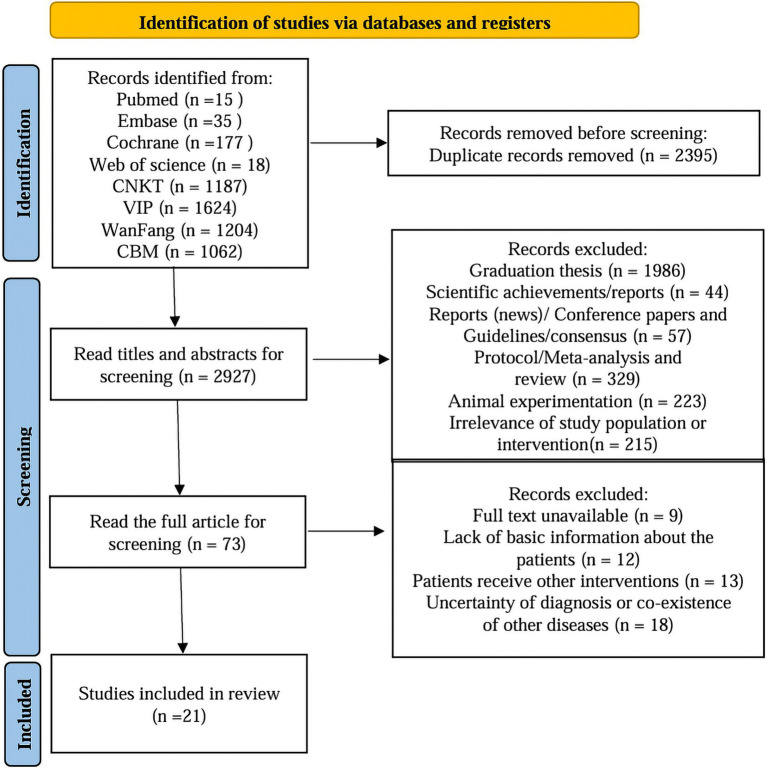
We searched PubMed, Cochrane Library, Embase, Web of Science, China National Knowledge Infrastructure (CNKI), Chinese Scientific Journals Database (VIP), Wanfang Database, and Chinese Biomedical Literature Service (CBM) for randomized controlled trials of acupuncture combined with rTMS for the treatment of upper limb motor dysfunction after stroke, and performed a screening process according to the inclusion and exclusion criteria. The data were screened, extracted, and analyzed using RevMan (version 5.4) software for Meta-analysis.
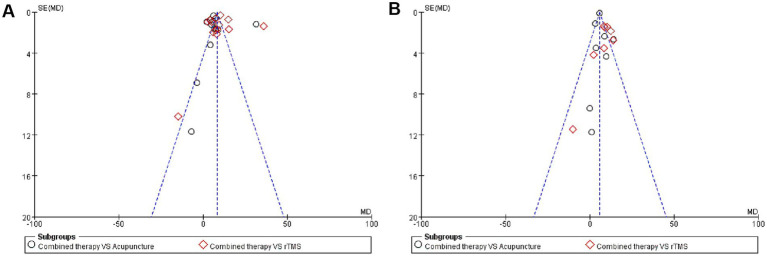
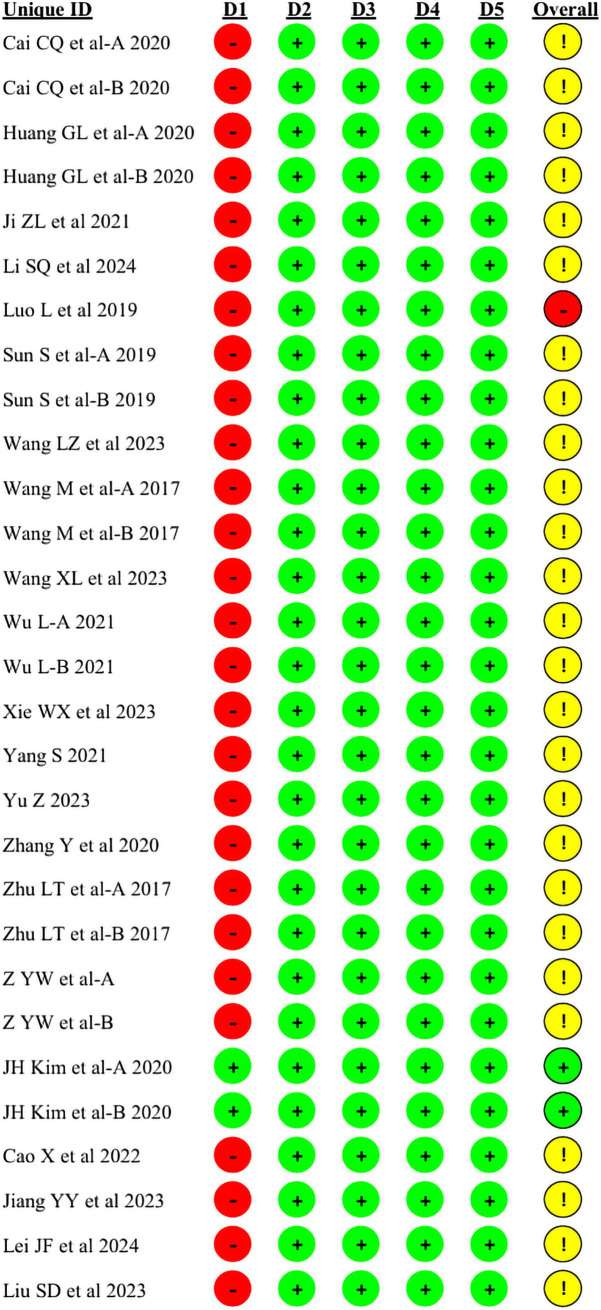
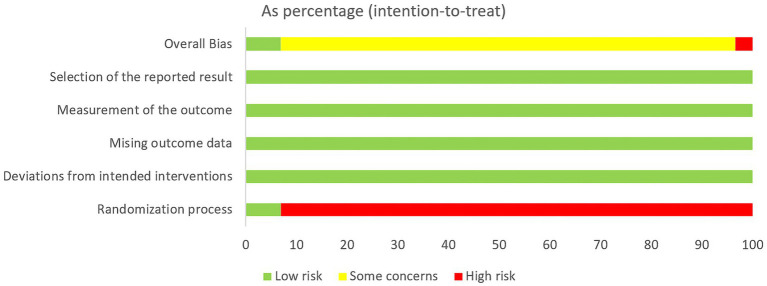
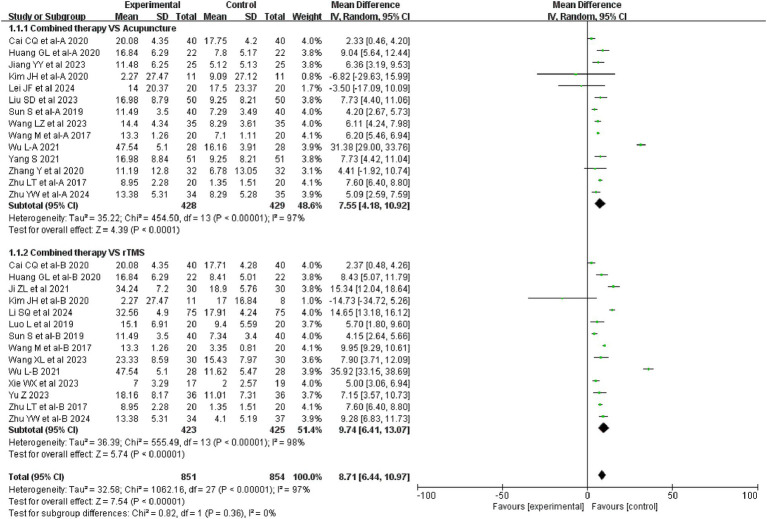
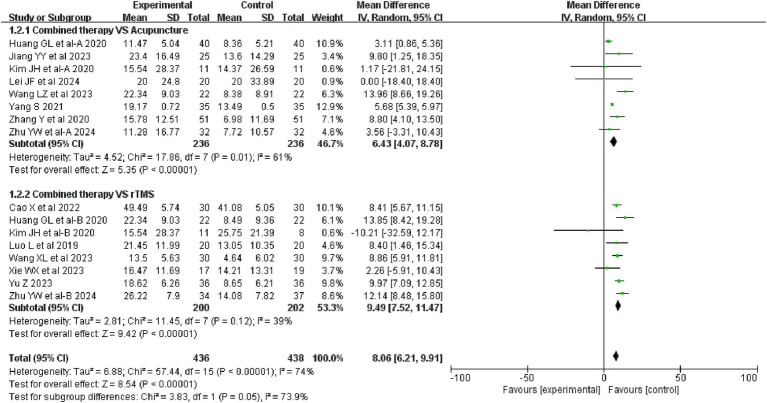
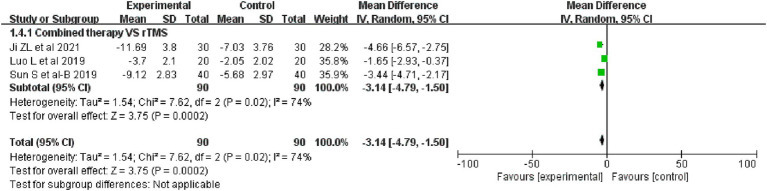
A total of 21 papers involving 1,550 patients were included. The results of the Meta-analysis showed that the combination therapy was superior to acupuncture alone and rTMS alone in improving FMA-UE (acupuncture: MD = 7.55, 95%CI: 4.18 ~ 10.92, I = 97%, < 0.00001; rTMS: MD = 9.74, 95%CI: 6.41 ~ 13.07, I = 98%, p < 0.00001); combination therapy was superior to acupuncture alone and rTMS alone in improving MBI (acupuncture: MD = 6.43, 95%CI: 4.07 ~ 8.78, I = 61%, = 0.01; rTMS: MD = 9.49, 95%CI: 7.52 ~ 11.47, I = 39%, = 0.12); combination therapy was more effective in improving MAS compared to acupuncture (MD = -0.55, 95% CI: -0.69 to -0.41, I = 0%, = 0.61); combination therapy was more effective in improving NIHSS compared to rTMS (MD = -3. 14, 95%CI: -4.79 to -1.5, I = 74%, = 0.02).
Acupuncture combined with rTMS is more effective than acupuncture or rTMS intervention alone in improving upper extremity motor function and daily living ability and improving neurological damage after stroke.
上肢运动功能障碍是中风常见的后遗症,对患者的生活质量和日常生活能力产生不利影响。虽然针灸和重复经颅磁刺激(rTMS)可以改善这种症状,但两种治疗方法联合应用是否能增强治疗效果尚不确定。
通过系统评价和Meta分析,探讨针灸联合rTMS对中风后上肢运动功能障碍的改善效果。
我们检索了PubMed、Cochrane图书馆、Embase、Web of Science、中国知网(CNKI)、维普中文科技期刊数据库(VIP)、万方数据库和中国生物医学文献服务系统(CBM),查找针灸联合rTMS治疗中风后上肢运动功能障碍的随机对照试验,并根据纳入和排除标准进行筛选。使用RevMan(5.4版)软件对数据进行筛选、提取和Meta分析。
共纳入21篇文献,涉及1550例患者。Meta分析结果显示,联合治疗在改善上肢Fugl-Meyer评估量表(FMA-UE)方面优于单纯针灸和单纯rTMS(针灸:MD = 7.55,95%CI:4.18~10.92,I² = 97%,P < 0.00001;rTMS:MD = 9.74,95%CI:6.41~13.07,I² = 98%,P < 0.00001);联合治疗在改善改良Barthel指数(MBI)方面优于单纯针灸和单纯rTMS(针灸:MD = 6.43,95%CI:4.07~8.78,I² = 61%,P = 0.01;rTMS:MD = 9.49,95%CI:7.52~11.47,I² = 39%,P = 0.12);联合治疗在改善肌肉活动评分量表(MAS)方面比针灸更有效(MD = -0.55,95%CI:-0.69至-0.41,I² = 0%,P = 0.61);联合治疗在改善美国国立卫生研究院卒中量表(NIHSS)方面比rTMS更有效(MD = -3.14,95%CI:-4.79至-1.5,I² = 74%,P = 0.02)。
针灸联合rTMS在改善中风后上肢运动功能、日常生活能力及改善神经损伤方面比单纯针灸或rTMS干预更有效。