Yim Seung Hyuk, Kim Deok-Gie, Kang Minyu, Koh Hwa-Hee, Choi Mun Chae, Min Eun-Ki, Lee Jae Geun, Kim Myoung Soo, Joo Dong Jin
Department of Surgery, Yongin Severance Hospital, Yonsei University College of Medicine, Gyeonggi-do, South Korea.
Department of Surgery, Research Institute for Transplantation, Yonsei University College of Medicine, Seoul, South Korea.
Hepatobiliary Surg Nutr. 2025 Jun 1;14(3):360-373. doi: 10.21037/hbsn-24-58. Epub 2024 Aug 2.
ABO-incompatible (ABOi) living-donor liver transplantation (LDLT) is increasingly considered for patients with end-stage liver disease or hepatocellular carcinoma, in regions facing severe organ shortage. However, its applicability for patients with high Model for End-stage Liver Disease (MELD) scores remains uncertain. We aimed to investigate the survival benefit of ABOi-LDLT in high MELD patients using intention-to-treat (ITT) analysis in retrospective cohort study.
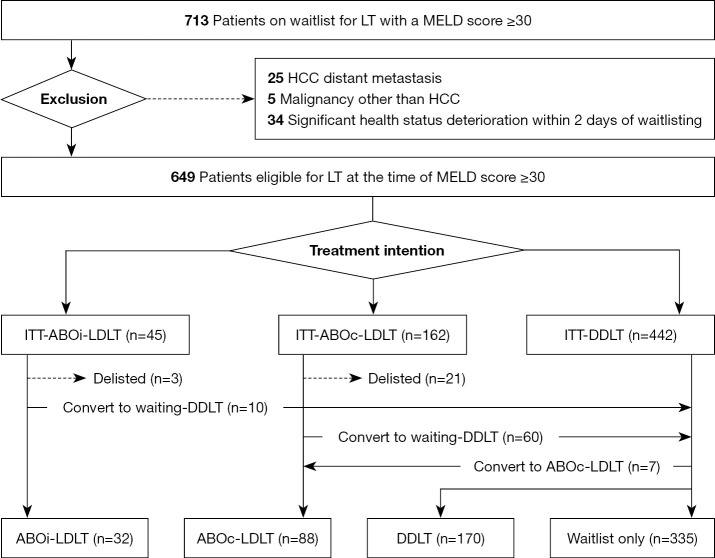
In a single-center study, 649 patients on a liver transplantation (LT) waitlist were divided into three groups: ITT-ABOi-LDLT (n=45), ITT-ABO-compatible (ABOc)-LDLT (n=162), and ITT-deceased-donor LT (DDLT) (n=442).
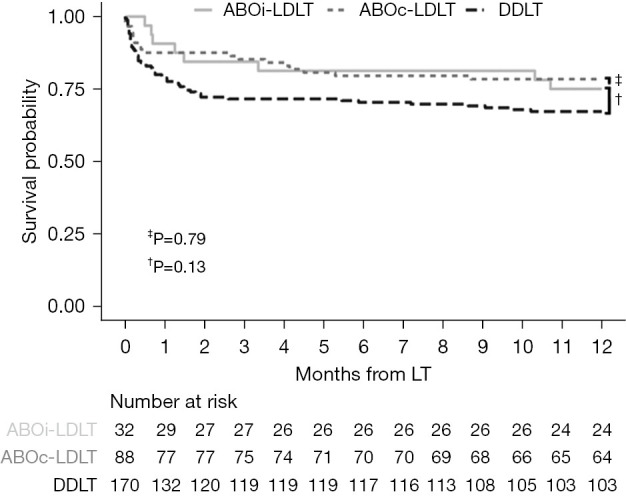
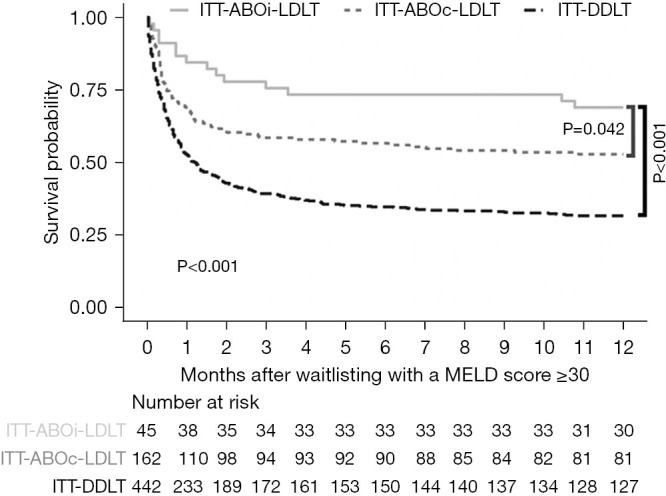
The ITT-ABOi-LDLT group had a median initial isoagglutinin-titer of 1:128 and 71.1% underwent ABOi-LDLT after desensitization. This group showed a higher survival rate compared to ITT-DDLT (66.7% 28.7%, P<0.001), and ABOi-LDLT intention was linked to significantly lower mortality (hazard ratio, 0.32; P<0.001). Survival among LT recipients was similar across ABOi-LDLT, DDLT, and ABOc-LDLT (P=0.13), but ABOi-LDLT recipients had higher biliary stricture rates compared to DDLT (25% 10%, P=0.04). Donor postoperative outcomes were comparable between ABOi- and ABOc-LDLT. Higher initial isoagglutinin-titers in ABOi-LDLT recipients were associated with increased in-hospital mortality and graft loss but not with antibody-mediated rejection or isoagglutinin-titer rebound.
ABOi-LDLT offers a viable option for high MELD score patients, improving survival compared to DDLT and yielding similar posttransplant outcomes to DDLT and ABOc-LDLT in severe organ shortage region.
在面临严重器官短缺的地区,对于终末期肝病或肝细胞癌患者,越来越多地考虑进行ABO血型不相容(ABOi)活体供肝移植(LDLT)。然而,其在终末期肝病模型(MELD)评分高的患者中的适用性仍不确定。我们旨在通过回顾性队列研究中的意向性分析(ITT)来调查ABOi-LDLT在高MELD评分患者中的生存获益。
在一项单中心研究中,649名等待肝移植(LT)的患者被分为三组:ITT-ABOi-LDLT组(n = 45)、ITT-ABO相容(ABOc)-LDLT组(n = 162)和ITT- deceased-donor LT(DDLT)组(n = 442)。
ITT-ABOi-LDLT组的初始同种凝集素滴度中位数为1:128,71.1%的患者在脱敏后接受了ABOi-LDLT。与ITT-DDLT组相比,该组显示出更高的生存率(66.7%对28.7%,P < 0.001),并且ABOi-LDLT意向与显著更低的死亡率相关(风险比,0.32;P < 0.001)。LT受者在ABOi-LDLT、DDLT和ABOc-LDLT组中的生存率相似(P = 0.13),但与DDLT组相比,ABOi-LDLT受者的胆道狭窄发生率更高(25%对10%,P = 0.04)。ABOi-LDLT和ABOc-LDLT组供者的术后结局相当。ABOi-LDLT受者较高的初始同种凝集素滴度与住院死亡率增加和移植物丢失相关,但与抗体介导的排斥反应或同种凝集素滴度反弹无关。
在严重器官短缺地区,ABOi-LDLT为高MELD评分患者提供了一种可行的选择,与DDLT相比可提高生存率,并且移植后结局与DDLT和ABOc-LDLT相似。