Cater Jordan H, El Salamouni Nehad S, Mansour Ghada H, Hutchinson Sebastian, Mc Guinness Conall, Mueller Stefan H, Spinks Richard R, Shanmugam Nirukshan, Pichard-Kostuch Adeline, Zahoransky Viktor, Ghodke Harshad, Ribezzi-Crivellari Marco, Yu Haibo, van Oijen Antoine M, Griffiths Andrew D, Spenkelink Lisanne M
Molecular Horizons, School of Chemistry and Molecular Bioscience, University of Wollongong, Wollongong, NSW, 2522, Australia.
Laboratoire de Biochimie, Chimie Biologie et Innovation, ESPCI Paris, Université PSL, Paris, France.
Commun Biol. 2025 Jun 18;8(1):937. doi: 10.1038/s42003-025-08359-3.
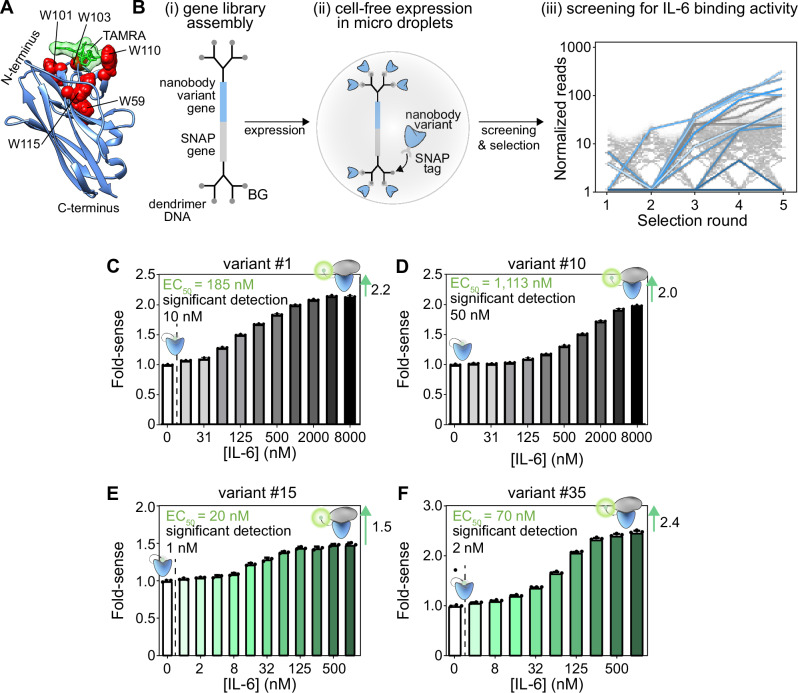
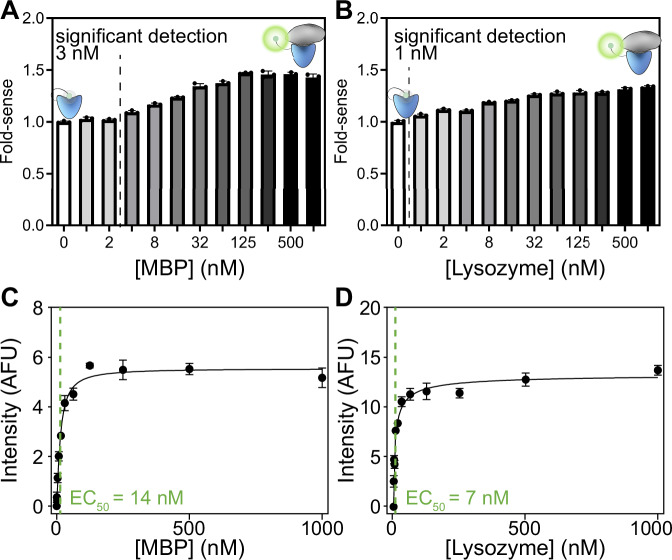
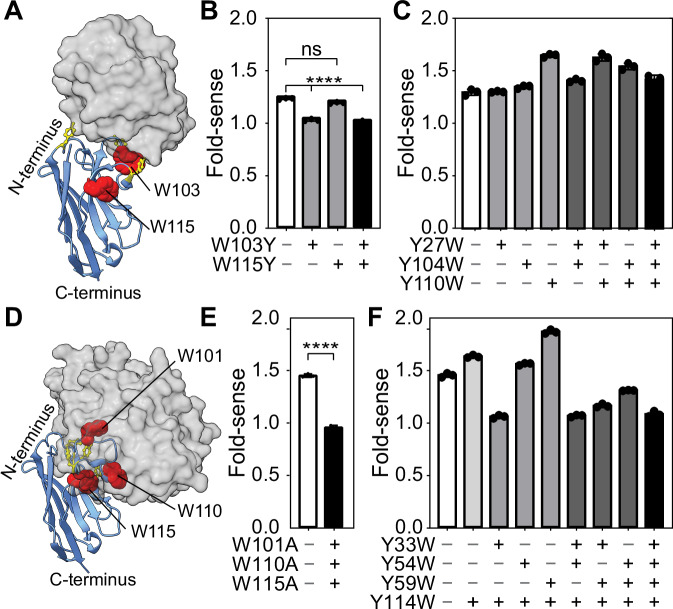
Quenchbodies, antibodies labelled with fluorophores that increase in intensity upon antigen binding, offer great promise for biosensor development. Nanobody-based quenchbodies are particularly attractive due to their small size, ease of expression, high stability, rapid evolvability, and amenability to protein engineering. However, existing designs for protein detection show limited dynamic range, with fluorescence increases of only 1.1-1.4 fold. Here we identify the tryptophan residues in the nanobody complementarity-determining regions (CDRs) that are critical to quenchbody performance. Using a combination of rational design and molecular dynamics simulations, we developed an optimised nanobody scaffold with tryptophans introduced at key positions. We used this scaffold in an in vitro directed-evolution screen against human inflammatory cytokine interleukin-6 (IL-6). This yielded quenchbodies with 1.5-2.4-fold fluorescence increases, enabling IL-6 detection down to 1-2 nM. Our scaffold provides a valuable platform for developing biosensors for diverse protein targets, with applications in research, diagnostics, and environmental monitoring.
淬灭体是一种用荧光团标记的抗体,在与抗原结合时荧光强度会增加,为生物传感器的开发带来了巨大希望。基于纳米抗体的淬灭体因其尺寸小、易于表达、稳定性高、进化速度快以及易于进行蛋白质工程改造而特别具有吸引力。然而,现有的蛋白质检测设计显示动态范围有限,荧光仅增加1.1 - 1.4倍。在此,我们确定了纳米抗体互补决定区(CDR)中的色氨酸残基,这些残基对淬灭体性能至关重要。通过合理设计与分子动力学模拟相结合的方法,我们开发了一种在关键位置引入色氨酸的优化纳米抗体支架。我们将这种支架用于针对人类炎性细胞因子白细胞介素-6(IL-6)的体外定向进化筛选。这产生了荧光增加1.5 - 2.4倍的淬灭体,能够检测低至1 - 2 nM的IL-6。我们的支架为开发针对多种蛋白质靶点的生物传感器提供了一个有价值的平台,可应用于研究、诊断和环境监测。