Mingjing Li, Xuemei Hu, Rui Luo, Chunhua Zhang, Ruimei Hu, Guibin Xue, Guorui Li, Jianjun Di, Cheng Wang, Xiaohui Gu, Zhimin Su, Ruxin Li, Yong Zhao, Fenglan Huang
College of Life Science and Food, Inner Mongolia Minzu University, Tongliao, China.
Tongliao Scientific Research Institute of Agriculture and Animal Husbandry, Tongliao, China.
Front Plant Sci. 2025 Jun 5;16:1584608. doi: 10.3389/fpls.2025.1584608. eCollection 2025.
Fertilizer selection and application is closely related to crop yield and quality. Tartary buckwheat is a medicinal and food crops, has a broad space for development. However, the effect of castor bean meal biofertilizer on the growth and development, yield and quality of Tartary buckwheat and Tartary buckwheat buds is not clear. The aim of this study was to elucidate the effect of castor bean meal biofertilizer on Tartary buckwheat yield and quality, and then to elucidate the effect of castor bean meal biofertilizer indirectly on Tartary buckwheat bud yield and quality.
Tong buckwheat 3 as the test material, in 2 years of field trials, no fertilizer, chemical fertilizer and cow manure as a control, a total of 10 types of fertilizer treatment, respectively, CK (0 kg·ha), F1, F2, F3 (fertilizer, 225, 300, 375kg·ha); N1, N2, N3 (cow manure, 7500, 15000, 22500kg·ha); B1, B2, B3(Castor bean meal biofertilizer, 7500, 15000, 22500kg·ha).
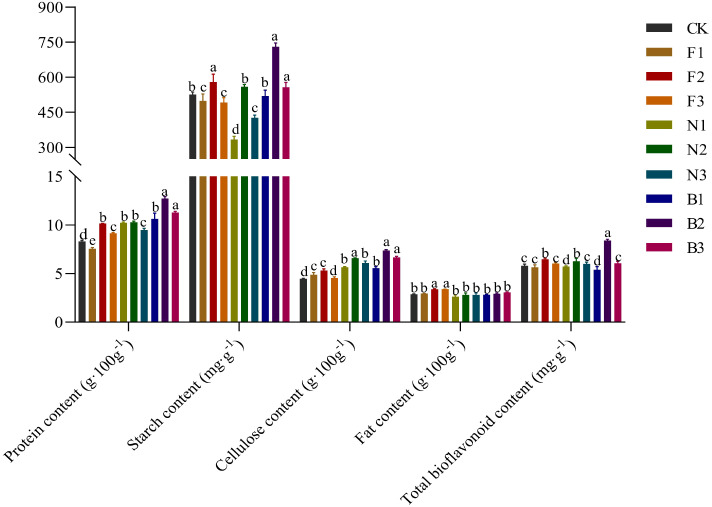
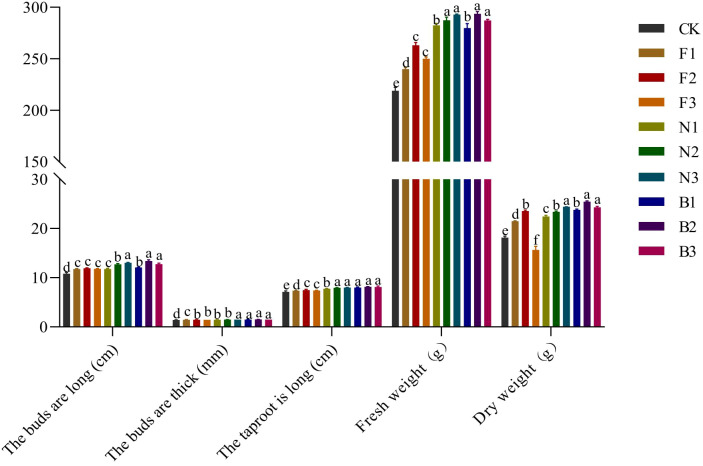
(1) under different fertilizer treatments, Tartary buckwheat plant height, stem thickness, the number of main stem nodes, the number of main stem branches, leaf area and chlorophyll content; single plant grain weight, thousand grain weight and yield of castor bean meal biofertilizer treatment is good, and in the B2 treatment to reach the maximum value. (2) under different fertilizer treatments, Tartary buckwheat protein, starch, cellulose, fat, flavonoid fractions and bioflavonoids are B2 treatment when the highest content. (3) Different fertilization treatments of Tartary buckwheat cultivated Tartary buckwheat buds bud length, fresh weight and dry weight there are significant differences. Tartary buckwheat buds in the 0-16d free amino acids, soluble sugars, total phenols, vitamin C and bioflavonoids content of Tartary buckwheat seeds in the B2 treatment of Tartary buckwheat cultivated Tartary buckwheat buds of the best indicators.
In short, this study provides a new fertilization option to improve Tartary buckwheat yield and quality.
肥料的选择与施用与作物产量和品质密切相关。苦荞是一种药食同源作物,具有广阔的发展空间。然而,蓖麻粕生物肥料对苦荞及其芽的生长发育、产量和品质的影响尚不清楚。本研究旨在阐明蓖麻粕生物肥料对苦荞产量和品质的影响,进而阐明蓖麻粕生物肥料对苦荞芽产量和品质的间接影响。
以同苦荞3为试验材料,在2年的田间试验中,以不施肥、化肥和牛粪为对照,共设置10种肥料处理,分别为CK(0 kg·ha)、F1、F2、F3(化肥,225、300、375kg·ha);N1、N2、N3(牛粪,7500、15000、22500kg·ha);B1、B2、B3(蓖麻粕生物肥料,7500、15000、22500kg·ha)。
(1)在不同肥料处理下,苦荞株高、茎粗、主茎节数、主茎分枝数、叶面积和叶绿素含量;单株粒重、千粒重和产量以蓖麻粕生物肥料处理较好,且在B2处理时达到最大值。(2)在不同肥料处理下,苦荞蛋白质、淀粉、纤维素、脂肪、黄酮类组分和生物类黄酮含量以B2处理时最高。(3)不同施肥处理栽培的苦荞芽,其芽长、鲜重和干重存在显著差异。苦荞芽在0-16d时,游离氨基酸、可溶性糖、总酚、维生素C和生物类黄酮含量以B2处理栽培的苦荞芽各项指标最佳。
总之,本研究为提高苦荞产量和品质提供了一种新的施肥选择。