Dastgerdi Ayda K, Bavil Alireza Y, Berninger Markus T, Fiedler Imke A K, Busse Björn, Krause Matthias, von Brackel Felix N
Department of Osteology and Biomechanics, University Medical Center Hamburg-Eppendorf, Hamburg, Germany.
Australian Centre for Precision Health and Technology (PRECISE), Griffith University, Gold Coast, QLD, Australia.
Sci Rep. 2025 Jun 20;15(1):20116. doi: 10.1038/s41598-025-04260-5.
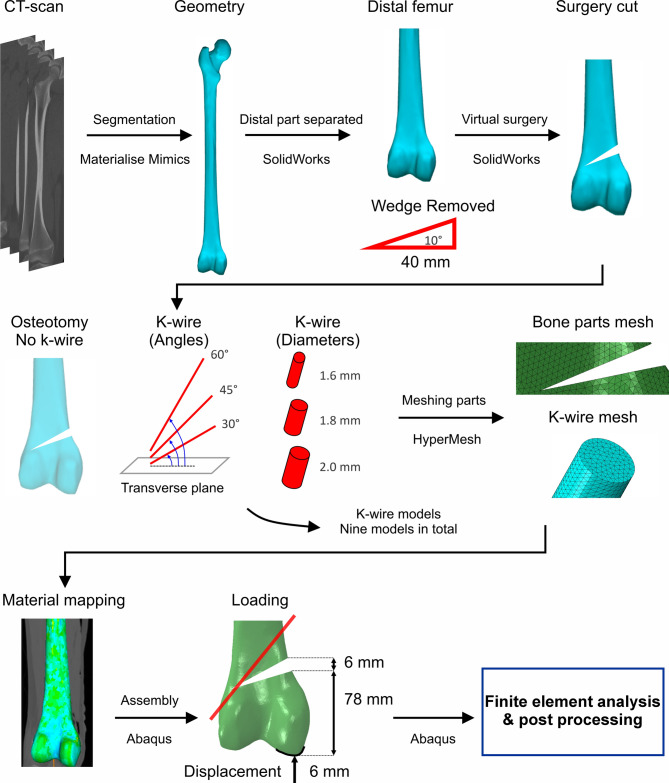
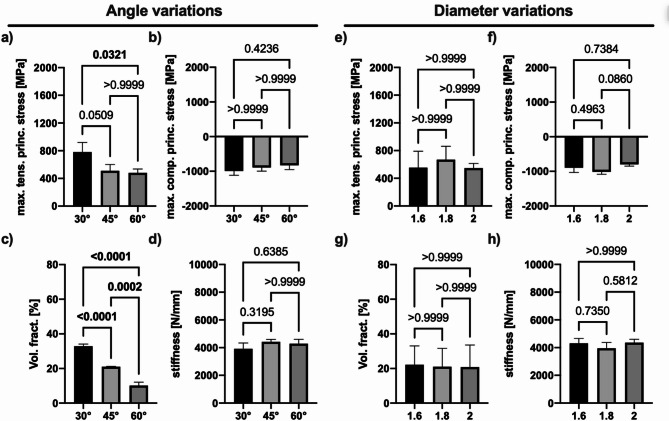
Medial closing-wedge surgery for distal femoral osteotomy is employed to correct genu valgum by correcting coronal plane malalignment. This procedure involves pre-surgery planning, creating a wedge incision, performing the osteotomy, and stabilizing with plates and screws. However, hinge fractures during wedge closure present significant challenges, often necessitating revisions. Contemporary solutions have explored the use of k-wires, and this study investigates their biomechanical implications. The interplay between k-wire insertion angle and diameter, often overlooked in existing literature, is a critical determinant of their efficacy in achieving successful osteotomies, highlighting gaps in our understanding of these key parameters. We hypothesize that k-wire mechanics vary with insertion angle and diameter. This study examines the introduction of k-wires at different angles (30°, 45°, and 60°) and diameters (1.6, 1.8, and 2 mm) using computed tomography-based finite element models to assess structural integrity during femoral medial closing-wedge osteotomy. Results reveal angle-dependent stress variations, with 60° configurations exhibiting favorable patterns that reduce tensile and compressive loads and plastic deformation-crucial in preventing hinge fractures. Diameter variations show no significant differences in stresses or system stiffness. It was also found that while angle significantly affects stresses, lower diameters appear optimal only in combination with higher angles. Comparative analysis of k-wire systems with a naïve model demonstrates that k-wires at a 60° angle reduce tensile and compressive loadings and plastically deformed volume fractions, thus lowering fracture risk. This study underscores the importance of optimizing k-wire placement and configuration, particularly highlighting the significance of the insertion angle. Future research should expand the range of angles and diameters tested and examine different femoral geometries and osteotomy angles to provide a more comprehensive understanding and enhanced clinical application.
股骨远端截骨的内侧闭合楔形手术用于通过纠正冠状面畸形来矫正膝外翻。该手术包括术前规划、制作楔形切口、进行截骨以及用钢板和螺钉固定。然而,楔形闭合过程中的铰链骨折带来了重大挑战,通常需要进行翻修。当代的解决方案探索了克氏针的使用,本研究调查了它们的生物力学影响。克氏针插入角度和直径之间的相互作用在现有文献中常常被忽视,而这是其在实现成功截骨方面功效的关键决定因素,凸显了我们对这些关键参数理解上的差距。我们假设克氏针的力学性能会随插入角度和直径而变化。本研究使用基于计算机断层扫描的有限元模型,研究了在不同角度(30°、45°和60°)和直径(1.6、1.8和2毫米)下引入克氏针,以评估股骨内侧闭合楔形截骨过程中的结构完整性。结果显示应力随角度变化,60°构型呈现出有利的模式,可减少拉伸和压缩载荷以及塑性变形,这对预防铰链骨折至关重要。直径变化在应力或系统刚度方面没有显著差异。还发现,虽然角度显著影响应力,但较小直径仅在与较大角度结合时似乎才是最佳的。将克氏针系统与一个简单模型进行对比分析表明,60°角度的克氏针可减少拉伸和压缩载荷以及塑性变形体积分数,从而降低骨折风险。本研究强调了优化克氏针放置和构型的重要性,尤其突出了插入角度的意义。未来的研究应扩大测试的角度和直径范围,并研究不同的股骨几何形状和截骨角度,以提供更全面的理解并增强临床应用。