Kim Ahreum, Cho Hyun-A, Oh Byeongjun, Song Jayoung, Kwon Yongseok
School of Pharmacy, Sungkyunkwan University, Suwon, Republic of Korea.
College of Medicine, Dankook University, Cheonan, Republic of Korea.
Commun Chem. 2025 Jun 21;8(1):190. doi: 10.1038/s42004-025-01584-1.
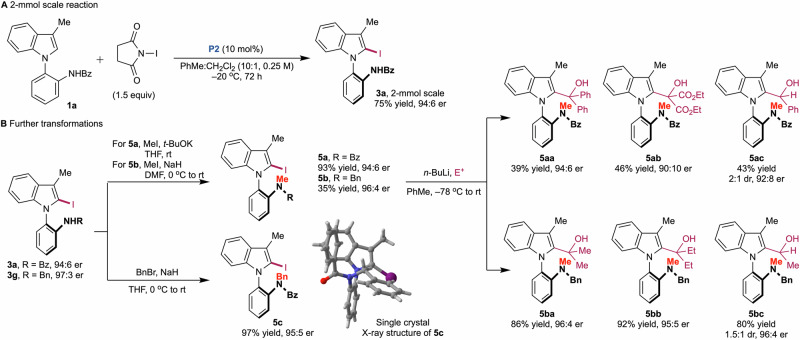
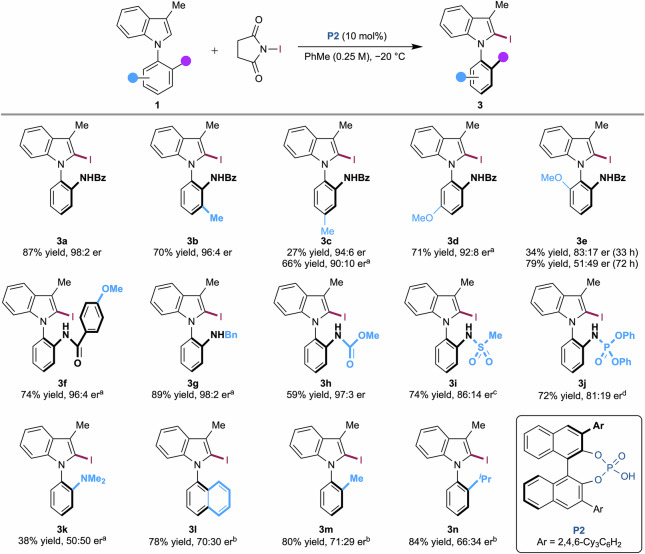
Axially chiral indoles have garnered significant attention due to their synthetic and biological importance. However, atroposelective halogenation of this scaffold has been rarely explored. This study presents a catalytic and enantioselective iodination of N-arylindoles, achieving precise control over the C-N stereogenic axis. The reaction is facilitated by a chiral phosphoric acid, which promotes iodination at the C-3 position of N-arylindole, followed by iodine migration and deprotonation. A hydrogen-bonding donor on the aromatic ring plays a key role in achieving high enantioselectivities. Under optimized reaction conditions, a wide range of substrates are well-tolerated, and subsequent reactions with various carbonyl electrophiles maintain enantioselectivity. Computational studies provide insights into the origin of enantioselectivity at the plausible enantiodetermining step.
轴手性吲哚因其合成和生物学重要性而备受关注。然而,该骨架的对映选择性卤化反应却鲜有研究。本研究报道了一种催化对映选择性碘化N - 芳基吲哚的方法,实现了对C - N立体中心轴的精确控制。该反应在手性磷酸的促进下进行,手性磷酸促进N - 芳基吲哚的C - 3位碘化,随后发生碘迁移和去质子化。芳环上的氢键供体在实现高对映选择性方面起着关键作用。在优化的反应条件下,多种底物都能很好地兼容,并且与各种羰基亲电试剂的后续反应保持对映选择性。计算研究为可能的对映体决定步骤中对映选择性的起源提供了深入见解。