Nussbaumer-Pröll Alina, Obermüller Markus, Weiss-Tessbach Matthias, Eberl Sabine, Zeitlinger Markus, Matiba Bernd, Mayer Christian, Kussmann Manuel
Department of Clinical Pharmacology, Medical University of Vienna, Vienna, Austria.
Department of Medicine I, Division of Infectious Diseases and Tropical Medicine, Medical University of Vienna, Währinger Gürtel 18-20, 1090, Vienna, Austria.
Med Microbiol Immunol. 2025 Jun 21;214(1):32. doi: 10.1007/s00430-025-00841-3.
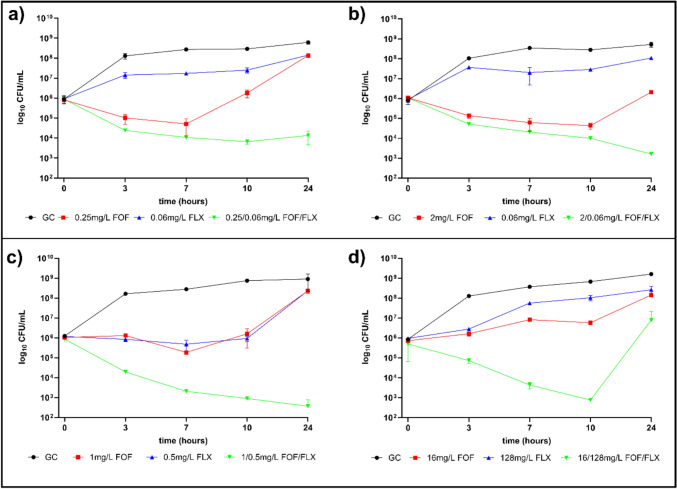
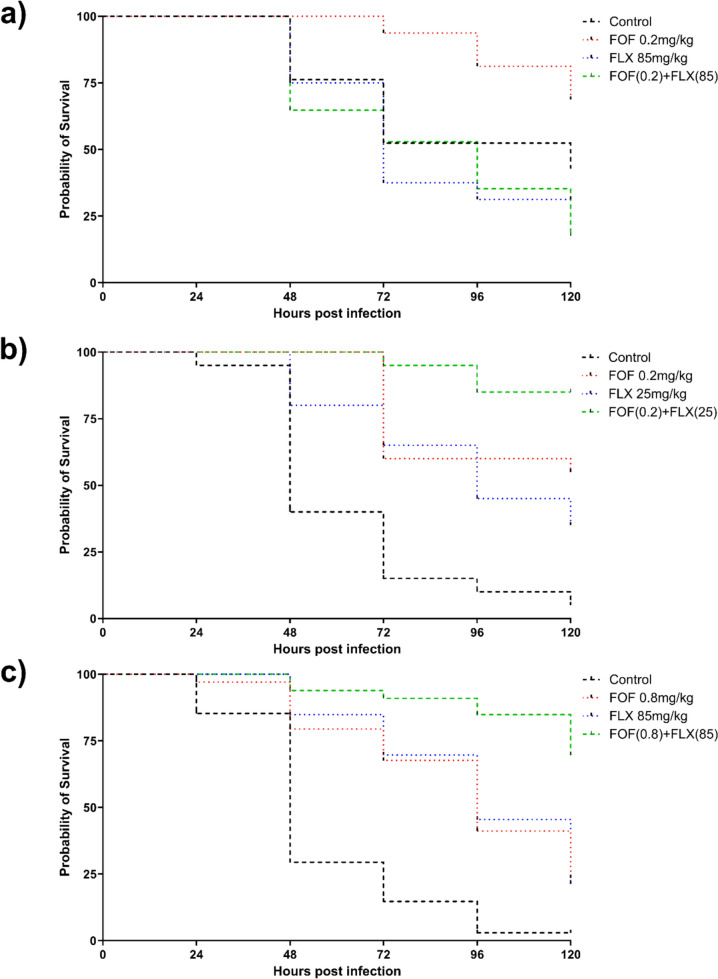
Fosfomycin (FOF) exhibits broad-spectrum antimicrobial activity, and is mainly used in combination therapy. Previous in vitro studies have shown synergistic effects of FOF in combination with flucloxacillin (FLX) against Staphylococcus aureus isolates. This study aims to validate these findings in vitro and investigate the synergistic effect in an in vivo Galleria mellonella model. Five methicillin- and FOF-susceptible isolates (ATCC-29213 & 4 clinical isolates); one methicillin- and FOF-resistant strain (DSMZ-23622) and four methicillin-resistant and FOF-susceptible strains (ATCC-33592 & 3 clinical isolates) were tested with checkerboard assays to assess synergism. Time-kill curves were generated for two MSSA (ATCC 29213 and 231/20) and two MRSA strains (ATCC 33592 and DSMZ 23622). The in vivo efficacy of FOF and/or FLX was evaluated by a G. mellonella survival assay and by determining the total bacterial count (TBC) in hemolymph. Checkerboard assays revealed additive or indifferent effects, with some indicating synergism. Time-kill curves demonstrated higher reduction in TBC with combination therapy compared to monotherapy. In vivo, the combination therapy showed the greatest reduction of TBC in larval haemolymph compared to monotherapy, and the survival assay showed highly synergistic activity of FLX plus FOF against MRSA (ATCC-33592) and MSSA (ATCC 6538), resulting in an average reduction in mortality of 48 and 40%, respectively, compared to monotherapies. Therefore, FOF plus FLX could be an alternative for the calculated or definitive treatment of S. aureus infections without antimicrobial susceptibility results or even for salvage therapy of MRSA infections after treatment failure or necessary discontinuation of classical MRSA drugs.
磷霉素(FOF)具有广谱抗菌活性,主要用于联合治疗。先前的体外研究表明,FOF与氟氯西林(FLX)联合对金黄色葡萄球菌分离株具有协同作用。本研究旨在体外验证这些发现,并在体内大蜡螟模型中研究协同效应。使用棋盘法测试了5株对甲氧西林和FOF敏感的分离株(ATCC - 29213和4株临床分离株);1株对甲氧西林和FOF耐药的菌株(DSMZ - 23622)以及4株对甲氧西林耐药但对FOF敏感的菌株(ATCC - 33592和3株临床分离株)以评估协同作用。为两株甲氧西林敏感金黄色葡萄球菌(ATCC 29213和231/20)以及两株耐甲氧西林金黄色葡萄球菌菌株(ATCC 33592和DSMZ 23622)绘制了时间 - 杀菌曲线。通过大蜡螟存活试验并测定血淋巴中的总细菌数(TBC)来评估FOF和/或FLX的体内疗效。棋盘法显示为相加或无关作用,部分显示为协同作用。时间 - 杀菌曲线表明,与单一疗法相比,联合治疗使TBC的降低幅度更大。在体内,与单一疗法相比,联合治疗使幼虫血淋巴中的TBC降低幅度最大,存活试验显示FLX加FOF对耐甲氧西林金黄色葡萄球菌(ATCC - 33592)和甲氧西林敏感金黄色葡萄球菌(ATCC 6538)具有高度协同活性,与单一疗法相比,平均死亡率分别降低了48%和40%。因此,在没有抗菌药敏结果的情况下,FOF加FLX可作为计算性或确定性治疗金黄色葡萄球菌感染的替代方案,甚至可用于耐甲氧西林金黄色葡萄球菌感染治疗失败或必须停用经典耐甲氧西林金黄色葡萄球菌药物后的挽救治疗。