
噬菌体作为一种生物防治策略预防大肠杆菌污染肉类产品的荟萃分析
Bacteriophages as a Biocontrol Strategy to Prevent the Contamination of Meat Products with Escherichia coli - a Meta-Analysis.
作者信息
Vega Iracema Islas, Rodríguez Nydia Edith Reyes, Pérez Victor Johan Acosta, Velázquez Andrea Paloma Zepeda, Sánchez Vicente Vega, Arana Jorge Luis DE LA Rosa, Noguez Jesús Benjamín Ponce, Gómez DE Anda Fabían Ricardo
机构信息
1Institute of Agricultural Sciences, Autonomous University of the State of Hidalgo, San Miguel Huatengo, Hidalgo, Mexico.
2Faculty of Higher Studies Cuautitlán, National Autonomous University of Mexico, Cuautitlán Izcalli, Estado de México, Mexico.
出版信息
Pol J Microbiol. 2025 Jun 18;74(2):165-176. doi: 10.33073/pjm-2025-014. eCollection 2025 Jun 1.
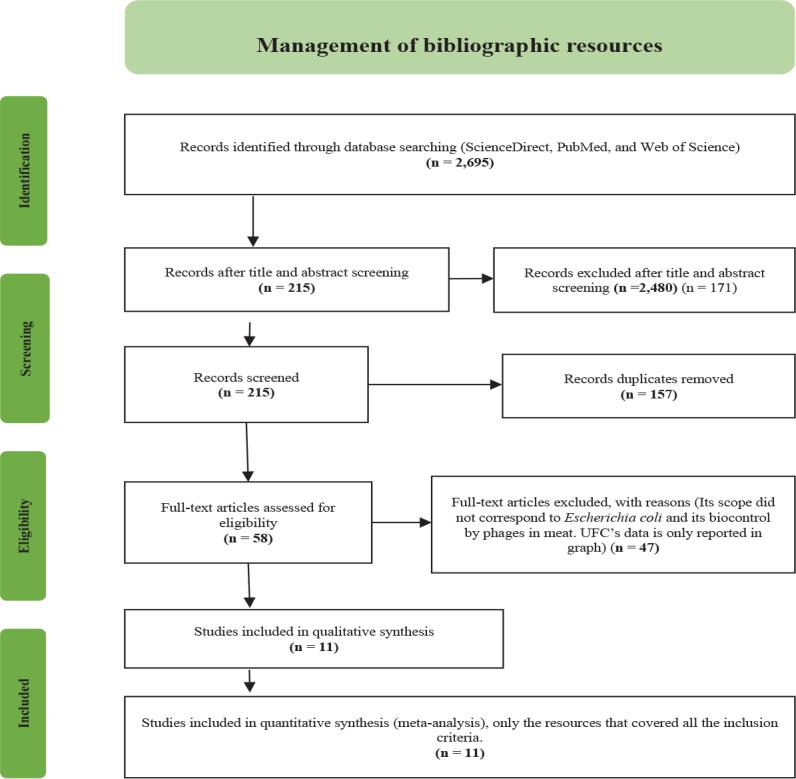
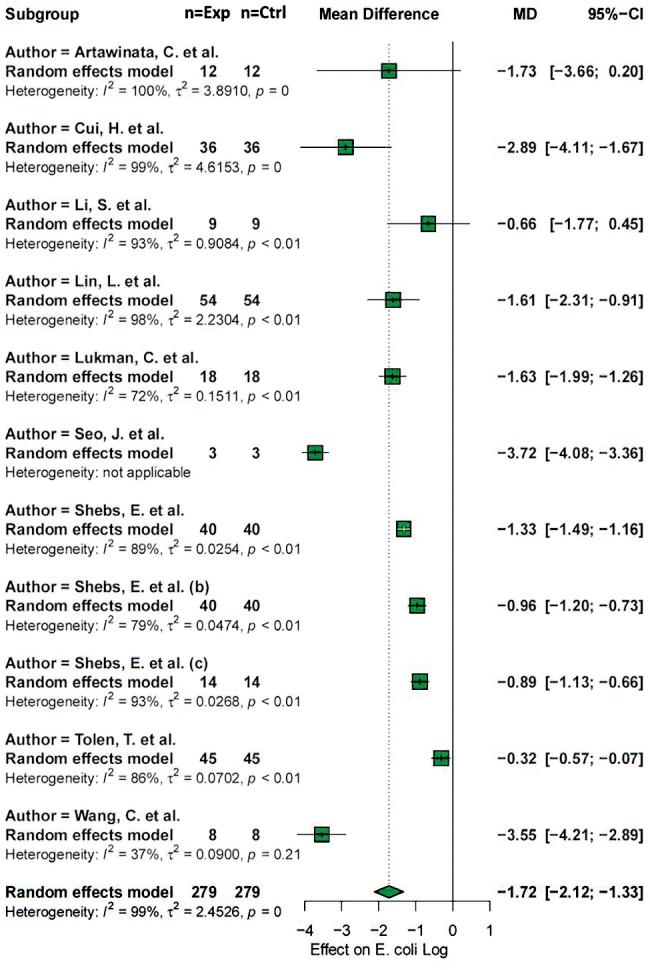
Bacteriophage-based biocontrol is a cost-effective, sustainable strategy with low ecological impact, which can control the growth of bacteria such as that impacts public health problems. This work aimed to perform a meta-analysis to evaluate the implementation of bacteriophages as a biocontrol strategy to prevent the contamination of meat products with . The search was performed by two field experts to avoid reviewer bias. The initial search identified 2,695 bibliographic sources, of which 2,480 were discarded because they did not meet the inclusion criteria, which were the origin of phage, application method, phage taxonomy, pathotype and meat products, getting 157 articles because they were duplicates, and 47 because they lacked the necessary numerical data. Finally, 11 articles were selected for quantitative analysis. Likewise, phage characteristics ( < 0.05) and pathotype ( < 0.05), showed that the bacteriophage-bacteria ratio is an item that should be taken into account for the design of bacteriophage application strategies. This meta-analysis evaluates the use of phages in the reduction of in meat products, considering multiple methodological criteria. Studies were included that specify the origin of the phages (natural or modified), their method of application (direct in meat, in solution, in aerosol, etc.), their taxonomic classification, as well as the pathotype of the target (EHEC, ETEC, etc.). In addition, the different types of meat products were analyzed, including beef, pork, and chicken. These criteria help clarify the factors affecting phage therapy efficacy in the meat industry.
基于噬菌体的生物防治是一种具有成本效益、可持续且生态影响低的策略,可控制诸如影响公共卫生问题的细菌生长。这项工作旨在进行一项荟萃分析,以评估噬菌体作为一种生物防治策略在预防肉类产品受到[细菌名称未给出]污染方面的应用。由两位领域专家进行检索以避免评审偏倚。初步检索识别出2695个文献来源,其中2480个因不符合纳入标准而被舍弃,纳入标准包括噬菌体的来源、应用方法、噬菌体分类学、[细菌名称未给出]致病型和肉类产品,因重复而得到157篇文章,因缺乏必要的数值数据而得到47篇文章。最后,选择了11篇文章进行定量分析。同样,噬菌体特征(<0.05)和[细菌名称未给出]致病型(<0.05)表明,噬菌体 - 细菌比例是噬菌体应用策略设计中应考虑的一个因素。这项荟萃分析考虑了多个方法学标准,评估了噬菌体在减少肉类产品中[细菌名称未给出]方面的应用。纳入的研究明确了噬菌体的来源(天然或改造)、其应用方法(直接用于肉类、溶液中、气溶胶中等等)、其分类学分类,以及目标[细菌名称未给出]的致病型(肠出血性大肠杆菌、肠产毒性大肠杆菌等等)。此外,还分析了不同类型的肉类产品,包括牛肉、猪肉和鸡肉。这些标准有助于阐明影响肉类行业噬菌体治疗效果的因素。



 Zotero 插件