Brennan Emily J
Center for Integrative and Experiential Learning, University of South Carolina, Columbia, South Carolina, USA.
Am J Biol Anthropol. 2025 Jun;187(2):e70071. doi: 10.1002/ajpa.70071.
The purpose of this study is to evaluate differences in adult mortality risk at the intersection of climate change and urbanization between late medieval (c. 1200-1500) and early modern (c. 1500-1800) Berlin. After the founding of the city in c. 1200, the early modern period saw increased population density and the advent of the Little Ice Age (LIA), whose long winters and wet summers destroyed crop yields.
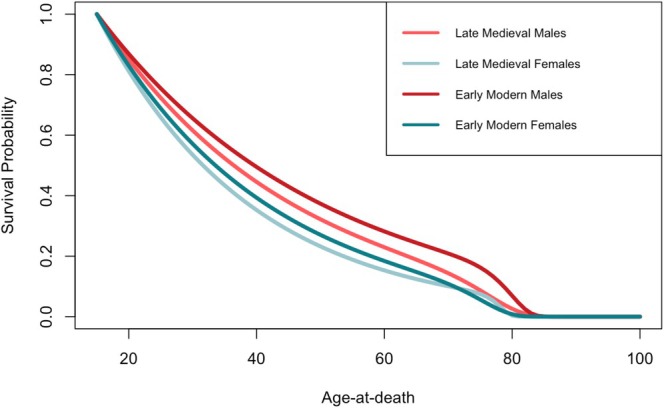
To test the hypothesis that mortality risk increased in the early modern period, this study examined Gompertz and Gompertz-Makeham mortality curves for adult individuals (n = 274) dated from c. 1200 to 1717 Berlin. To evaluate the magnitude of differences in mortality by time period and estimated sex, a Cox Proportional Hazards analysis was used.
All adults faced a decreased risk of mortality in the early modern period compared to the late medieval period. In both time periods, estimated females faced a higher risk of mortality compared to estimated males, though this difference was only statistically significant in the early modern period.
Decreased risk of mortality may indicate protective effects of urban life, even with the climatic variability of the LIA. The early modern period saw the proliferation of public hospitals and an increase in medical publications. Higher mortality risks for estimated females at this time may be a result of differential education and heightened religious tensions that resulted in witchcraft persecutions, possibly affecting social determinants of health for women at the time.
本研究的目的是评估中世纪晚期(约1200 - 1500年)和近代早期(约1500 - 1800年)柏林在气候变化与城市化交叉点上成人死亡风险的差异。约1200年建城后,近代早期人口密度增加,小冰期(LIA)来临,其漫长的冬季和潮湿的夏季破坏了农作物产量。
为检验近代早期死亡风险增加这一假设,本研究考察了约1200年至1717年柏林成年个体(n = 274)的冈珀茨和冈珀茨 - 马克姆死亡曲线。为评估不同时期和估计性别的死亡差异幅度,使用了Cox比例风险分析。
与中世纪晚期相比,所有成年人在近代早期面临的死亡风险均降低。在两个时期,估计女性比估计男性面临更高的死亡风险,不过这种差异仅在近代早期具有统计学意义。
死亡风险降低可能表明城市生活的保护作用,即使存在小冰期的气候变异性。近代早期公立医院激增,医学出版物增加。此时估计女性较高的死亡风险可能是由于教育差异以及宗教紧张局势加剧导致巫术迫害,这可能影响了当时女性的健康社会决定因素。