Gupta Sonali, Sharma Ananya, Pandey Hemchandra, Singh Nilam, Chandra Akash Deep, Khan Iftekhar, Upadhyay Ashish Datt, Gupta Somesh
Department of Dermatology and Venereology, All India Institute of Medical Sciences, New Delhi, India.
Department of Transfusion Medicine, All India Institute of Medical Sciences, New Delhi, India.
Indian J Sex Transm Dis AIDS. 2025 Jan-Jun;46(1):22-24. doi: 10.4103/ijstd.ijstd_115_24. Epub 2025 Jun 9.
Syphilis screening methods in blood banks have recently transitioned from manual nontreponemal tests to automated treponemal-specific enzyme immunoassays and chemiluminescence immunoassays (CIA). Although convenient and highly sensitive, this has led to increased false-positive rates leading to the wastage of blood resources.
This study aimed to evaluate the positive predictive value (PPV) of (TP)-CIA as a screening tool in healthy blood donors and determine optimal cutoff values to improve specificity, thereby reducing unnecessary blood wastage and donor exclusion.
It was a retrospective observational study that collected data from July 2019 to May 2023 on blood bank donors referred to the sexually transmitted disease clinic, in view of testing reactive on the Abbott ARCHITECT Syphilis TP CMIA (relative light unit [RLU] >1). Clinical details, Venereal Disease Research Laboratory (VDRL) titers, and confirmatory TP hemagglutination (TPHA) test records were corroborated.
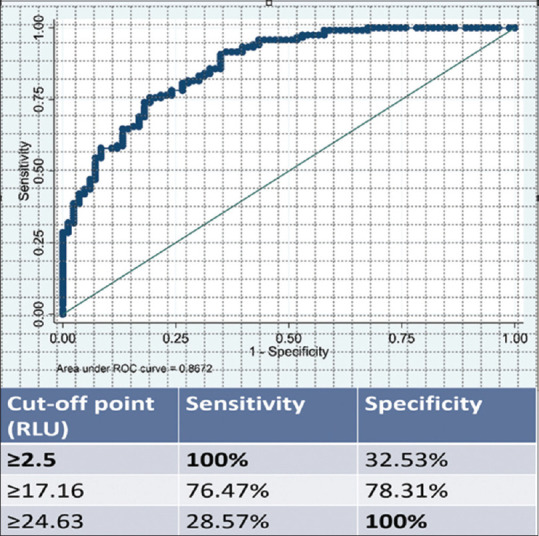
A total of 1791 patients were referred over 4 years as per blood bank records. Only 271 (15.13%) of these presented to the sexually transmitted infection clinic, indicating a high referral loss. Of patients with CIA titers available, 119/202 (58.9%) were diagnosed as confirmed syphilis based on VDRL and TPHA positivity, out of which majority (92.4%) were latent syphilis. PPV of TP-CIA rapid test at RLU >1 (manufacturer recommendation) was 64.3%, with an area under the receiver operating characteristic curve of 0.86. Setting the cutoff at RLU ≥2.5 improved sensitivity to 100% (patients with RLU <2.5 could be safely returned to the donor pool), while a cutoff of ≥24.63 achieved 100% specificity (confirmed syphilis).
The manufacturer cutoff for syphilis CMIA rapid test (RLU >1) maintains high sensitivity but generates high false positives, causing nearly one-third of patients to be referred unnecessarily, as well as blood wastage. Reflexive confirmatory testing with a second treponemal assay can minimize the psychological impact on healthy donors and prevent unnecessary donor exclusion. Large-scale studies are required to establish population-based cutoffs for ensured blood safety without wastage.
血库中的梅毒筛查方法最近已从手动非梅毒螺旋体试验转变为自动化梅毒螺旋体特异性酶免疫测定和化学发光免疫测定(CIA)。尽管这种方法方便且高度灵敏,但导致假阳性率增加,造成血液资源的浪费。
本研究旨在评估梅毒螺旋体(TP)-CIA作为健康献血者筛查工具的阳性预测值(PPV),并确定最佳临界值以提高特异性,从而减少不必要的血液浪费和献血者被排除的情况。
这是一项回顾性观察研究,收集了2019年7月至2023年5月转至性传播疾病诊所的血库献血者的数据,这些献血者在雅培ARCHITECT梅毒TP CMIA检测中呈反应性(相对光单位[RLU]>1)。核实了临床细节、性病研究实验室(VDRL)滴度以及梅毒螺旋体血凝试验(TPHA)的确认检测记录。
根据血库记录,4年间共有1791名患者被转诊。其中只有271名(15.13%)前往性传播感染诊所就诊,表明转诊流失率很高。在有CIA滴度数据的患者中,119/202(58.9%)基于VDRL和TPHA阳性被诊断为确诊梅毒,其中大多数(92.4%)为潜伏梅毒。RLU>1(制造商推荐值)时TP-CIA快速检测的PPV为64.3%,受试者操作特征曲线下面积为0.86。将临界值设定为RLU≥2.5可使灵敏度提高到100%(RLU<2.5的患者可安全返回献血者库),而临界值≥24.63时特异性达到100%(确诊梅毒)。
梅毒CMIA快速检测的制造商临界值(RLU>1)保持了高灵敏度,但产生了高假阳性,导致近三分之一的患者被不必要地转诊,以及血液浪费。采用第二种梅毒螺旋体检测进行反射性确认检测可将对健康献血者的心理影响降至最低,并防止不必要的献血者被排除。需要进行大规模研究以建立基于人群的临界值,确保血液安全且不造成浪费。