Wang Huan-Fang, Li Yun-Hua, Zhang Qiaoling, Han Lihong, Wang Lirong, Zhang Lifang, Bai Xue, Cheng Mingyue, Zhang Ting, Zhao Fang, Li Hui, Wang Xiao-Yun
Nursing Department, Inner Mongolia Maternal and Child Health Care Hospital, Hohhot, China.
College of Education, Chengdu College of Arts and Sciences, Chengdu, China.
Front Psychiatry. 2025 Jun 6;16:1585702. doi: 10.3389/fpsyt.2025.1585702. eCollection 2025.
Childhood asthma is a prevalent chronic disease that affects millions of children worldwide. Managing this disease demands not only medical treatment but also the long-term self-management efforts of both children and their parents. Conventional self-management education typically depends on face-to-face approaches, often failing to take into account the personalized requirements and ongoing support needed. Nevertheless, with the evolution of artificial intelligence (AI) technology, fresh prospects have emerged to boost the effectiveness of self-management for childhood asthma. Based on it, we have designed an AI Health Education Accurately Linkage System (AI-HEALS) to explore whether AI-driven interventions can improve self-management capabilities of families with asthmatic children, thereby helping them control the disease and reduce medical costs.
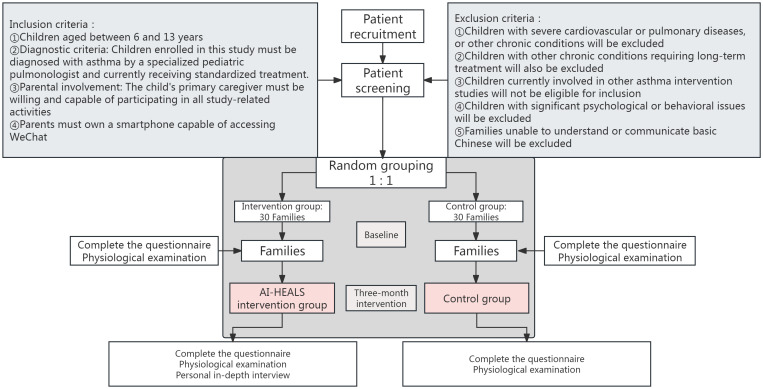
This research is a pilot single-blind randomized controlled trial (RCT) intended to gauge the efficacy of the AI-HEALS intervention delivered via the WeChat platform in enhancing the self-management abilities of families with asthmatic children. Participants will be recruited from eligible families whose children have been diagnosed with asthma and randomly allocated to either the intervention group or the control group. The control group will receive standard treatment, whereas the intervention group will receive both standard treatment and the AI-HEALS intervention. The intervention includes an AI-enabled, voice-activated interactive question-and-answer system, as well as monitoring and recording of physiological indicators, regular reminders, and customized educational articles. All components of the intervention will mainly be provided through a WeChat official account named "Children's Asthma Health Management Expert." AI-HEALS will construct its knowledge base according to pediatric asthma treatment guidelines to enhance the accuracy and reliability of the information it offers. The primary outcome measure is the alteration in asthma symptom control levels, while secondary outcomes comprise a variety of other physiological indicators related to asthma, parents' self-management behaviors, and mental health conditions.
This study combines AI and mobile health technology to develop the AI-HEALS system, with the aim of assisting families of children with asthma in controlling the disease symptoms. The primary objective is to evaluate whether the intervention can improve asthma symptom control.
The study is scheduled to begin in April 2025 and is expected to conclude in December 2026. This research protocol is the first version and was registered with the China Clinical Trial Registration Center on February 14, 2025 (Registration Number: ChiCTR2500097233).
儿童哮喘是一种常见的慢性疾病,影响着全球数百万儿童。管理这种疾病不仅需要医疗治疗,还需要儿童及其父母长期的自我管理努力。传统的自我管理教育通常依赖面对面的方式,往往没有考虑到个性化需求和所需的持续支持。然而,随着人工智能(AI)技术的发展,出现了新的前景来提高儿童哮喘自我管理的有效性。基于此,我们设计了一个人工智能健康教育精准联动系统(AI-HEALS),以探索人工智能驱动的干预措施是否可以提高哮喘儿童家庭的自我管理能力,从而帮助他们控制疾病并降低医疗成本。
本研究是一项试点单盲随机对照试验(RCT),旨在评估通过微信平台提供的AI-HEALS干预措施在提高哮喘儿童家庭自我管理能力方面的疗效。将从符合条件的、其子女已被诊断患有哮喘的家庭中招募参与者,并随机分配到干预组或对照组。对照组将接受标准治疗,而干预组将接受标准治疗和AI-HEALS干预。干预措施包括一个人工智能驱动的、语音激活的交互式问答系统,以及生理指标的监测和记录、定期提醒和定制的教育文章。干预措施的所有组成部分将主要通过一个名为“儿童哮喘健康管理专家”的微信公众号提供。AI-HEALS将根据儿童哮喘治疗指南构建其知识库,以提高其提供信息的准确性和可靠性。主要结局指标是哮喘症状控制水平变化,次要结局包括与哮喘相关的各种其他生理指标、父母的自我管理行为和心理健康状况。
本研究结合人工智能和移动健康技术开发了AI-HEALS系统,旨在帮助哮喘儿童家庭控制疾病症状。主要目的是评估干预措施是否可以改善哮喘症状控制。
该研究计划于2025年4月开始,预计于2026年12月结束。本研究方案是第一版,于2025年2月14日在中国临床试验注册中心注册(注册号:ChiCTR2500097233)。