Liu Diyue, Fan Siyuan, Huang Xincheng, Gu Wenjing, Yin Yifan, Zhang Ziyi, Ma Baotong, Xia Ruitong, Lu Yuanwei, Liu Jingwen, Xin Hanjia, Cao Yumeng, Yang Saier, Li Runqing, Li Han, Zhao Ji, Zhang Jin, Gao Zheng, Zeng Yaxin, Ding Yixiao, Ren Zhuolun, Guan Yan, Zhang Na, Li Jia, Ma Yan, Wei Pei, Dong Jingjing, Zhou Yajing, Dong Yong, Qian Yan, Chen Chen, Zhao Yujie, Li Yimiao, Zheng Yujia, Chen Rongyi, Li Xiaomeng, Han Yuke, Xia Yaoyao, Xu Huixin, Wu Zhaolin, Wu Mingyou, Wu Xinrui, Hou Junyi, Cai Yuelai, Dai Xiaofan, Li Wenbo, Nie Ting, Zhang Chongzhe, Wang Xiaoya, Li Dan, Yan Siyao, Yi Zhiheng, Liu Chenxi, Zhang Xinyue, Shi Lei, Li Haomiao, Jiang Feng, Zhou Xiaoming, Sun Xinying, Wu Yibo
International School of Public Health and One Health Hainan Medical University Haikou Hainan China.
Yanjing Medical College Capital Medical University Beijing China.
Health Care Sci. 2024 Dec 20;3(6):475-492. doi: 10.1002/hcs2.125. eCollection 2024 Dec.
This study protocol specifies the primary research line and theoretical framework of the 2023 Survey of the Psychology and Behavior of the Chinese Population. It aims to establish a consistent database of Chinese residents' psychological and behavioral surveys through multi-center and large-sample cross-sectional surveys to provide robust data support for developing research in related fields. It will track the public's physical and psychological health more comprehensively and systematically.
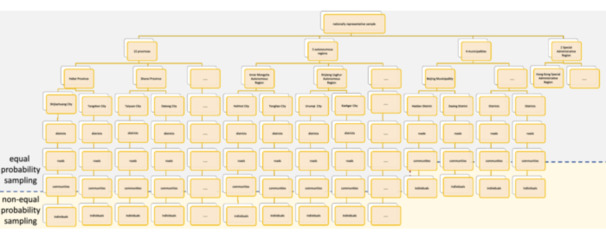
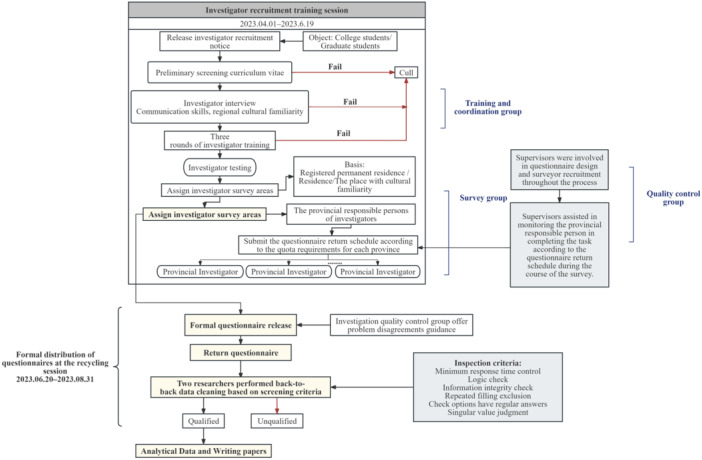
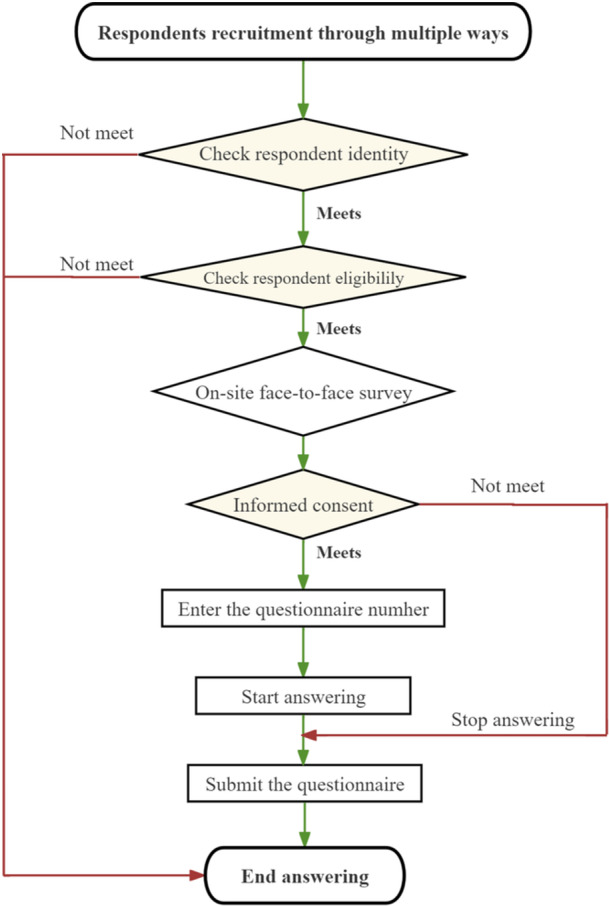
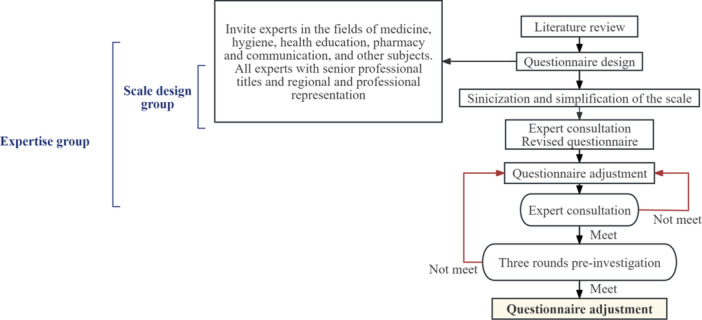
The study was conducted from June 20, 2023 to August 31, 2023, using stratified and quota sampling methods. A total of 150 cities across 800 communities/villages were surveyed, selected from China (Despite extensive coordination, we have been unable to contact our counterparts in the Taiwan region of China to obtain relevant statistical data). The questionnaires were distributed to the public one-on-one and face-to-face by trained surveyors. The questionnaires included basic information about the individual, personal health status, basic information about the family, the social environment in which the individual lives, psychological condition scales, behavioral level scales, other scales, and attitudes towards topical social issues. Supervisors conducted quality control during the distribution process and returned questionnaires, logically checked and cleaned for data analysis.
Data collection has been finished, and scientific outputs based on this data will support the development of health promotion strategies in China and globally. In the aftermath of the pandemic, it will guide policymakers and healthcare organizations to improve their existing policies and services to maximize the physical and mental health of the Chinese population.
This study was filed in the National Health Security Information Platform (Record No.: MR-37-23-017876) and officially registered in the China Clinical Trials Registry (Registration No.: ChiCTR2300072573).
本研究方案规定了《2023年中国人口心理与行为调查》的主要研究方向和理论框架。其目的是通过多中心、大样本横断面调查,建立一个关于中国居民心理与行为调查的统一数据库,为相关领域的研究发展提供有力的数据支持。它将更全面、系统地跟踪公众的身心健康状况。
本研究于2023年6月20日至2023年8月31日进行,采用分层配额抽样方法。在中国选取了800个社区/村庄所在的150个城市进行调查(尽管经过广泛协调,但我们仍无法联系到中国台湾地区的对应方以获取相关统计数据)。问卷由经过培训的调查员一对一、面对面地发放给公众。问卷内容包括个人基本信息、个人健康状况、家庭基本信息、个人生活的社会环境、心理状况量表、行为水平量表、其他量表以及对热点社会问题的态度。在问卷发放过程中,督导员进行质量控制,并对回收的问卷进行逻辑检查和数据清理,以进行数据分析。
数据收集工作已经完成,基于这些数据的科学成果将支持中国乃至全球健康促进策略的制定。在疫情之后,它将指导政策制定者和医疗保健组织改进现有政策和服务,以最大限度地促进中国人口的身心健康。
本研究已在国家医保信息平台备案(备案号:MR-37-23-017876),并在中国临床试验注册中心正式注册(注册号:ChiCTR2300072573)。