Horta Pedro, Raposeira Helena, Juste Javier, Razgour Orly, Rebelo Hugo
CIBIO/InBio Centro de Investigação em Biodiversidade e Recursos Genéticos da Universidade do Porto Vairão Portugal.
Palombar - Conservação da Natureza e do Património Rural Vimioso Portugal.
Evol Appl. 2025 Jun 20;18(6):e70103. doi: 10.1111/eva.70103. eCollection 2025 Jun.
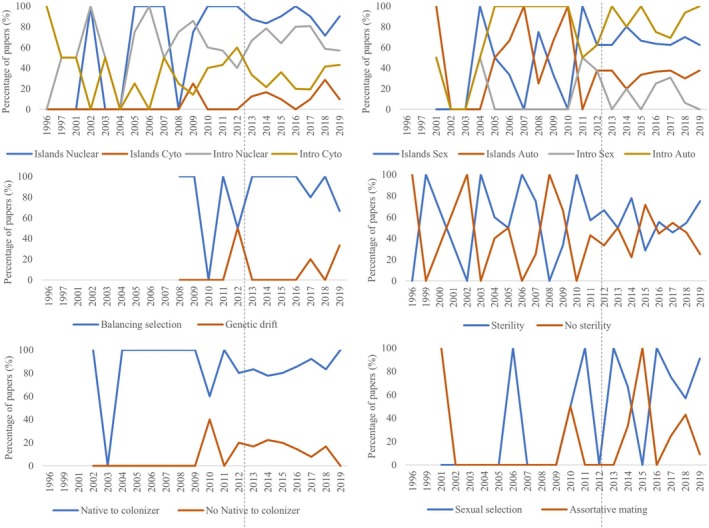
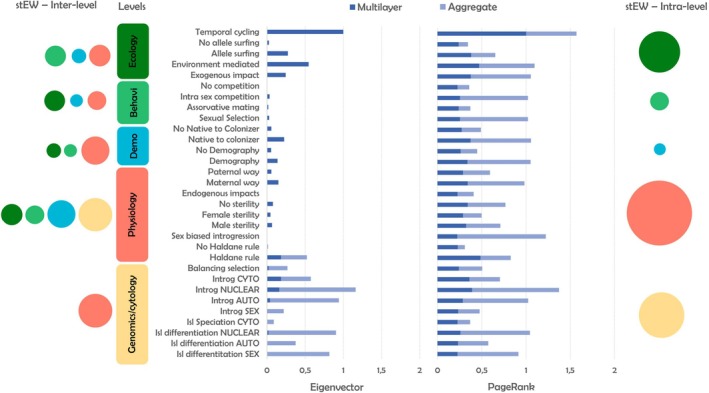
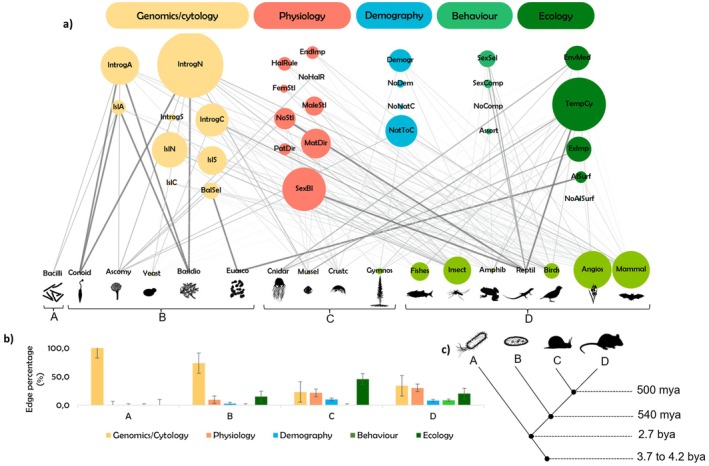
There is growing evidence for the role of introgressive hybridization in promoting species adaptation (i.e., adaptive introgression) owing to increasing genomic studies on a diversity of taxa over the past decades. However, introgressive hybridization was, and still is, regarded as a homogenizing process hindering the evolutionary process of adaptation to selection pressures. Despite methodological advances, key gaps remain in understanding how adaptive introgression due to hybridization functions across taxonomic groups and biological levels. This study has three objectives: (1) to explore historical trends in the understanding of adaptive introgression, particularly its genomic and functional dimensions; (2) to investigate structural organismal characteristics influencing patterns of adaptive introgression; and (3) to evaluate how adaptive introgression interacts with counteracting evolutionary mechanisms. We carried out a systematic review of the adaptive introgression literature and a multidimensional meta-analysis. The current knowledge trends have been shaped by the genomic revolution. Since 2012, genomic studies have contributed to establishing a clearer understanding of adaptive introgression. The amount and variety of published studies increased from bacteria to mammals across a complexity gradient, focusing on the genomic level and progressively having consequences at a greater number of levels of biological organization (from physiological and demographic to behavioral/ecological). Testing for tendencies, our study also revealed evolutionary mechanisms linked to adaptive introgression co-occurring with divergence forces, demonstrating that these processes are not mutually exclusive, even when they act in opposite directions, i.e., convergence and divergence, such as autosomal introgression (versus islands of differentiation in sex-linked chromosomes), balancing selection (versus genetic drift), or sexual selection (versus assortative mating). This balance is mediated by environmental conditions as they are frequently reported in the studies, regardless of the organisms' structural complexity, shaping the path of the evolutionary process of introgressing species. Studying introgression patterns has important implications for understanding adaptation in rapidly changing environments.
在过去几十年里,随着对各种分类群的基因组研究不断增加,关于渐渗杂交在促进物种适应(即适应性渐渗)中所起作用的证据越来越多。然而,渐渗杂交过去被,现在仍然被,视为一个阻碍适应选择压力进化过程的同质化过程。尽管在方法上取得了进展,但在理解杂交导致的适应性渐渗如何在分类群和生物水平上发挥作用方面,关键差距仍然存在。本研究有三个目标:(1)探索对适应性渐渗理解的历史趋势,特别是其基因组和功能维度;(2)研究影响适应性渐渗模式的生物体结构特征;(3)评估适应性渐渗如何与对抗性进化机制相互作用。我们对适应性渐渗文献进行了系统综述和多维荟萃分析。当前的知识趋势受到基因组革命的影响。自2012年以来,基因组研究有助于更清楚地理解适应性渐渗。从细菌到哺乳动物,已发表研究的数量和种类沿着复杂性梯度增加,重点是基因组水平,并逐渐在更多生物组织水平(从生理和人口统计到行为/生态)产生影响。通过测试趋势,我们的研究还揭示了与适应性渐渗相关的进化机制与分歧力量同时出现,表明这些过程并非相互排斥,即使它们以相反方向起作用,即趋同和分歧,如常染色体渐渗(与性连锁染色体上的分化岛相对)、平衡选择(与遗传漂变相对)或性选择(与选型交配相对)。这种平衡由环境条件介导,因为在研究中经常报道环境条件,无论生物体的结构复杂性如何,它塑造了渐渗物种进化过程的路径。研究渐渗模式对于理解快速变化环境中的适应具有重要意义。