Wen Xuan, Neumann Adam, Dhungana Seema, Womelsdorf Thilo
Department of Psychology, Vanderbilt University, Nashville, Tennessee, United States of America.
Vanderbilt Brain Institute, Nashville, Tennessee, United States of America.
PLoS Biol. 2025 Jun 23;23(6):e3003255. doi: 10.1371/journal.pbio.3003255. eCollection 2025 Jun.
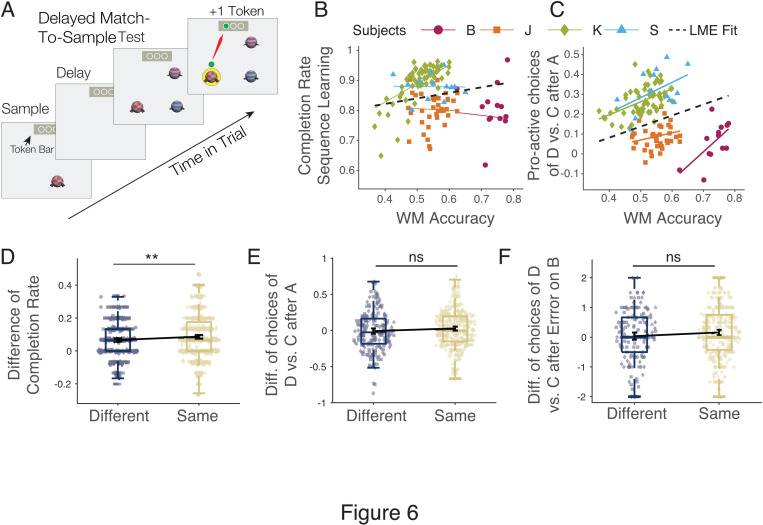
Intelligent behavior involves mentally arranging learned information in novel ways and is particularly well developed in humans. While nonhuman primates (NHP) will learn to arrange new items in serial order and re-arrange neighboring items within that order, it has remained contentious whether they are capable to re-assign items more flexibly to non-adjacent serial positions. Such mental re-indexing is facilitated by inferring the sequential structure of experiences as opposed to learning serial chains of item-item associations. Here, we tested the ability for flexible mental re-indexing in rhesus macaques. Subjects learned to choose five objects in a predetermined sequential order. A change of the background context indicated when the object order changed, probing the subjects to mentally re-arrange objects to non-adjacent positions of the learned serial structure. Subjects successfully used the context cue to pro-actively re-index items to new, non-adjacent positions. Mental re-indexing was more likely when the initial order had been learned at a higher level, improved with more experience of the re-indexing rule and correlated with working memory performance in a delayed match-to-sample task. These findings suggest that NHPs inferred the sequential structure of experiences beyond a chaining of item-item associations and mentally re-arrange items within that structure. The pattern of results indicates that NHPs form non-spatial cognitive maps of their experiences, which is a hallmark for flexible mental operations in many serially ordered behaviors including communication, counting or foraging.
智能行为涉及以新颖的方式在头脑中整理所学信息,在人类中尤其发达。虽然非人类灵长类动物(NHP)会学习按顺序排列新物品,并在该顺序内重新排列相邻物品,但它们是否能够更灵活地将物品重新分配到不相邻的序列位置仍存在争议。与学习物品与物品关联的序列链相反,通过推断经验的顺序结构有助于这种心理重新索引。在这里,我们测试了恒河猴灵活进行心理重新索引的能力。受试者学习以预定的顺序选择五个物体。背景环境的变化表明物体顺序何时改变,促使受试者在头脑中将物体重新排列到所学序列结构的不相邻位置。受试者成功地利用情境线索主动将物品重新索引到新的、不相邻的位置。当初始顺序是在更高水平上学习时,心理重新索引的可能性更大,随着对重新索引规则的更多经验而改善,并且与延迟样本匹配任务中的工作记忆表现相关。这些发现表明,非人类灵长类动物推断出经验的顺序结构,而不仅仅是物品与物品关联的链条,并在该结构内进行心理上的物品重新排列。结果模式表明,非人类灵长类动物形成了它们经验的非空间认知地图,这是许多序列有序行为(包括交流、计数或觅食)中灵活心理操作的一个标志