Dragomir Laura-Nicoleta, Ghiţulică Cristina-Daniela, Cucuruz Andreia, Lazar Andreea, Voicu Georgeta, Dinescu Sorina
Science and Engineering of Oxide Materials and Nanomaterials Department, Faculty of Chemical Engineering and Biotechnologies, National University of Science and Technology Politehnica Bucharest, 1-7 Gh. Polizu Street, Sector 1, RO-011061 Bucharest, Romania.
Biomaterials and Medical Devices Department, Faculty of Medical Engineering, National University of Science and Technology Politehnica Bucharest, 1-7 Gh. Polizu Street, Sector 1, RO-011061 Bucharest, Romania.
Antibiotics (Basel). 2025 May 22;14(6):534. doi: 10.3390/antibiotics14060534.
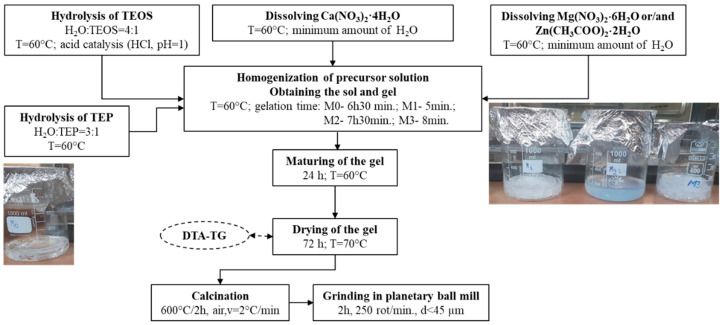
Bioactive glasses in the SiO-CaO-PO system represent emerging materials for hard-tissue-regeneration applications. This article focuses on the synthesis, characterization, and biological interaction of glasses doped with Mg and/or Zn, with an emphasis on their effects on biomineralization, antibacterial behavior, and interactions with preosteoblasts from the MC3T3-E1 cell line. The bioglasses were synthesized using the sol-gel method, and the vitreous nature remained predominant even after thermal treatment at 600 °C for 2 h. From an in vitro perspective, the synthesized bioglasses demonstrated strong cell adhesion and proliferation (notably in the case of Mg doping), low cytotoxicity, and antibacterial properties (especially in Zn-doped samples). Additionally, the simultaneous doping with Mg and Zn of the bioactive glass matrix is a prospective strategy for developing biomaterials with a "dual" biological characteristics-both osteoinductive and antibacterial.
SiO-CaO-PO体系中的生物活性玻璃是用于硬组织再生应用的新兴材料。本文重点研究了掺杂Mg和/或Zn的玻璃的合成、表征及生物相互作用,着重探讨了它们对生物矿化、抗菌行为以及与MC3T3-E1细胞系前成骨细胞相互作用的影响。采用溶胶-凝胶法合成生物玻璃,即使在600℃热处理2小时后,玻璃态性质仍占主导。从体外研究角度来看,合成的生物玻璃表现出较强的细胞黏附与增殖能力(特别是在Mg掺杂的情况下)、低细胞毒性以及抗菌性能(尤其是在Zn掺杂样品中)。此外,对生物活性玻璃基体同时掺杂Mg和Zn是开发具有骨诱导和抗菌“双重”生物学特性生物材料的一种前瞻性策略。